

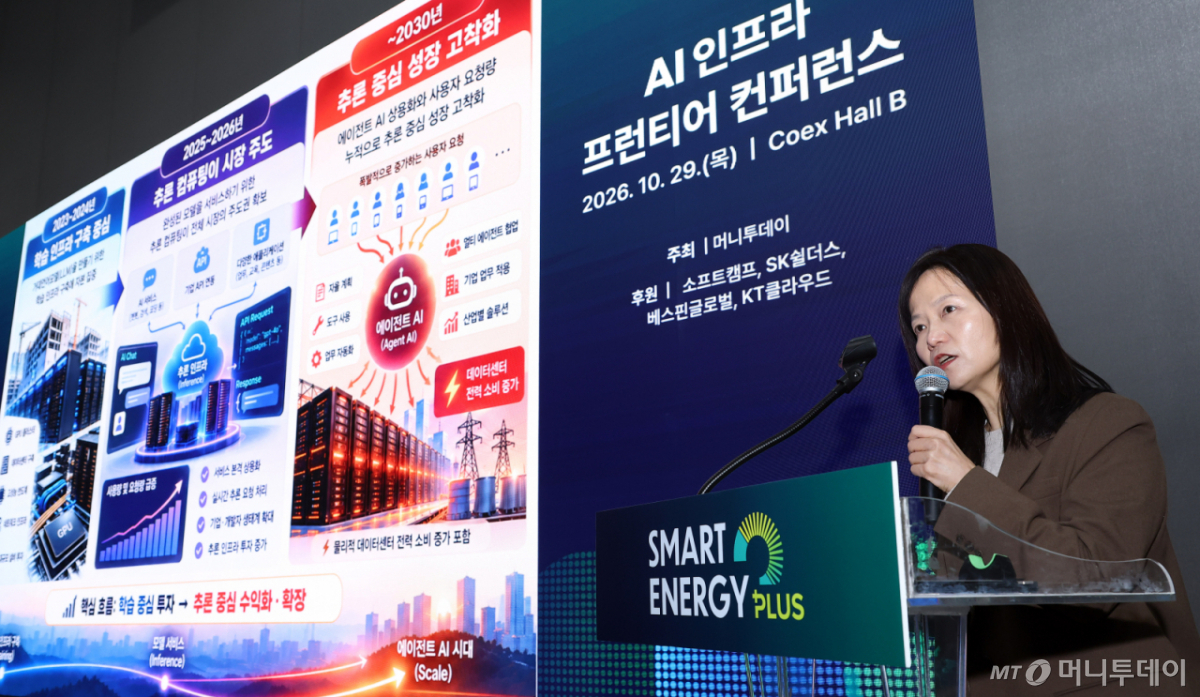
A forecast has emerged that the "era of learning," which was defined by GPUs (Graphics Processing Units) through 2027, will come to an end and the "era of inference" will fully take off. Accordingly, HYBE-led AI infrastructure, which minimizes costs while maximizing efficiency, is set to become the mainstream.
Kim Eun-ju, director-general of the Intelligent Technology Infrastructure Division at NIA (National Information Society Agency), said this at the "2026 AI Infrastructure Frontier Conference" held on the 29th in Hall B of COEX in Samsung-dong, Seoul.
Kim said, "If this year was a groundbreaking year where learning and inference intersected, the era of inference will officially begin from 2027." This means that the period when the majority of global AI computing resources are used for inference rather than AI training is approaching.
Inference computing has already overtaken learning computing this year. Deloitte released an analysis stating that approximately 67% of global AI computing resources were used for inference in 2026. McKinsey also revealed in a report published last June that more than half of AI infrastructure is being used for inference.
Kim said, "If the era of learning was the era of investment, the era of inference is the era where one must make money with AI," adding, "The whole world will strive to lower costs." Consequently, it is expected that AI infrastructure will shift in a direction that minimizes power consumption.
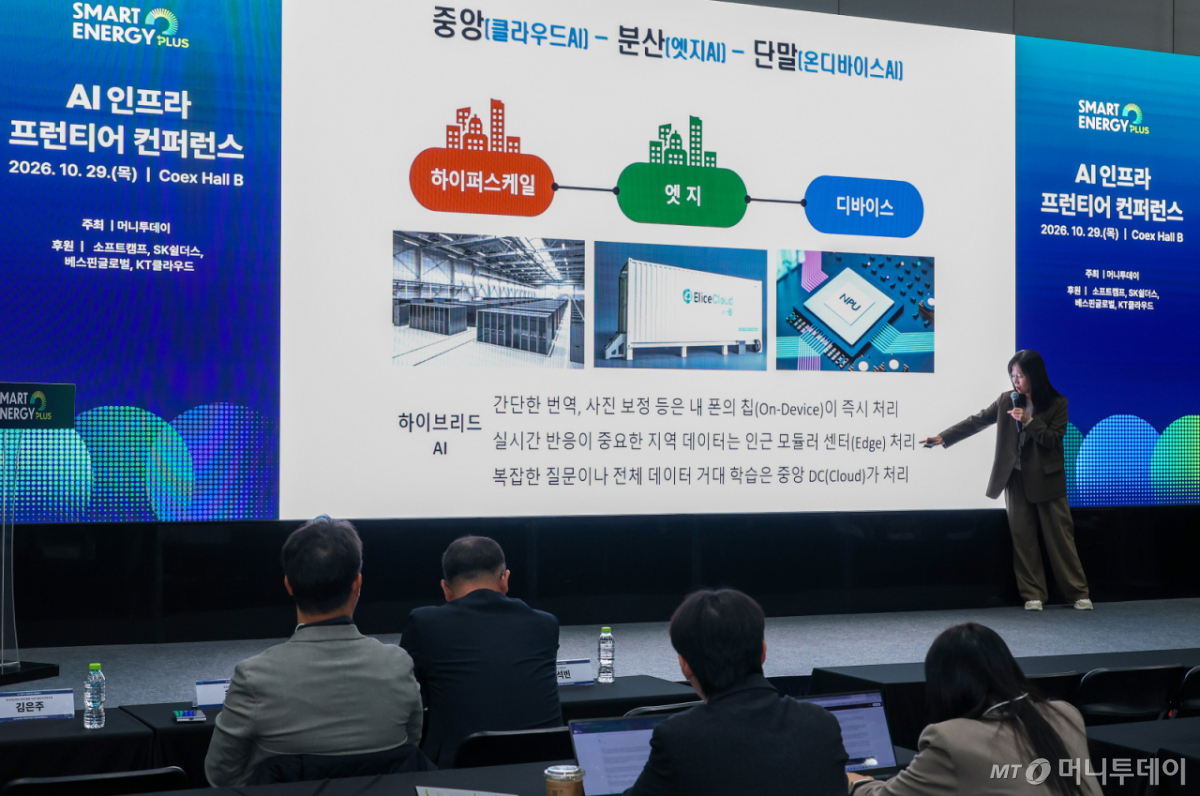
Kim emphasized that the solution is "HYBE AI infrastructure." This model distributes power across: hyperscale data centers (DCs) handling complex queries or large-scale training of entire datasets; edge DCs processing regional data where real-time response is critical; and on-device chips for quickly handling simple tasks.
Cooling methods will also change. The industry is moving from "air cooling," which circulates cold air to cool chips, to "direct-to-chip" liquid cooling, which attaches cold plates to high-heat-generating chips to circulate coolant. According to Director-General Kim, while the liquid cooling method has become a standard model overseas, South Korea is still in the entry stage. The "immersion cooling" method, which directly submerges entire servers in tanks, remains at an experimental stage globally.
Kim said, "The era of inference is an opportunity for South Korea." With centralized large-scale AIDCs serving as a foundation, attention is turning to on-device and edge computing centers, opening a path for South Korea to enter the AI infrastructure market with its technological capabilities.
According to the presentation, South Korea's strategy is a "comprehensive ecosystem." Kim stated, "South Korea's AI strategy is not a global big tech model where a single company operates a full stack from AI chips to services, but rather one where each company takes on specialized roles and combines them into a single ecosystem."
Semiconductor companies such as Furiosa and Rebellions are handling inference-specialized chips through the development of domestic NPUs (Neural Processing Units).
In the cooling technology sector, while gradually expanding liquid cooling, the market for immersion cooling oil is being prepared centered on domestic refiners. Alongside this, investments are being made in regional edge AI (MDC) and on-device AI.
From 2030 onwards, "space AIDCs will fully take off." Space AIDCs are systems that launch multiple artificial satellites, each functioning as an edge AI server, to operate data centers by utilizing the low-temperature environment of space and solar energy.
Kim said, "I believe the future of AI data centers in the 2030s lies in space," adding, "NIA will formulate policies while researching where South Korea currently stands and where it needs to go."

 in TECH

