

"It is good to set ambitious goals, but the metrics must be highly insightful and granular."
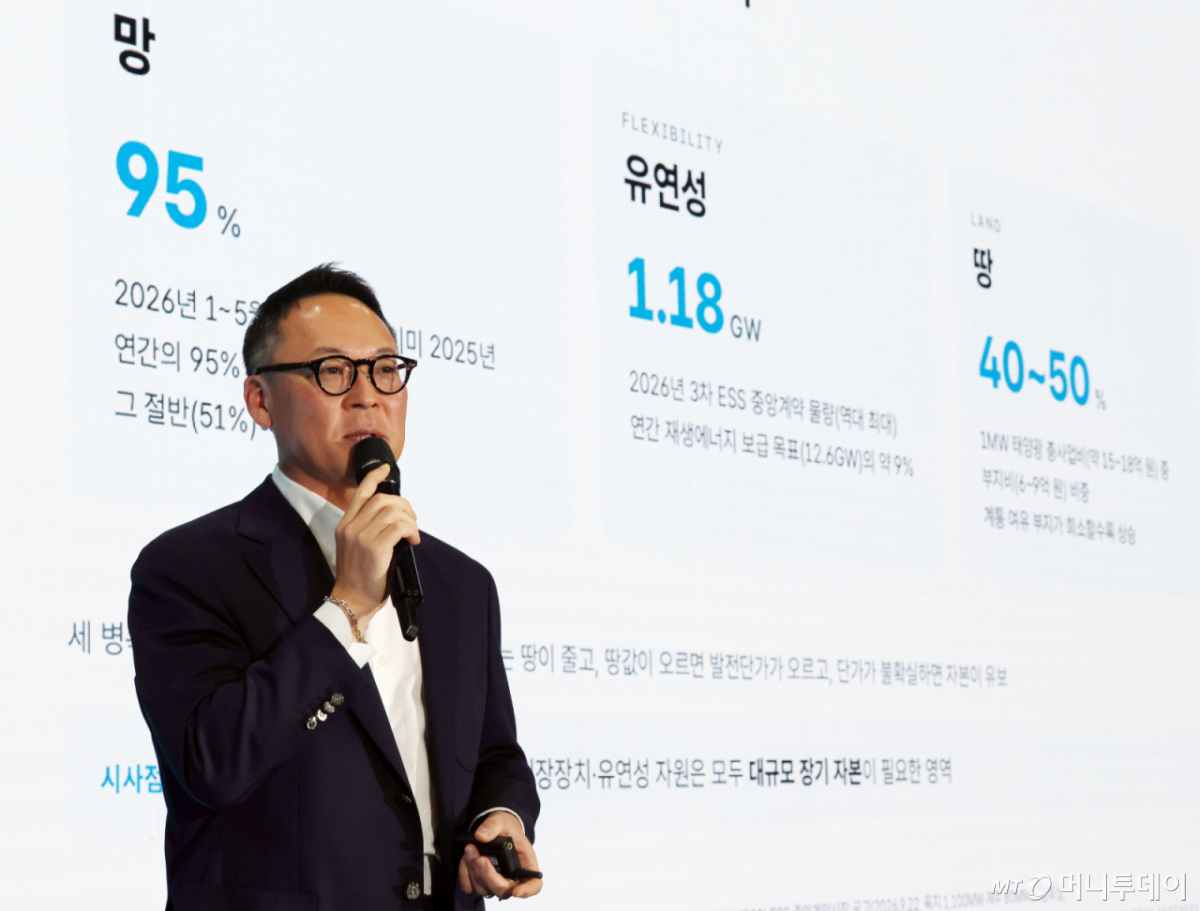
Chairman Kim Hee-seong of Brite Energy Partners said this while delivering a presentation on "Energy Moneyball – Surging Power Demand in the AI Era and the Role of Renewable Energy" at "Smart Energy Plus (SMART ENERGY PLUS·SEP) 2026," at COEX in Samsung-dong, Seoul on Thursday.
The remarks addressed the government's target to deploy 100GW (gigawatts) of renewable energy by 2030. He pointed out that policy performance should be evaluated using detailed metrics such as actual power generation, grid connection feasibility, and output curtailment reduction records, rather than simply the amount of renewable energy equipment installed.
In this context, Kim cited the movie "Moneyball" as an example. Based on a true story, the film depicts how Billy Beane, general manager of the Oakland Athletics in Major League Baseball, built a competitive team with a limited budget. Instead of traditional metrics such as batting average and home runs that teams valued at the time, Beane focused on on-base percentage. By leveraging statistics and detailed indicators to discover undervalued players and build his roster, he set a record of 20 consecutive wins in 2002.
Kim emphasized that this Moneyball approach should be applied to domestic energy policy as well. "Just like the team in Moneyball, we have a goal of winning 100 games a year, but shouldn't we break down the process and create insightful metrics?" he explained. "It seems there is only a big goal."
A representative example is renewable energy installed capacity. "The utilization rate of renewable energy generation facilities is only 15 to 20 percent," Kim noted. "Even with the same capacity, the power generation is much lower." He added, "It will be important to emphasize not just installed capacity, but targets for how much power to generate, or raising the share of renewable energy in generation from the current 8 percent to a certain percentage by a specific year."
He also suggested that output curtailment issues at already-installed solar power plants should be managed as Key Performance Indicators (KPIs). "Power plants that are already grid-connected are throwing away electricity," Kim said. "Shouldn't sharp, incisive KPIs, such as how much the output curtailment rate has been reduced, be assigned to these stakeholders?"
Considerable hurdles are expected in achieving the 100GW renewable energy target. As of the end of last year, South Korea's cumulative renewable energy installed capacity was approximately 37GW, meaning an additional 63GW must be installed by 2030.
This requires an average annual installation of 12.6GW, but new solar installations last year amounted to only about 3GW. "Over the past 10 or 20 years, 95 percent of newly installed renewable energy in Korea has been solar," Kim emphasized. "To add another 63GW, we need to install 12.6GW every year, which is more than four times our current pace."
He identified insufficient power grids as a major obstacle. If the capacity of transmission and distribution networks is lacking, it becomes difficult to supply generated electricity to the grid even if solar generation equipment is installed.
"The capacity of transmission lines, distribution networks, transformers, and substations is currently quite insufficient," Kim said. "Actually expanding this requires astronomical amounts of money, and delays due to complaints are long, so it is not a direction that can be resolved in the short term."
Expanding Energy Storage Systems (ESS) and securing sites suitable for solar power generation were also presented as challenges. "The 1.18GW volume announced this year for the third ESS central contract market falls short of even 10 percent of the annual renewable energy installation target of 12.6GW," Kim stated, noting that it is "quite insufficient."
He added, "Installing 1MW (megawatt) of solar power requires about 2,000 to 2,500 pyeong, and land costs alone are 700 million to 800 million won, accounting for about 40 percent of the total project cost. Suitable land prices are soaring."
Kim also stated that when evaluating the performance of renewable energy policy, factors such as actual power generation, output curtailment reduction records, ESS utilization rates, and the effect of attracting private investment should be considered comprehensively, in addition to installed capacity.
"I personally strongly support the broad policy direction the government is thinking about," he said, while adding, "It is good to set ambitious goals, but the metrics must be highly insightful and granular."

 in INDUSTRY
