

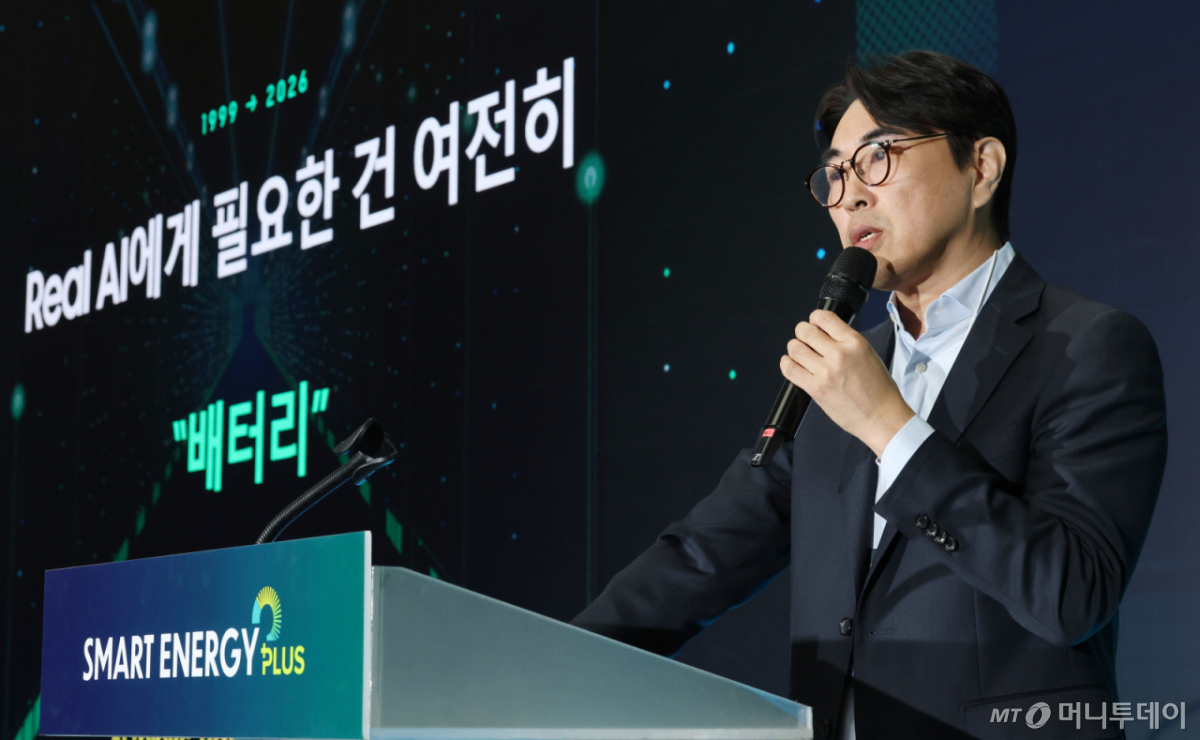
"The timeline for the power required by current AI (artificial intelligence) data centers is not keeping pace with the clock demanded by AI development."
Hyun Chang-seok, executive officer at Samsung SDI, made this remarks on Friday while presenting "Speed Wall" and "Energy Wall" as challenges facing data centers at 'Smart Energy Plus (SEP) 2026' held at COEX in Seoul.
He added, "No single battery solution can overcome all these walls," proposing three solutions: Battery Energy Storage Systems (BESS), Uninterruptible Power Supplies (UPS), and Battery Backup Units (BBU). Samsung SDI is the only company in the world that supplies batteries for all three of these areas.
The Speed Wall refers to the problem where existing power infrastructure cannot keep up with AI computing speeds. Graphics Processing Units (GPUs) react in milliseconds (one-thousandth of a second), while power grids operate on scales ranging from seconds to minutes.
The Energy Wall is the challenge of handling surging power demand. According to the International Energy Agency (IEA), global data center power consumption is projected to increase by approximately 2.3 times, from 415 TWh (terawatt-hours) in 2024 to 945 TWh in 2030.
In particular, AI data centers are characterized by rapid fluctuations in power usage over short periods as numerous GPUs perform computations simultaneously. In a simulation presented by Samsung SDI, the power load of a 100 MW (megawatt)-class AI training cluster was found to fluctuate up to approximately 40 MW within 0.1 seconds.
Hyun stated, "If loads from various data centers are connected directly to the grid without buffering, it could cause problems with grid stability," adding that this is "why many hyperscalers are currently demanding solutions such as BBU, UPS, and BESS."
Samsung SDI's strategy is to apply different battery solutions for each segment, from the power grid to the servers. BESS responds to delays in grid connection and reduces loads during peak usage hours. UPS supplies emergency power during outages while absorbing sudden power fluctuations generated during AI computations. B
BU supports stable GPU operation by responding to millisecond-level power changes near the server. Hyun emphasized, "In particular, our market share for batteries used in UPS and BBU is 40% to 50%, respectively," adding that "revenue this year is also expected to increase by more than 70% compared to the previous year."
Samsung SDI is expanding its product lineup to meet AI data center demand. Following the introduction of 'SBB 1.7,' which uses prismatic Nickel-Cobalt-Aluminum (NCA) batteries this year, the company plans to supply 'SBB 2.0' based on Lithium Iron Phosphate (LFP) by the end of the year. SBB 2.0 is designed with a target of 25 years of operation, carrying 5 MWh (megawatt-hours) of batteries in a 20-foot container.
Hyun said, "Prismatic batteries are the most suitable solution for ESS when considering various factors such as safety," explaining that the company also plans to unveil high-output products in 2028 and 'SBB 3.0' with a capacity of 7 MWh in 2029.
UPS and BBU are also transitioning from existing emergency power applications to high-output products designed to handle rapid power fluctuations in AI data centers.
Hyun said, "We launched the 'Gen 4' solution capable of responding to AI this year, and discussions with customers have already taken place," adding, "In the BBU field, we decided to respond to the power rack market by moving from the existing 18650 cylindrical format to 2170, which has improved output performance." He added, "We also plan to develop next-generation LFP (Lithium Iron Phosphate) targeting an output of 300 W (watts) per cell in 2028."
Above all, the need for cooperation between power companies and battery manufacturers was emphasized. In response to a question about cooperation plans with KEPCO, Hyun stated, "I would like the battery industry and power companies to design together from the initial stage of building the grid network," proposing that "for future projects, if we consult with battery companies from the planning stage to design customized solutions, we can supply all three solutions on a turnkey basis."

 in INDUSTRY
