

“The light in the sky that catches enemy drones”
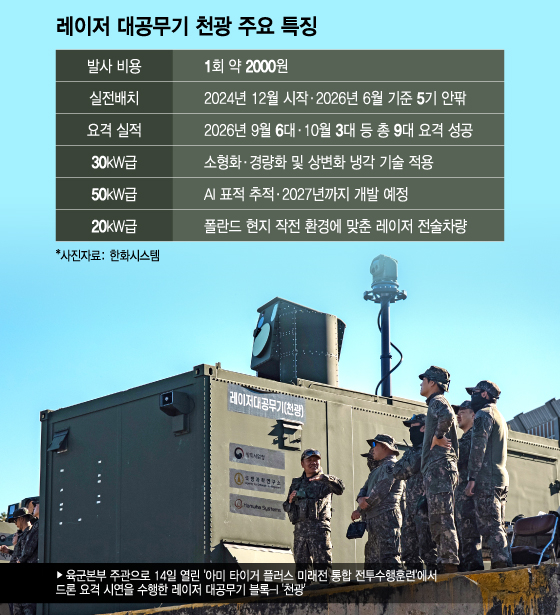
This is not a scene from a science fiction (SF) movie. A laser air defense weapon designed to counter aerial threats, including North Korean unmanned aircraft, is actually being operated on the grounds of the Ministry of National Defense in Yongsan, Seoul. The star of this system is Hanwha Systems’ “Cheonggwang” (). Cheonggwang, which means “light of the sky,” shoots down drones using high-energy lasers instead of missiles or artillery shells. It began actual military deployment in December 2024. As of June this year, it is known that approximately five units have been deployed to major national facilities, including the Ministry of National Defense headquarters.
Recently on the battlefield, low-cost drones and small unmanned aircraft are being utilized not only for reconnaissance and surveillance but also as direct attack tools. This is because existing air defense systems that use expensive missiles to shoot down relatively cheap drones carry a significant cost burden. The need for weapon systems capable of responding to situations where multiple drones attack simultaneously is also growing. This is the background behind laser weapons gaining attention as next-generation air defense means.
“2,000 won per shot” … “All six drones shot down”
Cheonggwang Block-I is an air defense weapon that detects and tracks drones and small unmanned aircraft before neutralizing them with high-energy lasers. It operates using a “Hard Kill” method, which concentrates laser energy on the target to heat and destroy external structures or internal electronic devices. It was developed to defend urban densely populated areas and major national facilities from illegal drones and small unmanned aircraft.
Its greatest advantage is cost-effectiveness. The firing cost per laser shot is approximately 2,000 won. This offers overwhelming economic efficiency compared to missiles. Since no separate ammunition is required, it can operate continuously for 24 hours without ammunition resupply as long as power is supplied. In particular, because it utilizes light, it can precisely track small and fast-moving targets from several kilometers away and neutralize them within seconds.
Cheonggwang has already proven its interception performance in two public demonstrations. At the “2026 Defense Drone Technology Exhibition” hosted by the Ministry of National Defense, held at the Army Promotion Training Ground last September, it consecutively shot down four drones and two unmanned aircraft. It intercepted all six targets, recording a 100% success rate. A month later, on October 14, at the “Army Tiger Plus Future War Integrated Combat Execution Training” hosted by the Republic of Korea Army Headquarters, it successfully intercepted three drones. Across the two demonstrations, a total of nine drones and unmanned aircraft were shot down.
Cheonggwang is the result of combining the government’s efforts to acquire and operationalize advanced weapon systems with the technological capabilities of defense companies. From 2019 to 2023, the Agency for Defense Development (ADD) led development, while Hanwha Aerospace participated as the prototype manufacturer. Subsequently, with the start of actual military deployment in December 2024, the developed technology was translated into real air defense capability. Under the advanced weapon system acquisition roadmap led by the Ministry of National Defense and the Defense Acquisition Program Administration, the technology developed by the Agency for Defense Development was connected to actual military operations, followed by confirmation of interception capabilities through public training exercises.
From fixed to mobile… Hanwha Systems develops 30kW and 50kW laser guns
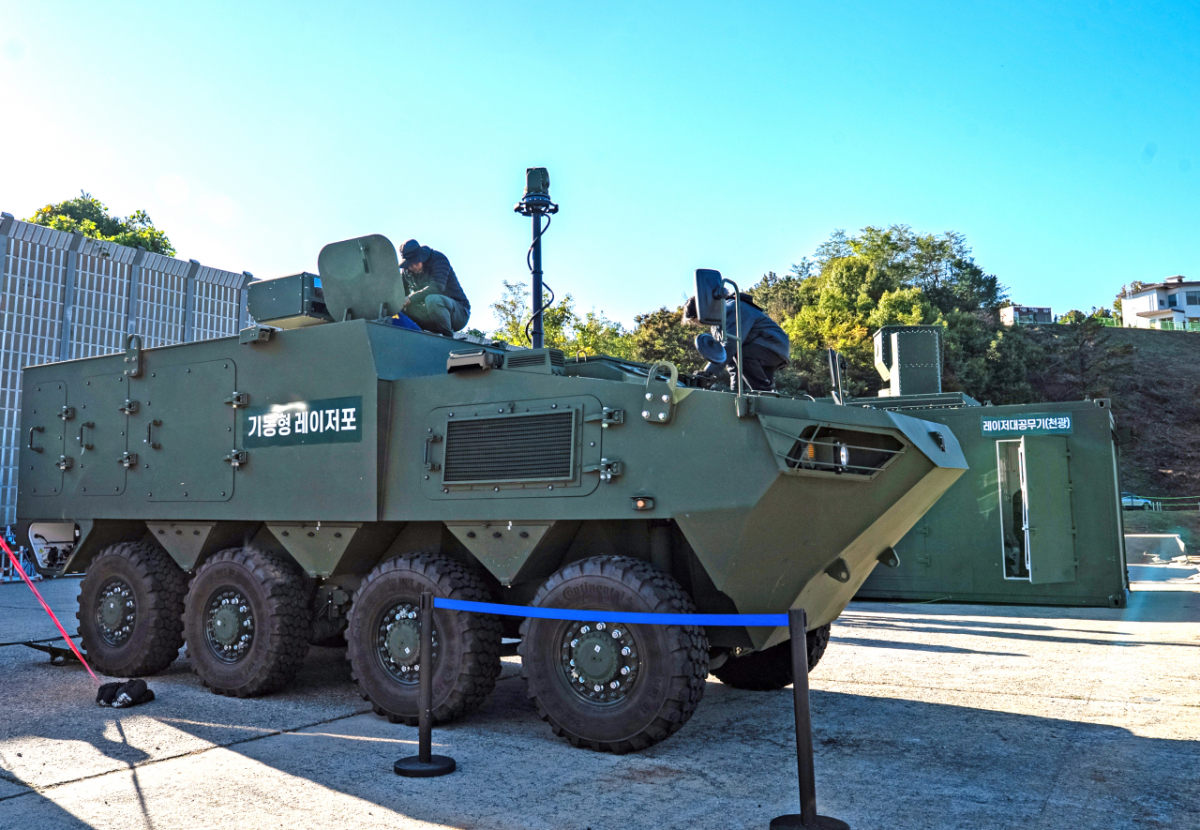
Following the acquisition of the laser business from Hanwha Aerospace last January, which unified the group’s laser weapon capabilities, Hanwha Systems is expanding its development scope to include mobile laser weapon systems that can be mounted on combat vehicles. This is to secure weapon systems capable of moving with maneuver units and conducting operations, going beyond fixed weapons like Cheonggwang that defend specific facilities.
A representative example is the 30kW (kilowatt)-class “Combat Vehicle-Mounted High-Energy Laser Gun.” The Korea Institute of Defense Technology (KRIT) managed the project, while Hanwha Systems led development. Its features include miniaturizing and lightening key components to facilitate mounting on combat vehicles, and applying “phase-change-based cooling technology” to efficiently manage heat generated during high-power operation. This simultaneously improved mobility and operational stability. The 30kW-class laser gun also performed a drone interception demonstration at the “Army Tiger Plus Future War Integrated Combat Execution Training” last October.
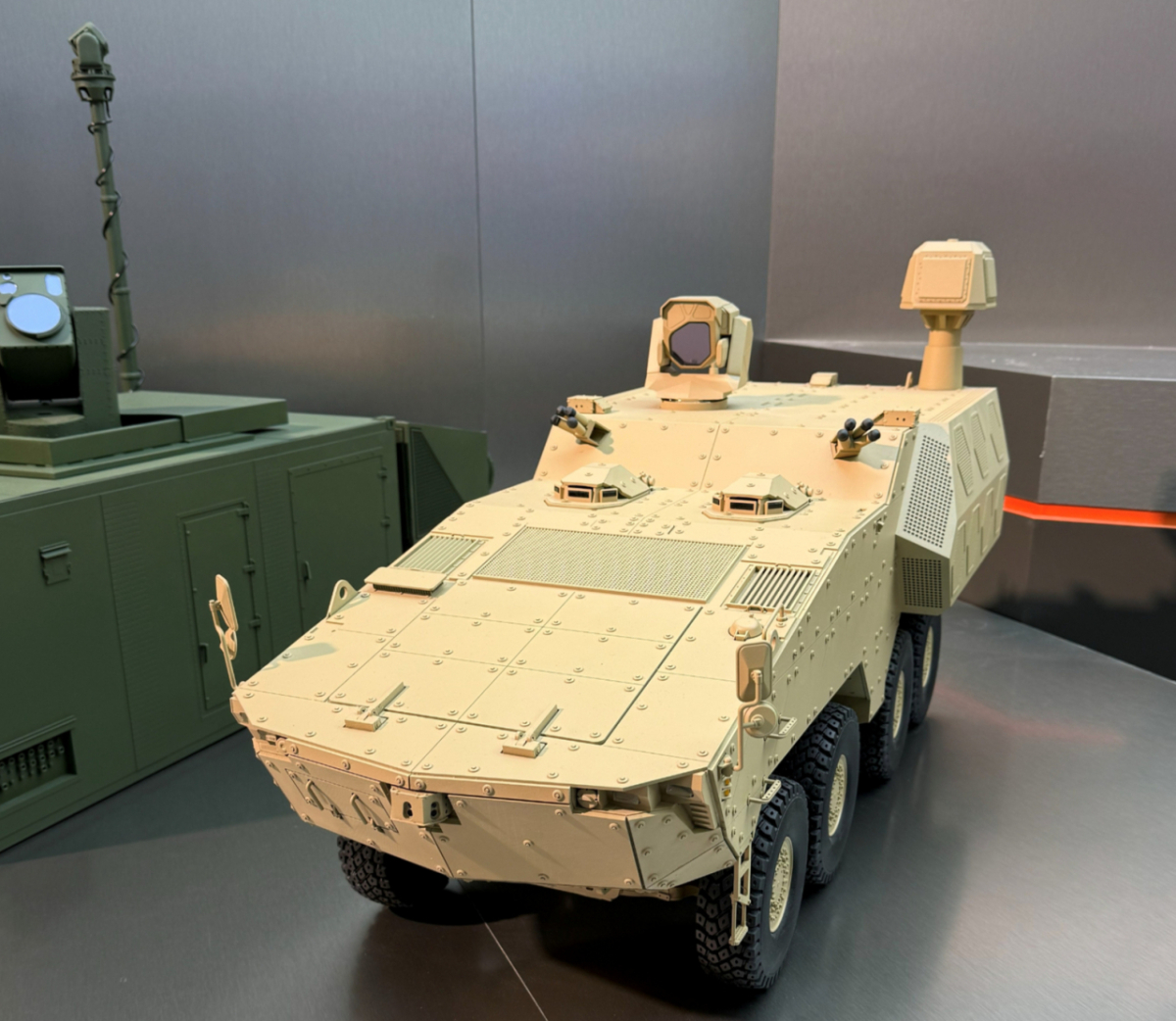
The 50kW-class laser armored vehicle currently under development is designed to be organized with maneuver units to conduct operations. It ensures operational performance and survivability by miniaturizing and lightening components. Its ability to operate in various operational environments without being fixed to a specific area is also a strength.
In particular, it implements technology that detects targets using its own onboard radar and tracks them with an electronic-optical system applied with artificial intelligence (AI). It is designed to conduct operations independently without relying on external detection systems. Hanwha Systems plans to develop a 50kW laser armored vehicle that simultaneously enhances mobility and output, reflecting the requirements of overseas customers, by 2027.
Even a Poland-tailored 20kW laser gun… Targeting the European defense market
The market Hanwha Systems ultimately aims for is overseas. Cheonggwang is receiving high interest from global markets, including Europe, as an effective means of responding to low-cost drone threats. Based on Cheonggwang’s domestic military operational track record, the goal is to develop laser weapon systems tailored to each country’s operational environment and customer requirements to promote exports.
To this end, Hanwha Systems showcased Cheonggwang, a 50kW laser armored vehicle, and a 20kW-class laser tactical vehicle together at “MSPO 2026,” the largest defense industry exhibition in Eastern Europe, held in Kielce, Poland last September. The 20kW laser tactical vehicle was designed to be optimized for local operational environments in Poland. By configuring the system based on small tactical vehicles, it enhanced operational and deployment flexibility. Based on the mobility of the tactical vehicle, effective operation is possible even in urban and narrow areas, which received a strong response locally.
Based on its capabilities in proprietary laser weapon design and high-energy laser light source development, Hanwha Systems plans to launch laser weapons tailored to the needs of various global customers through continuous technological development. The goal is to secure new growth drivers by combining precision electronic-optical technology with high-energy laser light source and firing technologies.
Shin Ju-hoon, head of the Laser Business Center at Hanwha Systems, said, “Laser weapons are a core game-changer that will change the landscape of future air defense,” adding, “We will actively target the global market by leading with Cheonggwang, which has proven combat performance, and the 50kW laser armored vehicle, which boasts excellent mobility and high-output interception capabilities.”

 in INDUSTRY


