

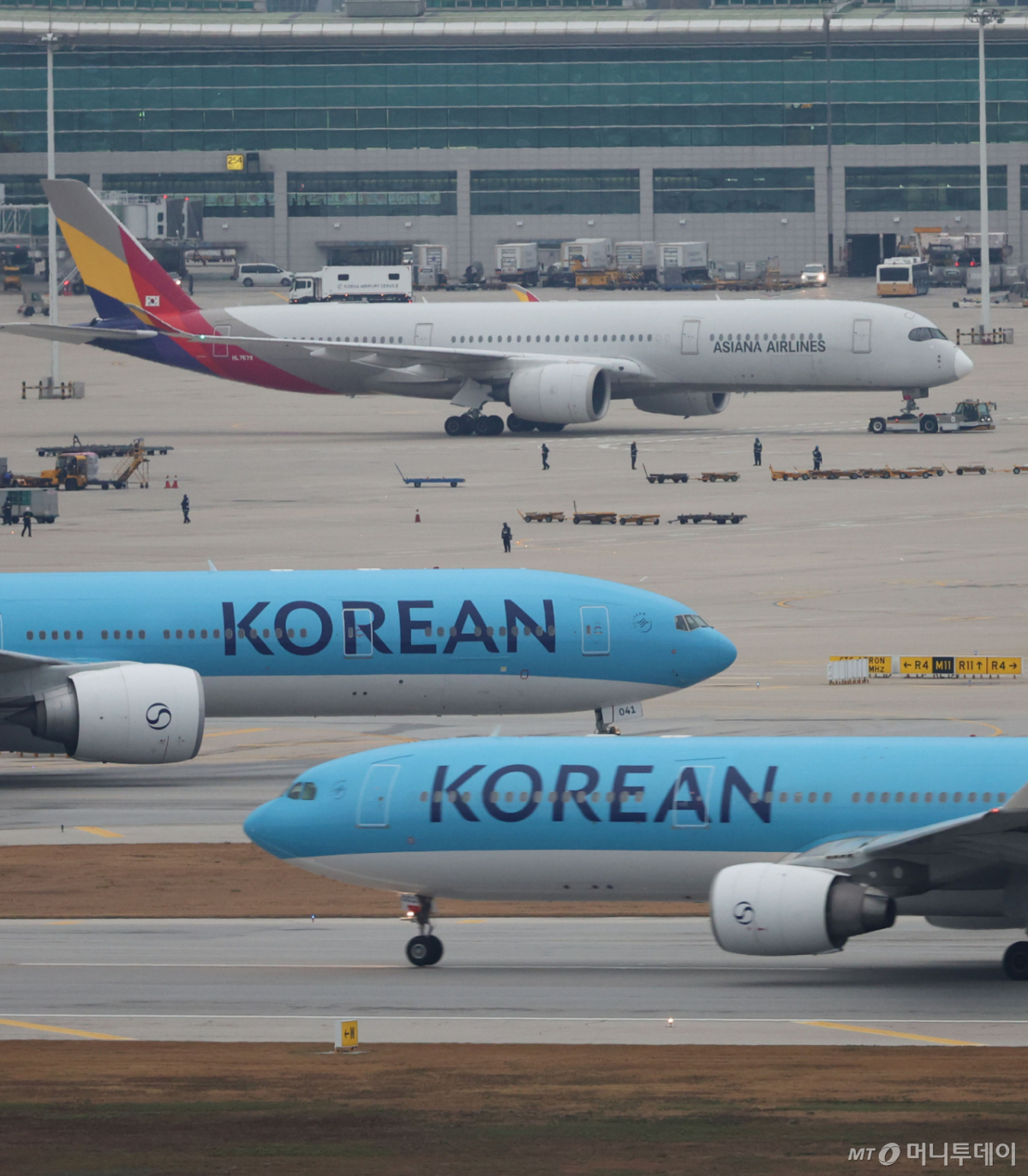
Korean Air and Asiana Airlines are broadening opportunities for customers to use their mileage ahead of their merger, but related debt is actually increasing. While Asiana Airlines reduced its balance that had swelled in the first half of the year, Korean Air’s increase exceeded that reduction. The two airlines appear to be striving to enhance customer convenience before and after integration and manage financial burdens by allowing cross-use of mileage, in addition to special flights and discount campaigns.
According to the quarterly reports of both companies on the 16th, the total deferred revenue from mileage on a standalone basis as of the end of September was recorded at 4 trillion 174.3 billion won. This represented an increase of approximately 108 billion won compared with the end of June. Compared with 3 trillion 780.6 billion won at the end of last year, it is an increase of approximately 393.7 billion won.
Korean Air’s deferred revenue from mileage as of the end of September was 3 trillion 237.6 billion won, up by approximately 117.7 billion won from the end of June. In contrast, Asiana Airlines’ balance decreased by approximately 9.7 billion won over the same period, from 946.4 billion won to 936.7 billion won. Despite the decrease at Asiana Airlines, the combined total of the two companies expanded due to the increase in Korean Air’s balance.
Deferred revenue from mileage refers to the amount retained as a liability rather than recognized as revenue, representing the portion of consideration received from airline ticket sales or transactions with partners that corresponds to mileage. It reflects the obligation to provide services such as airline tickets when customers use their mileage in the future. When actual services are provided, the related amount is recognized as revenue, and the liability decreases.
Ahead of the integration, the two companies have expanded the seats available for mileage redemption and the places where mileage can be used. Korean Air operated special mileage flights on the Gimpo-Jeju route during the Chuseok (Mid-Autumn Festival) and National Foundation Day and Hangul Day holidays. Asiana Airlines is also broadening usage opportunities by operating a total of more than 850 special mileage flights this year, comprising over 700 domestic and over 150 international flights.
Asiana Airlines also operates the “Mileage Now” discount campaign on an ongoing basis, which lowers the cash co-payment required to purchase airline tickets with mileage to a maximum of 10,000 miles. Starting from the 4th, it also launched a partnership service allowing customers to use Asiana Airlines mileage to purchase Korean Air mileage tickets or upgrade seats. This is a measure to broaden options by adding Korean Air flights to existing Asiana Airlines routes.
Even after the integrated Korean Air launches on December 17, existing Asiana Airlines mileage will be operated separately for 10 years. The obligation to provide services for the mileage accumulated by both companies will also carry over to the integrated entity. After the merger, utilizing the expanded route network to allow customers to use their mileage on desired flights is expected to become a task that must address both customer satisfaction and financial burden management simultaneously.
An official in the aviation industry said, “After integration, we need to expand mileage redemption options to reduce the burden of deferred revenue,” adding, “It appears they will increase the supply of mileage bonus tickets by utilizing their expanding aircraft fleet and strengthen collaborations with partners such as hotels to encourage the consumption of mileage accumulated at both companies.”

 in INDUSTRY
