

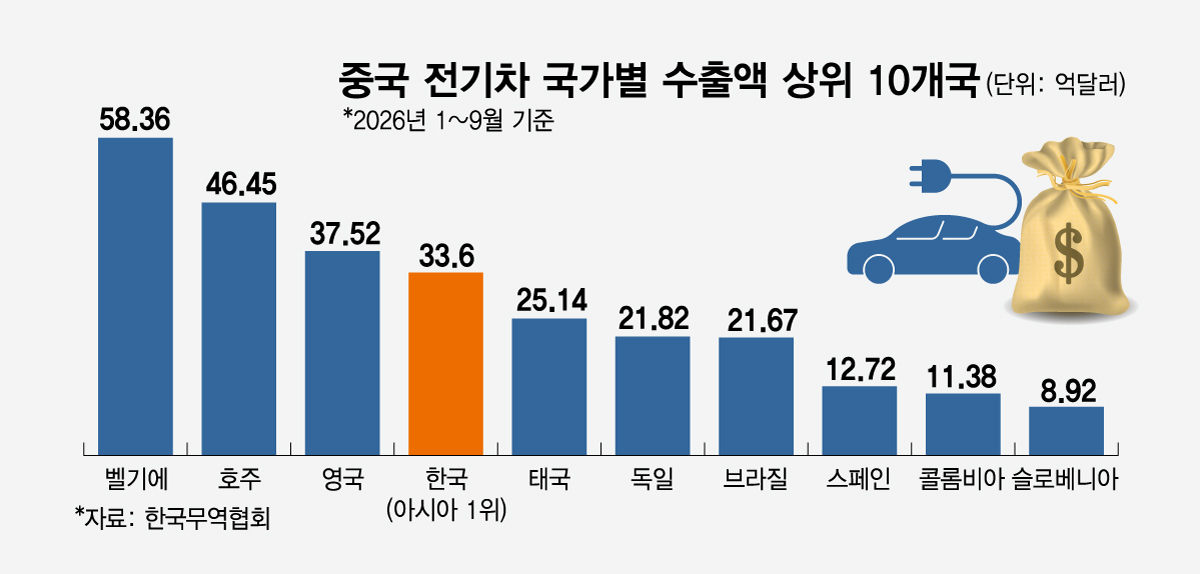
South Korea has emerged as China's largest Asian export market for electric passenger vehicles. In fact, the value of EVs exported from China to South Korea this year has surged to roughly double that of the same period last year.
With domestic carmakers' share of the local EV market falling below 50%, momentum is building behind the auto industry's call for EVs to be included in the scope of a proposed tax credit on domestically produced goods currently under discussion at the National Assembly.
According to the Korea Trade-Investment Promotion Association (KITA) on the 17th, China's EV exports to South Korea totaled $3.35991 billion from January to September this year, up 99.2% year-on-year.
In terms of China's EV exports by destination country, South Korea ranked fourth globally, trailing Belgium ($5.83589 billion), Australia ($4.64473 billion) and the United Kingdom ($3.75225 billion). In Asia, it took the top spot, overtaking Thailand ($2.51399 billion).
Inflows of Chinese-made EVs into South Korea have grown sharply over the past five years. China's EV exports to South Korea rose from $12.32 million in 2020 to $2.14173 billion last year, an increase of roughly 174-fold.
This year, within just nine months, exports already exceeded last year's full-year total by more than $1.2 billion. Over the same period, South Korea's trade deficit with China in the EV category also widened to $3.35744 billion.
Although the government overhauled the EV subsidy payment system in July to reflect factors such as contribution to domestic supply chains and post-sale and safety management, exports of Chinese-made EVs continued their upward trend.
China's EV exports to South Korea rose 14.6% from $410.76 million in July to $470.67 million in September. However, the statistics include not only vehicles from Chinese brands but also overseas-brand cars produced in China, such as Tesla.
China's expansion of production capacity is also cited as a reason for the export growth. According to the China Passenger Car Association (CPCA), China's auto production capacity increased by about 10.21 million units, from 19.46 million units in 2020 to 29.67 million units last year.
In contrast, domestic sales over the same period rose only 4.45 million units, from 19.29 million to 23.74 million. Industry observers believe that China's capacity expansion and price competitiveness have contributed to the rise in overseas exports.
As inflows of Chinese-made EVs expand, the share held by domestic cars in the local market is shrinking. According to the Korea Automobile Manufacturers Association (KAMA), the market share of domestic EVs (overall) fell from 75% in 2022 to 55% in the first nine months of this year.
Narrowing the scope to passenger EVs, the domestic carmakers' share dropped to 48.7%, breaking below the majority threshold. Over the same period, 112,417 Chinese-made EVs were newly registered in South Korea, accounting for 43.5% of the total market.
Consequently, discussions on tax support aimed at maintaining the domestic EV production base are expected to accelerate. While the government introduced a new tax credit on domestically produced goods in this year's tax reform plan, it excluded EVs from the scope of support.
However, bills amending the Tax Special Measures Act to include EVs as eligible recipients have been successively submitted at the National Assembly. Lawmakers from both ruling and opposition parties also emphasized during last month's national audit that supporting domestic production of EVs is necessary.
Lee Hyoung-il, Deputy Prime Minister and Minister of Economy and Finance, also stated on the 2nd at an industry roundtable held at the Hyundai Motor-Kia Technology Research Institute in Hwaseong, Gyeonggi Province, that he would thoroughly review options for supporting EV production tax credits during the National Assembly's deliberation process.
Whether to include EVs and the scope of support are expected to be key issues during the review of the tax law amendment bill by the Tax Subcommittee of the National Assembly's Committee on Strategy and Finance this month.
The auto industry is raising its voice, arguing that EVs should be included in the scope of support for the domestic production tax credit, given the policy's intent to consider factors such as the importance and growth potential of an industry and the need for support.
The auto industry accounts for 14.1% of South Korea's manufacturing shipment value as of 2024 and creates approximately 1.56 million direct and indirect jobs across upstream and downstream sectors, including finished vehicle and parts manufacturing, sales, maintenance and logistics.
Abroad, Japan has implemented a "Tax System for Promoting Domestic Production in Strategic Sectors" since 2024 to support domestic production of EVs and other vehicles.
A tax credit of 400,000 yen per vehicle applies to battery electric vehicles and fuel cell electric vehicles, while plug-in HYBRID vehicles receive a credit of 200,000 yen per unit.
An industry official said, "The domestic production tax credit is not a scheme designed to support industries in need of restructuring or loss-making companies," adding, "Policy focus should be on selecting core strategic industries that underpin the nation's future growth and economic security, and providing concentrated support to ensure their domestic production bases are maintained and expanded."

 in INDUSTRY
