

As the offensive by Chinese automakers intensifies in the European auto market, Hyundai Motor’s local subsidiary has recorded a substantial net loss, leading to deteriorated financial health.
While the European auto market continues to show growth, Hyundai’s sales volume declined, and the scale of capital impairment at the local subsidiary expanded approximately 10-fold within one year.
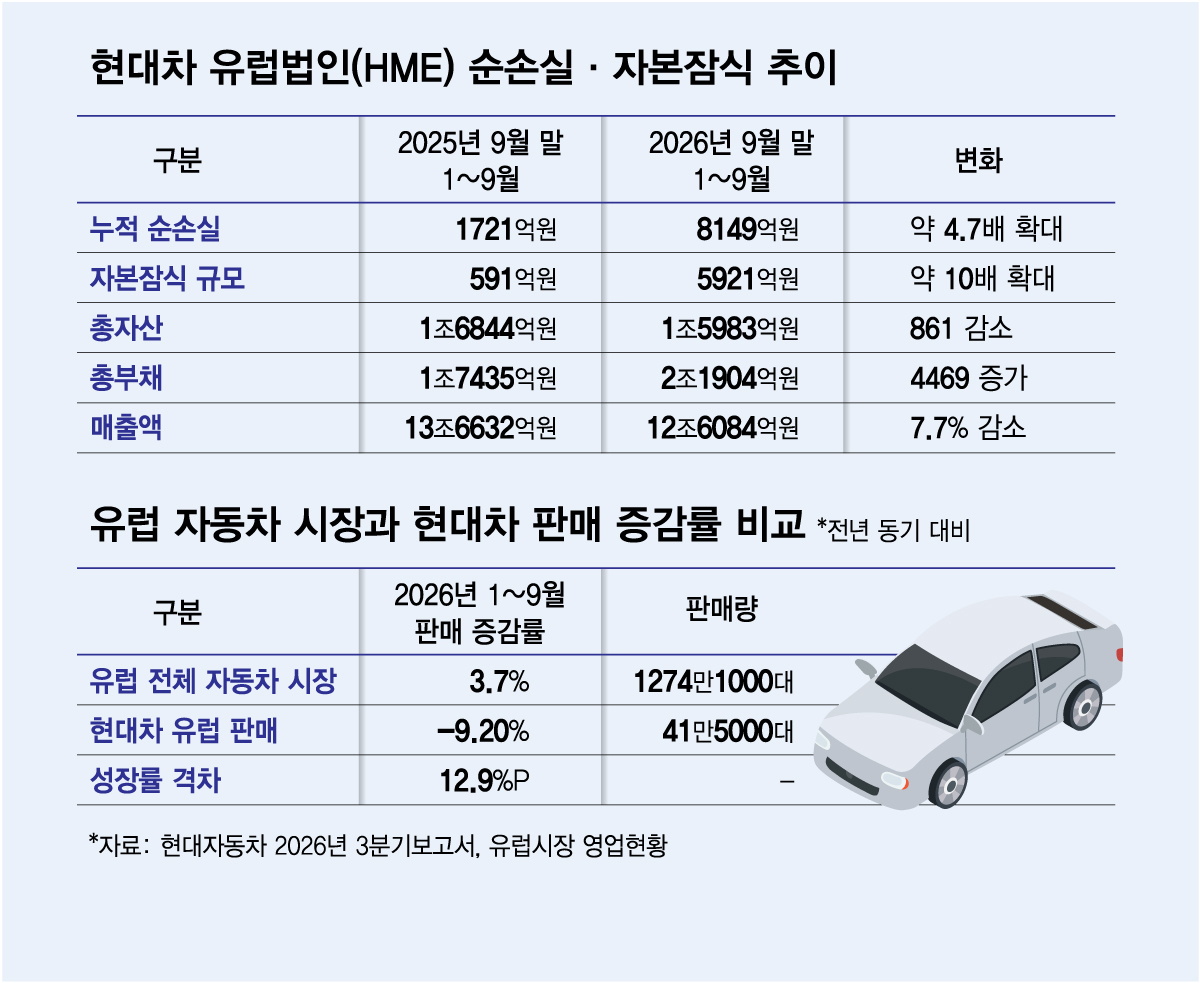
According to Hyundai Motor’s third-quarter report submitted on Monday, the net loss for its European sales subsidiary, Hyundai Motor Europe (HME), on a consolidated basis from January to September this year was 814.9 billion won.
This represents an increase of approximately 4.7 times compared to the net loss of 172.1 billion won recorded during the same period last year.
In particular, losses were concentrated in the third quarter. HME’s cumulative net loss for the first half of this year was 314.2 billion won, but an additional net loss of approximately 500.7 billion won occurred solely in the third quarter. The net loss generated over three months exceeded the cumulative loss of the preceding six months.
The financial structure also deteriorated. As of the end of September, HME’s consolidated total assets were 1 trillion 598.3 billion won, while total liabilities amounted to 2 trillion 190.4 billion won.
With liabilities exceeding assets by approximately 592.1 billion won, the company is in a state of capital impairment. Considering that the scale of capital impairment was approximately 59.1 billion won at the end of September last year, it has expanded roughly 10-fold over the past year.
Weak local sales are cited as a primary background factor. In the European auto market from January to September this year, 12.741 million vehicles were sold, an increase of 3.7% compared to the same period last year. The overall market continued its growth trend as demand for electrified vehicles improved.
In contrast, Hyundai’s sales volume in Europe was 415,000 units during the same period, a decrease of 9.2% compared to the same period last year. The gap between the market growth rate and Hyundai’s sales growth rate reached 12.9 percentage points (p). While overall market sales increased, Hyundai’s sales actually declined.
This was reflected in the local subsidiary’s revenue as well. HME’s revenue from January to September this year was 12 trillion 608.4 billion won, a decrease of 7.7% compared to 13 trillion 663.2 billion won during the same period last year.
Intensifying competition
With both sales volume and revenue declining simultaneously, and net losses expanding, restoring profitability in the European business has emerged as a critical task.
A Hyundai Motor official said, “Competition has intensified, centered on battery electric vehicles (BEVs), due to the expanded entry of Chinese automakers into the European market, coupled with sluggish sales of existing key models.”
This indicates that although electrification demand is recovering, it has not translated into sales performance for Hyundai as competitors’ market entry expands.
Hyundai’s weak sales in Europe are not an issue limited to this year. Annual sales volume, which was 621,000 units in 2023, decreased to 606,000 units in 2024 and further to 604,000 units last year, marking two consecutive years of decline.
Last year, sluggish sales of internal combustion engine vehicles were a major contributing factor.
Recently, the competitive landscape in the European auto market is changing rapidly, centered on electric vehicles. Hyundai faces a situation where it must recover sales of existing key models while enhancing competitiveness in the electrification market.
With the confirmation of large-scale losses and expanded capital impairment at the local subsidiary, there are indications that improving financial health is as urgent as reversing sales trends.

 in INDUSTRY
