

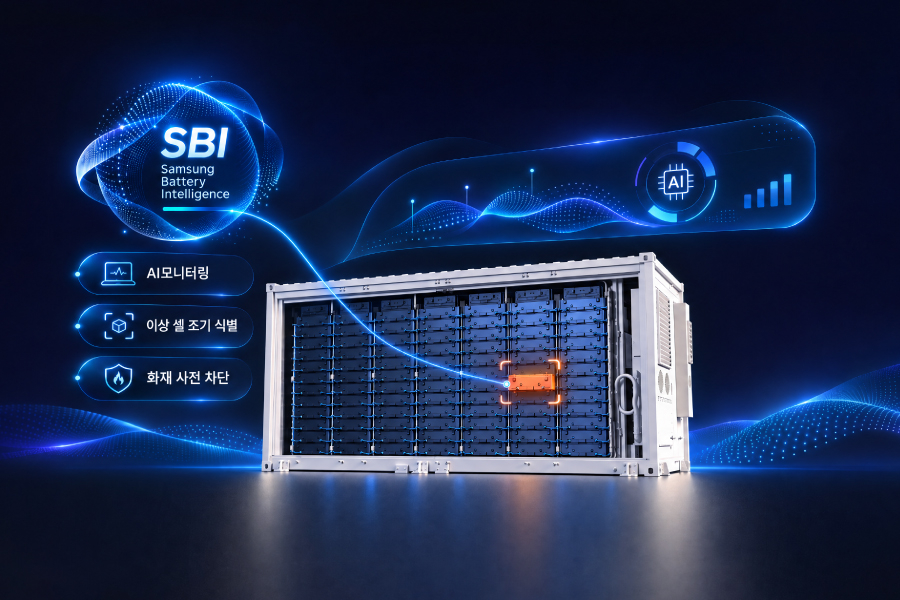
Samsung SDI said Thursday that its plan to apply Samsung Battery Intelligence (SBI), an artificial intelligence-based fire prevention software, to its Samsung Battery Box (SBB) battery solution for energy storage systems (ESS) being supplied under the government's third round of ESS central contract market construction project.
The concept is to enhance the safety of ESS by adding AI-driven software to existing hardware-centric safety technologies. SBI uses AI to diagnose the condition of battery cells and identify potential abnormal cells at an early stage, thereby helping prevent fires.
In particular, it can detect warning signs and provide alerts up to three days before abnormal situations such as thermal runaway occur.
SBI monitors approximately 1,400 ESS installation sites operated by Samsung SDI both domestically and internationally.
After training AI with the accumulated data, it comprehensively analyzes subtle changes within the battery, installation environment, usage patterns, and other factors to predict and detect danger signs.
The company plans to expand the application of SBI to previously installed SBB units as well, accumulate diverse operational data, and continuously improve the reliability of battery condition diagnostics based on this data.
By comprehensively analyzing battery conditions and providing necessary information, the system can also contribute to reducing operation and maintenance costs.
Alongside SBI, Samsung SDI is applying existing hardware safety technologies such as thermal propagation prevention (No TP). While SBI plays a role in identifying abnormal signs in batteries at an early stage, No TP prevents heat from spreading to adjacent cells when an abnormal situation occurs.
A Samsung SDI official stated, "We are implementing 'intelligent ESS battery' technology that allows the battery to self-diagnose its condition and detect danger signs."
The official added, "Going forward, we plan to continuously enhance the safety and operational reliability of ESS by combining AI-based proactive prevention technologies with existing hardware safety technologies."
Meanwhile, the government announced that the scale of the third round of ESS bidding has been doubled compared to the first and second rounds, totaling 1,180 megawatts (MW).
This includes 1,100 MW on land and 80 MW in Jeju. Selected contractors must complete the construction of the ESS by February 2029. Bidding was conducted until the 11th of last month, and the winning bidder is expected to be determined within this month.

 in INDUSTRY
