

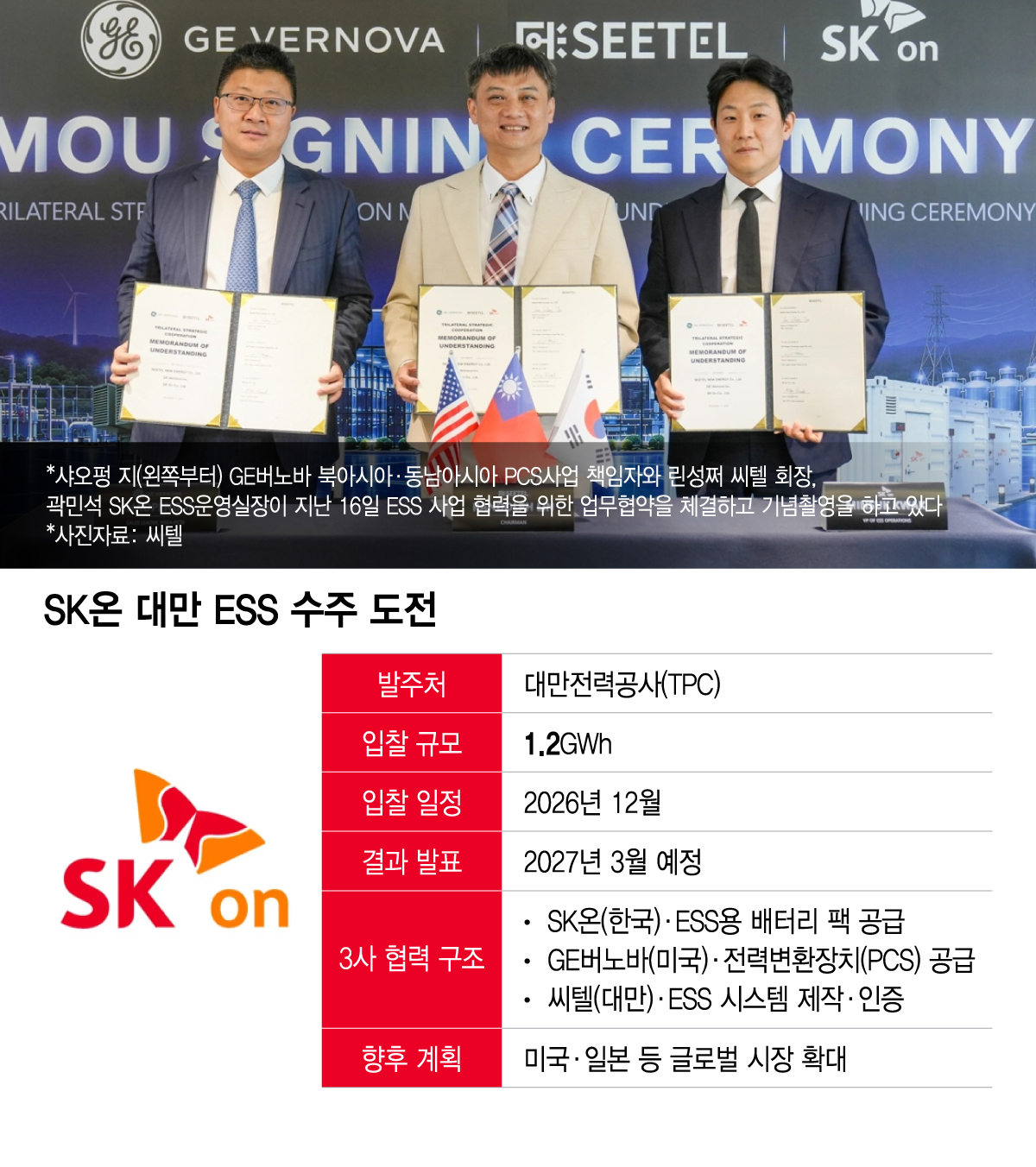
SK On is set to participate in the bidding for an Energy Storage System (ESS) project to be issued by the Taiwan Power Company in December. Through its first joint venture with U.S. energy company GE Vernova and Taiwanese ESS firm Seetel, SK On aims to target the public ESS market in Taiwan, which has high demand for non-Chinese-made batteries, and plans to expand the scope of cooperation to global markets such as the United States and Japan in the future.
According to battery industry sources on the 19th, SK On is pushing forward with its participation in the bidding for a 1.2GWh (gigawatt-hour) scale ESS project by the Taiwan Power Company, based on the Memorandum of Understanding (MOU) recently signed with GE Vernova and Seetel. This bid is the first project to be pursued after the three companies established their cooperative relationship, and it is scheduled to take place in December, with results expected to be announced around March next year.
Specifically, SK On will be responsible for supplying battery packs for ESS, while Seetel will handle the manufacturing and certification of the ESS system. GE Vernova will supply the Power Conversion System (PCS) required to feed electricity stored in the batteries into the power grid or store external electricity in the batteries. This is significant as it goes beyond simple technical cooperation to involve joint participation in an actual ESS supply project. The three companies have a strategy to expand their cooperation in global markets, including Taiwan, the United States, and Japan, starting with the bid from the Taiwan Power Company.
The LFP (Lithium Iron Phosphate) batteries for ESS that SK On will supply will be manufactured at production facilities both domestically and abroad. SK On has production capacities of 21GWh at its Seosan plant in Chungcheongnam-do Province and 47.5GWh in Hungary. In the United States, it has secured a total production capacity of 102GWh, including SK Battery America Plants 1 and 2 in Georgia (22GWh), the Tennessee plant (45GWh), and the joint venture plant with Hyundai Motor Group, HSBMA (35GWh). Although it also maintains a production hub in China with a capacity of 67.5GWh, supplying Chinese-made batteries appears difficult given Taiwan’s policies regarding information security and supply chains.
A notable aspect of this cooperation is the supply chain policy in the Taiwanese ESS market. Taiwan is a market where demand for non-Chinese-made batteries has formed due to policies on information security and supply chains. In public and subsidy-supported projects, battery origin and supply chain stability serve as key considerations. The importance of power grid stability has been highlighted following successive large-scale blackouts in 2021 and 2022, and electricity demand from AI (Artificial Intelligence) data centers and other facilities is also increasing. According to market research firm DIGITIMES, the size of the Taiwanese ESS market is expected to expand approximately fourfold, from about 1.9GW (gigawatts) in 2025 to 7–8GW by 2030.
This market environment is expected to serve as a new business opportunity for SK On. This is because, amid Taiwan’s policy stance to reduce dependence on Chinese-made batteries, the company can target the local public ESS market by leveraging its non-Chinese battery supply capabilities. In addition, it is expected that combining U.S.-based GE Vernova’s power conversion technology with Seetel’s system integration capabilities in Taiwan will enhance competitiveness in winning bids for large-scale ESS projects.
In this regard, an SK On official stated, “Through this cooperation, we will expand business opportunities not only in South Korea and the United States but also in global ESS markets such as Taiwan and Japan, and strengthen our long-term competitiveness in the ESS business.”

 in INDUSTRY
