

As young people complain about the difficulty of finding jobs while SMEs (small and medium-sized enterprises) struggle with labor shortages, there is a growing call for policy support to address this "mismatch."
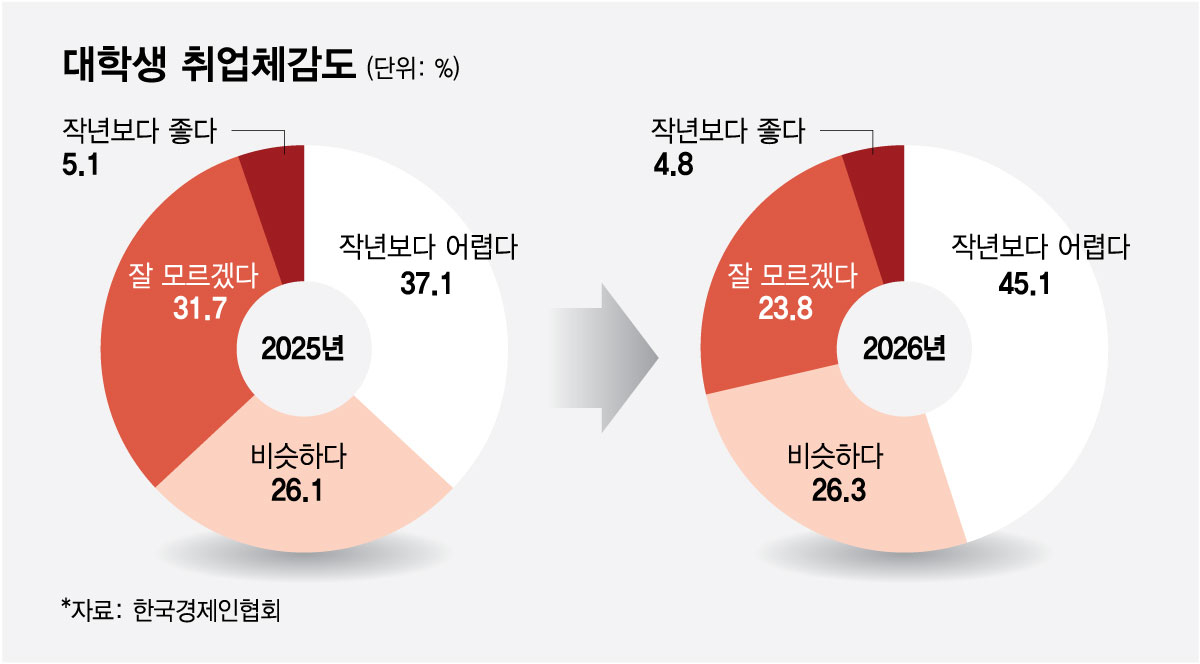
According to the "2026 Survey on University Students' Perceptions of Employment," conducted by the Korea Association of Economic Organizations (KAEF) on the 22nd among 2,488 current students and graduates from four-year universities nationwide, 45.1% responded that this year's new graduate hiring market is "more difficult than last year," an increase of 8.0 percentage points from the previous year. In contrast, only 4.8% answered that it is "better than last year."
The gate to actual employment has also narrowed. Current students in their fourth year or above and graduates who are actively job-hunting applied for jobs an average of 10.2 times this year and passed the document screening stage 1.9 times. The document screening pass rate was 18.6%, down 0.8 percentage points from last year. Additionally, 23.5% responded that they failed all document screenings.
Forecasts of a prolonged job preparation period have also increased. The proportion expecting to spend more than one year preparing for employment rose from 35.9% last year to 40.6% this year. Difficulties experienced during the job preparation process included "decrease in new graduate hiring opportunities" (27.6%) and "lack of good jobs matching desired working conditions" (24.2%).
Even after securing a job, settling down is difficult in the case of SMEs (small and medium-sized enterprises). According to the "Survey on Early Resignation and Settlement Status of Youth in SMEs," conducted by the Korea Chamber of Commerce and Industry (KCCI) among 451 HR managers at SMEs (small and medium-sized enterprises) and 366 working youth, 95.6% of HR managers answered that there have been cases of new graduate employees who joined within the last three years resigning within one year.
The most frequently cited difficulty in hiring youth for SMEs (small and medium-sized enterprises) was "repeated hiring due to early resignation after recruitment" (40.6%). The most common reason for early resignation identified by HR managers was "dissatisfaction with low compensation such as salary and benefits" (49.9%). This was followed by "inability to adapt to rigid organizational culture" (35.0%) and "difficulty in work-life balance due to overtime and weekend work" (24.6%).
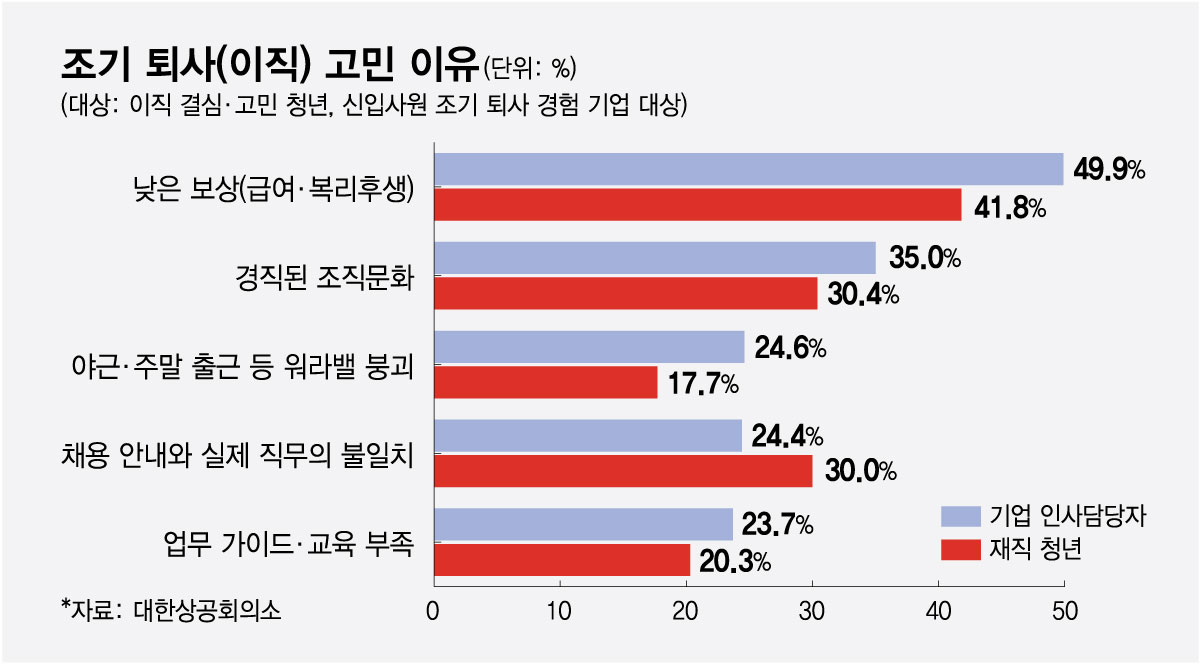
64.8% of working youth also answered that they had decided to resign or were seriously considering it within one year of joining their first job. Reasons for considering resignation included low compensation (41.8%), rigid organizational culture (30.4%), and mismatch between recruitment information and actual job duties (30.0%).
Yoo Il-ho, head of the Employment and Labor Team at KCCI, stated, "Companies must first create treatment commensurate with performance and a communicative organizational culture, and strive to provide accurate job descriptions and training for new employees." He added, "The government should also supplement support methods and procedures so that SMEs (small and medium-sized enterprises) with limited resources can easily utilize them, and strengthen incentives to help with workplace adaptation and long-term retention."

 in INDUSTRY

