

Companies and investors are at odds over the "speed" of mandatory ESG (Environmental, Social, and Governance) disclosure. Companies cite "lack of preparation," while investors emphasize "information reliability."
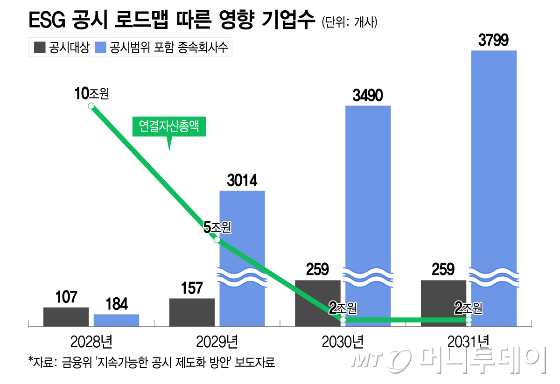
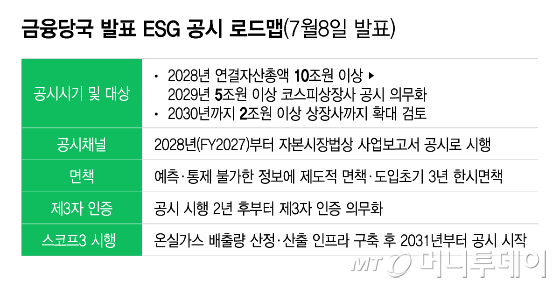
According to the financial investment industry on the 22nd, an amendment to the Capital Markets Act and Financial Investment Business Act includes a mandate for ESG disclosure and certification. The amendment requires KOSPI-listed companies with total consolidated assets of 10 trillion won or more to disclose their ESG status along with their annual business reports starting from the 2027 fiscal year. A total of 291 entities, comprising 107 listed companies subject to the mandate and 184 major subsidiaries, must make disclosures in the first year of implementation. The amendment is currently pending before the Political Affairs Committee (Political Affairs Committee) Bill Review Subcommittee (Bill Subcommittee) of the National Assembly.
Although it has not been finalized whether the disclosure will be included in business reports or prepared as a separate sustainability report, the likelihood is high that it will be decided to use the business report format, given that the Financial Services Commission (Financial Services Commission) agrees with this approach.
Large corporations subject to the mandate in the first year of implementation, as well as small and mid-sized companies, are voicing concerns that ESG disclosure is burdensome regardless of asset size. Even large corporations already publishing sustainability management reports are pleading that there is a severe lack of time and cost to include ESG disclosures in their business reports.
For entities with a December fiscal year-end, business reports are primarily disclosed in March, whereas sustainability management reports are released at the end of June. This reflects the fact that emissions under the Emissions Trading Scheme and Greenhouse Gas Target Management System are finalized and disclosed at the end of May. This is to describe in the report how much companies have reduced carbon emissions and how well they have met government-set greenhouse gas reduction targets.
Listed companies must advance emission measurements by at least two to three months to include them in their business reports. The fact that emission notices for December are issued in January of the following year further tightens the timeline. In particular, since disclosure is on a consolidated basis, data must be collected from overseas subsidiaries as well. Companies argue that if local subsidiary documents cannot be reviewed directly at the location, it is difficult to ensure accuracy, and processing information differently by country into a unified format for disclosure incurs significant costs in terms of time and personnel.
Although the Financial Services Commission and the amendment have established buffer mechanisms to alleviate the burden on listed companies, there are indications that these are insufficient. In September, at the Political Affairs Committee Bill Subcommittee, the Financial Services Commission acknowledged the need to introduce a system that temporarily exempts liability for compensation, administrative sanctions, surcharges, and criminal penalties if information contains errors but is unpredictable or uncontrollable. A direction has been set to grant a two-year grace period before the obligation to obtain third-party certification of ESG reports prior to disclosure takes effect.
An official from a KOSPI-listed company with total assets of 10 trillion won or more stated, "We must measure emissions including overseas subsidiaries and complete third-party verification, but the review personnel at verification agencies are severely insufficient, making it physically impossible to meet the deadline." The official added, "If things continue like this, it will inevitably result in a patchwork disclosure, yet I do not understand why we are starting so early."
An official from a related agency said, "Even advanced countries in disclosure such as the European Union (EU) and the United States are slowing down the introduction of ESG disclosure, but going in the opposite direction is frustrating." The official added, "I am unsure if there is a need to align domestic companies with global standards." Continuing, the official argued, "We have also amended the Commercial Act and made efforts to improve corporate governance, yet the fact that foreign selling continues in the domestic stock market suggests that corporate fundamentals (basic strength) and growth potential are more important than ESG." The official further claimed, "Allocating costs that should be spent on expanding new businesses or R&D (Research and Development) to building ESG disclosure infrastructure actually undermines fundamentals."
Unifying different standards through disclosure... "Reliable information is the 'alpha' and 'omega' of investment"
From an investor's perspective, there is the advantage of being able to compare climate risks and carbon regulation costs across companies through standardized disclosure. It is explained that quantifying non-financial indicators according to unified disclosure standards makes comparisons between companies much easier.
Kim Ho-jung, a researcher at Yuanta Securities, analyzed, "Synthesizing prior research from the United States and Korea, what investors evaluate is not whether an ESG report is published or its length, but information that is financially material and comparable across companies." Kim added, "Companies need to focus their efforts on financially material items and consolidated data systems."
It was also argued that companies need to voluntarily respond in areas that are not mandatory, such as obtaining certification before the third-party certification mandate takes effect. According to Yuanta Securities, prior research has confirmed that the negative relationship between mandatory greenhouse gas emission disclosure and corporate valuation is mitigated among domestic companies that voluntarily conduct ESG disclosures alongside mandatory ones.
The asset management industry also expects that mandatory ESG disclosure will enhance information reliability and enable comparisons between companies within the same industry. It is assessed that if ESG information is included in business reports, timing and scope, such as fiscal year and consolidated basis, are uniformly standardized, and failure to comply requires separate explanation, thereby increasing the value of the information.
An official from an asset management company emphasized, "Looking at existing reports, companies arbitrarily determine the boundary scope of ESG items, and there is no obligation to specify reasons for changes, which reduces their utility as information." The official added, "If ESG disclosure becomes mandatory, information will be contained within a framework set in audited reports, thereby improving the quality of information."
Global institutional investors also judge that a system where ESG information is disclosed together with financial statements in a single report can provide timely and comprehensive information to investors. The International Corporate Governance Network (ICGN) sent a letter of appreciation to the Financial Services Commission upon the release of the final draft of the ESG disclosure introduction roadmap. ICGN is an international organization led by global investors, with member firms managing over 100 trillion dollars (approximately 13 quadrillion won) in total assets under management. It is an authoritative institutional investor that presents global standards on corporate governance and investor stewardship.
Previously, Jen Sison, head of ICGN, sent an open letter urging the release of the ESG disclosure introduction roadmap, stating, "The mandatory sustainability disclosure based on the Capital Markets Act is a highly welcome measure in terms of providing legal clarity and ensuring consistency with international standards." Sison added, "We expect that by releasing the ESG disclosure roadmap based on the Capital Markets Act, the Financial Services Commission can reduce corporate uncertainty and contribute to investment decisions made by investors based on comparable and reliable information."
It is also projected that if the reliability of information is guaranteed through disclosure, "big players" such as pension funds and institutional investors can use ESG as an evaluation criterion for fund management. The Financial Services Commission also announced in July, when releasing the final draft of the ESG disclosure roadmap, that the National Pension Service plans to expand the use of ESG disclosure information across its overall fund management. Additionally, the Financial Services Commission stated that it will check and disclose whether ESG elements are reflected in trustee responsibility policies when reviewing the implementation status of institutional investors' stewardship codes.
An official from an asset management company said, "Whether it is ESG investment or climate change response, the beginning and end of investing in the financial market is information disclosure." The official added, "All systems, such as market activation, directionality, and support for new businesses, operate based on reliable information." Continuing, the official explained, "Accounting disclosure was introduced to view corporate reality financially, so providing reliable information is also the starting point for ESG. Ultimately, refusing to disclose means refusing to do the work behind the scenes."

 in STOCK

