

The business community argued that the government must legally establish the government’s share of funding for maternal protection programs, such as parental leave benefits, before pushing to raise the employment insurance premium rate. Critics point out that the structure in which employers and employees bear the costs of national population policy through insurance premiums is the root cause of the deteriorating finances of the Employment Insurance Fund.
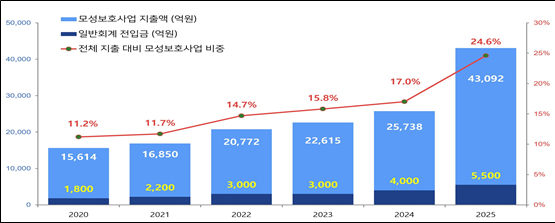
According to a report titled “Problems and Challenges in the Funding Structure of Maternal Protection Systems” by the Korea Federation of Employers (KFB) on the 24th, 75.1% of the increase in expenditure from the unemployment benefit account of the Employment Insurance Fund last year was attributed to a surge in spending on maternal protection programs, including parental leave benefits. Of last year’s maternal protection program expenditures, the share covered by transfers from the general government budget was only 12.8% (550 billion won), while the remaining 87.2% (approximately 3.8 trillion won) was funded by employer and employee insurance premiums. This amount is more than double the deficit of the unemployment benefit account in the same year (1.8 trillion won).
The government announced legislative proposals in September to separate the maternal protection program account and raise the unemployment insurance premium rate from 1.8% to 2.0% next year. The KFB analyzed that in this scenario, the additional burden on employers and employees would increase by approximately 1.6 trillion won annually, while the increase in transfers from the general government budget would be limited to 300 billion won, rising from 600 billion won this year to 900 billion won next year. This means that among the newly introduced funding sources, the burden on employers and employees is about five times the amount of the increased government fiscal allocation.
The KFB also cited as an issue the fact that raising the premium rate can be finalized solely through amendments to enforcement decrees, whereas government fiscal support depends on annual budgeting. It noted that even for health insurance, which has a statutory standard for government support, actual support amounts fall short of the standard every year. The KFB further pointed out that the plan to move maternity and paternity leave benefits to the Employment Stability and Vocational Ability Development account, where employers pay the full insurance premium, would force employers to bear the cost of benefits even for periods during which they have no legal obligation to provide paid leave.
International cases were also presented. Germany funds parental benefits, equivalent to parental leave benefits, through general taxation. Japan, which operates an employment insurance system, legally mandates that the government bears one-eighth of the costs of childcare leave benefits. It also includes a flexible clause allowing for lower premium rates if fiscal capacity is sufficient.
The KFB recommended reforming the funding structure in the following order: legislating government cost-sharing, adjusting premium rates, and transitioning to taxation in the long term. It stated that the Employment Insurance Act should specify the government’s mandatory share of expenditure on the maternal protection account, starting at a level of at least 20%—comparable to the government support level for health insurance—and gradually increasing to over 50% in the medium to long term. The KFB clarified that raising premium rates should be postponed until the government’s fiscal responsibility is legally guaranteed, or at the very least, implemented simultaneously with amendments to the Employment Insurance Act.
Lee Sang-cheol, Head of the Employment and Social Policy Division at the KFB, said, “The business community deeply empathizes with the need to expand maternal protection systems to overcome low birth rates,” while adding, “Maternal protection programs, such as parental leave, are national population policies that create future labor force and taxpayers, so it is a principle that their costs should be shared through general taxation.” He emphasized, “Even if adjusting premium rates becomes unavoidable due to the fund’s financial difficulties, legislating the government’s mandatory share of funding for maternal protection programs should take priority.”

 in INDUSTRY
