

LG Electronics has caught up with China’s TCL in the global TV market in terms of shipment market share within just one year. Despite stagnant global TV demand and rising costs, the company improved the profitability of its TV business by expanding sales of premium products centered on OLED (organic light-emitting diode) technology and targeting emerging markets.
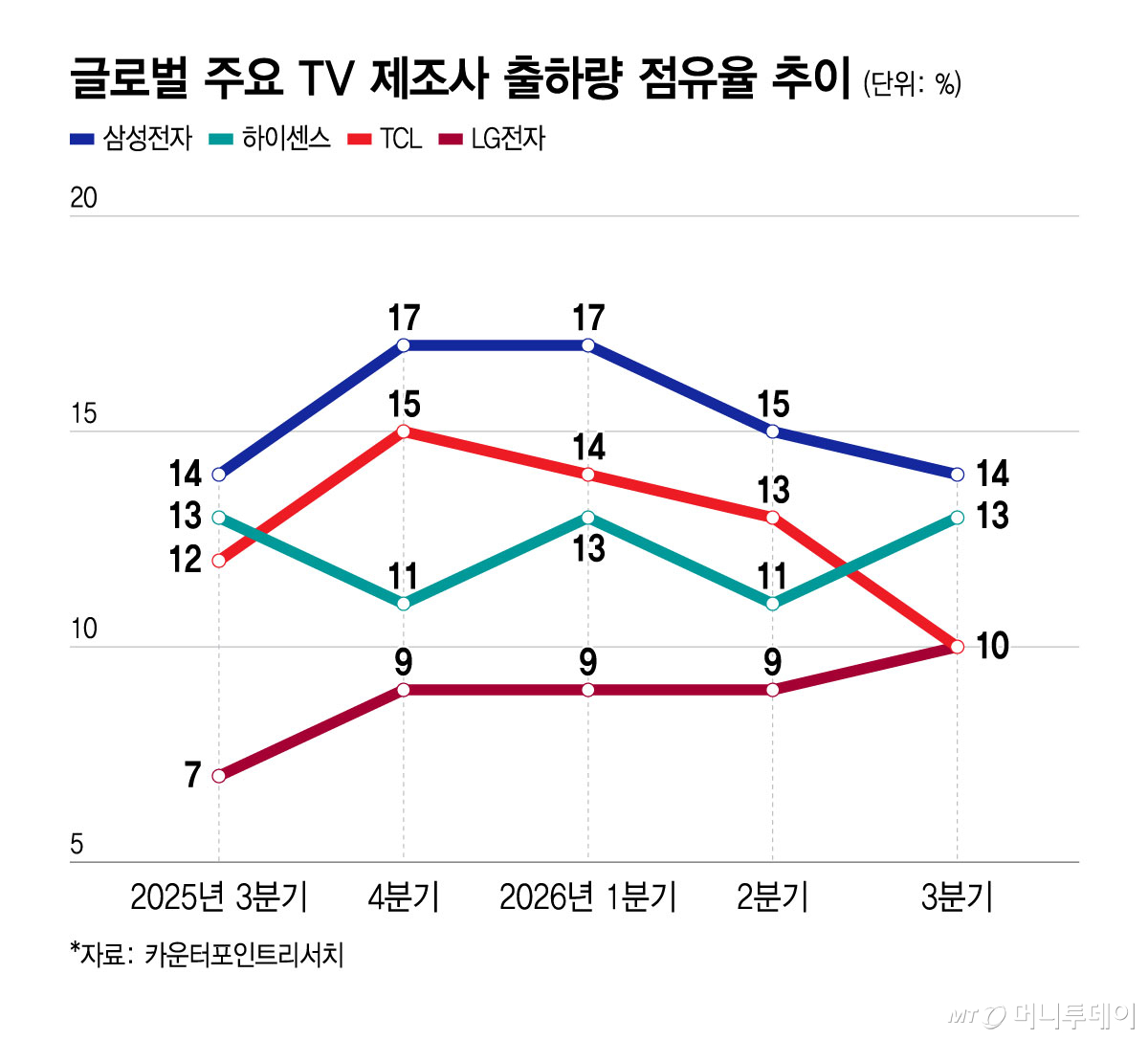
According to market research firm Counterpoint Research on the 26th, LG Electronics’ global TV shipment market share in the third quarter of this year was 10%, up 3 percentage points from 7% in the same period last year. During the same period, TCL’s share fell from 12% to 10%. Among the top four global TV shippers, LG Electronics is the only company whose market share increased compared to the same period last year.
The market share gap between LG Electronics and TCL, which had widened to 6 percentage points in the fourth quarter of last year, narrowed to 5 percentage points in the first quarter of this year and 4 percentage points in the second quarter. In the third quarter, as LG Electronics’ share rose to double digits, the two companies recorded a tie based on their reported figures.
Although LG Electronics has recovered its market share, the offensive by Chinese manufacturers in the global market remains fierce. The gap between Samsung Electronics (14%), which maintained the top spot in third-quarter shipments, and second-place Hisense (13%) was only 1 percentage point. Hisense reclaimed the world’s No. 2 position within a year by targeting the European market with soccer sponsorship marketing and premium RGB (red, green, blue) mini-LED (light-emitting diode) TVs. Samsung Electronics also launched its M series of affordable mini-LED TVs in the second quarter to respond to Chinese manufacturers and defend its shipment volume.
As competition for market share among manufacturers intensifies, global TV demand has failed to recover despite the hosting of this year’s FIFA (Fédération Internationale de Football Association) World Cup. Coupled with rising prices of key components, there is a growing atmosphere of increased pressure on profitability. LG Electronics also forecast in its quarterly report that this year’s global TV market size will be approximately 208 million units, similar to last year.
Despite such deteriorating industry conditions, LG Electronics’ average selling price for TVs has turned upward. According to LG Electronics’ third-quarter quarterly report, the average selling price this year rose by 10.6% compared to the annual average last year. Last year, it had fallen by 4.5% compared to 2024.
In fact, the profitability of the TV business has also turned positive. The MS (Media & Entertainment Solutions) Business Company, which oversees the TV business, recorded revenue of 5.0215 trillion won and an operating profit of 146.7 billion won in the third quarter of this year. Compared to an operating loss of 302.6 billion won in the same period last year, operating results improved by 449.3 billion won. In addition to strong sales of high-value-added OLED TVs and emerging markets, growth in the platform business based on webOS, the smart TV operating system, has allowed the company to maintain profitability for three consecutive quarters this year.
LG Electronics plans to continue its premium strategy centered on OLED TVs, a segment in which it has maintained the global No. 1 position for 13 consecutive years. At the same time, it is strengthening its offensive in the high-end LCD (liquid crystal display) market by expanding its Micro RGB evo and QNED (Quantum Nano Emission Display) evo lineups to ultra-large products of 100 inches or more.
An industry official said, “Defending profitability has become crucial for manufacturers due to the stagnation in the TV market and rising prices of components such as memory,” adding, “The strategy of increasing the share of premium products and growing platform revenue supported the improvement in performance.”

 in INDUSTRY
