

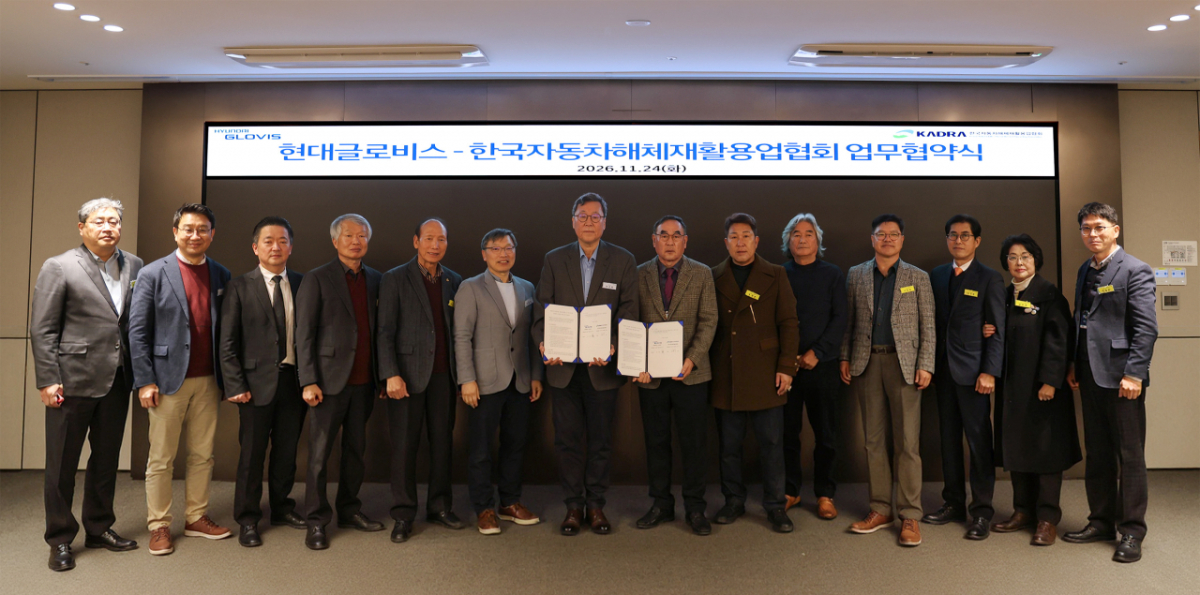
Hyundai Glovis is partnering with the domestic automobile dismantling and recycling industry to create an automotive circular economy ecosystem. Amid strengthening global environmental regulations, the company plans to build a supply chain that covers everything from recovering key resources such as used batteries and aluminum from end-of-life vehicles to utilizing recycled raw materials.
Hyundai Glovis announced on the 26th that it signed a Memorandum of Understanding (MOU) with the Korea Automobile Dismantling and Recycling Industry Association for "the promotion of the automotive circular economy industry and the creation of a sustainable ecosystem."
The signing ceremony, held on the 24th at the Hyundai Glovis headquarters in Seongdong-gu, Seoul, was attended by Lee Gyu-bok, President (CEO) of Hyundai Glovis, Kim Jong-sik, Chairman of the Korea Automobile Dismantling and Recycling Industry Association, and others.
The two parties agreed to build an automotive circular economy network and expand the recycling of materials such as used batteries and aluminum generated during the safe dismantling of electric vehicles, hydrogen fuel cell vehicles, and internal combustion engine vehicles.
As the adoption of electric vehicles expands, the value of utilizing key resources recovered at the end-of-life stage, such as nickel, cobalt, lithium, and aluminum, is increasing. Global mandates for using recycled raw materials to reduce carbon emissions are also becoming stricter.
The European Union (EU) is pushing a plan to mandate the use of recycled plastics and recycled aluminum in the vehicle manufacturing stage through the End-of-Life Vehicles Regulation (ELVR). Under the EU Battery Regulation (EUBR), standards requiring the use of at least 16% recycled cobalt, 6% lithium, and 6% nickel in battery manufacturing will apply from 2031.
In response to these environmental changes, the two parties will cooperate to share policies, systems, technologies, and market trends related to the automotive circular economy industry, as well as to improve the efficiency of dismantling operations. They also plan to develop cooperation models for improving supply chain management (SCM) efficiency of recovered resources and securing recycled materials.
The initial area of cooperation is the recycling of used batteries from electric vehicles. Hyundai Glovis will provide technology necessary for safe battery removal, transportation, and storage, and will be responsible for the recycling process of the recovered batteries.
In the long term, the company plans to build a supply chain connecting the stage of resource recovery from end-of-life vehicles to the stage where recycled raw materials are reused in related industries, thereby supporting the growth of the domestic end-of-life vehicle industry.
Hyundai Glovis and the Association stated, "This is to establish an automotive circular economy cooperation system in line with a market environment where carbon reduction has become a future corporate competitiveness and a new global standard," adding, "We will elevate the domestic automotive circular economy ecosystem to a global level."

 in INDUSTRY
