

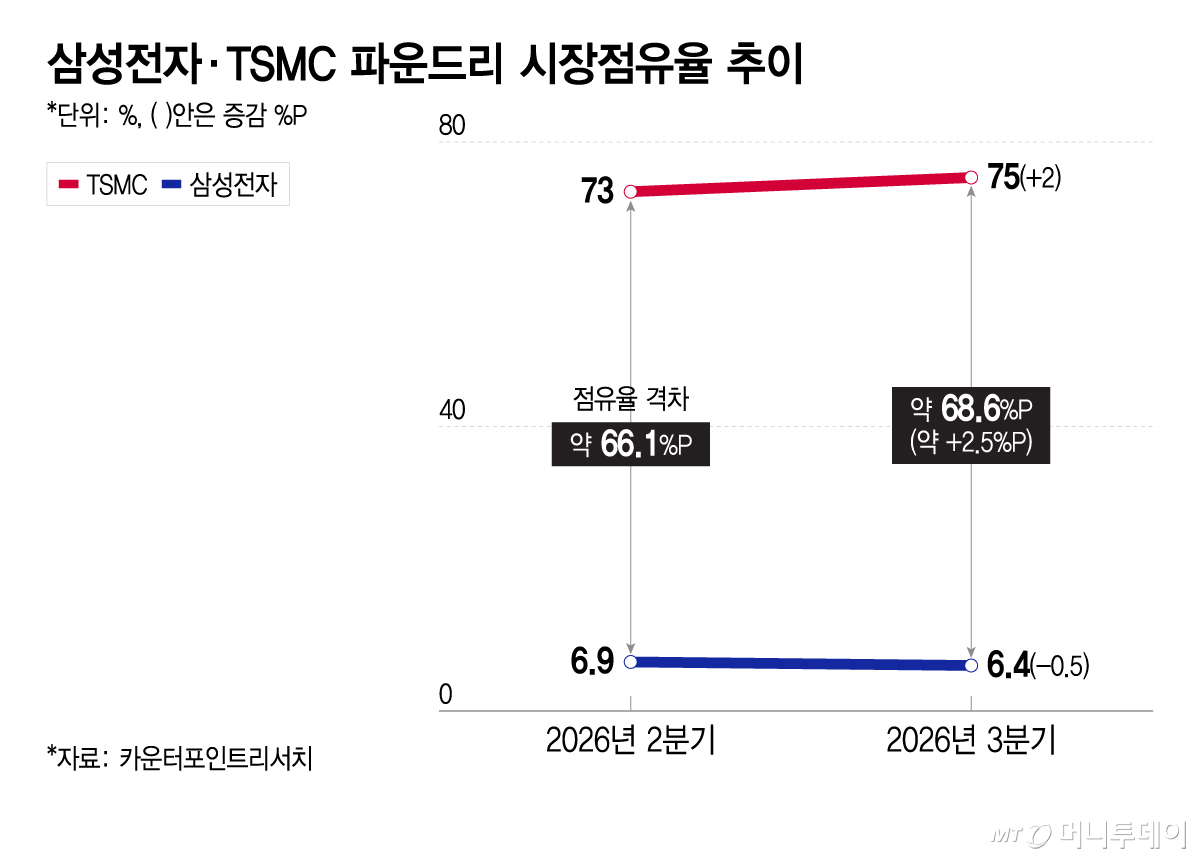
While the global foundry (semiconductor contract manufacturing) market is growing rapidly amid surging demand for AI semiconductors, the market share gap between Taiwan's TSMC and Samsung Electronics has actually widened. As Samsung Electronics expands its orders for leading-edge processes centered on AI and HPC (high-performance computing), the operation of its Taylor plant in the United States next year and mass production of new 2-nanometer products are expected to be key factors in reversing its market share decline.
According to market research firm Counterpoint Research on the 27th, the global foundry market grew by 36% year-on-year and 13% quarter-on-quarter in the third quarter of this year, based on revenue. This was driven by demand for leading-edge processes for AI semiconductors and advanced packaging outpacing supply.
The benefits of market growth were concentrated on TSMC. TSMC's revenue increased by 16% quarter-on-quarter due to the expansion of 2-nanometer (nm, one-billionth of a meter) production, full operation of its 3-nanometer production lines, and the expansion of production capacity for CoWoS (Chip on Wafer on Substrate), an advanced packaging technology. In contrast, Samsung Electronics' revenue growth rate was 6%, falling short of even half the market's growth rate. TSMC's market share rose from 73% to 75%, while Samsung Electronics, despite maintaining its position as the world's second-largest foundry, saw its share drop from 6.9% to 6.4%. The gap in market share between the two companies widened by approximately 2.5 percentage points (p) in just one quarter.
As the market share gap expanded, Samsung Electronics is diversifying its leading-edge process business structure, which has been centered on mobile devices, toward AI and HPC. In fact, during the third-quarter earnings announcement conference call held last month, the company disclosed that it had secured 2-nanometer projects from major cloud service providers (CSPs) and AI/HPC customers.
The shift in customer base is expected to lead to a restructuring of its medium- to long-term revenue structure. In July last year, Samsung Electronics signed a foundry supply contract worth 2,276.48 billion won with Tesla through the end of 2033, agreeing to produce next-generation AI chips, "AI6," at its Taylor plant in the United States. This year, the company also pursued strategic cooperation with U.S. semiconductor design firm Broadcom in the memory and foundry sectors. Samsung Electronics forecasted that its HPC revenue share would exceed 50% of its total foundry business next year.
However, Counterpoint Research stated that improving the yield (ratio of good products) for 2-nanometer processes and achieving stable mass production are crucial for Samsung Electronics to narrow the market share gap. Analysts noted that if such stabilization in mass production is supported, TSMC's supply shortage in advanced packaging could present additional order opportunities for Samsung Electronics. The industry expects TSMC's CoWoS supply-demand gap to reach approximately 20% this year and about 10% next year. Consequently, it is observed that if Samsung Electronics enhances its competitiveness in integrated services spanning foundry, memory, and advanced packaging, it can absorb demand from customers seeking alternative suppliers.
To respond to increasing AI and leading-edge process demand, Samsung Electronics is also accelerating the expansion of its production capacity. Its first Taylor plant in the United States has begun operating cleanrooms and bringing in equipment, while also proceeding with wafer input and dispatching specialized personnel from headquarters. Samsung Electronics forecasted that utilization rates for leading-edge processes would improve significantly as it fully operates the Taylor plant next year, expands mass production of 2- and 4-nanometer products, and begins mass production of new products for major 2-nanometer customers in the second half of the year.
An industry official said, "Since we have broadened our order base to AI and HPC, the operation of the Taylor plant next year and stable mass production of new 2-nanometer products will determine whether we can reverse our market share decline."

 in INDUSTRY
