

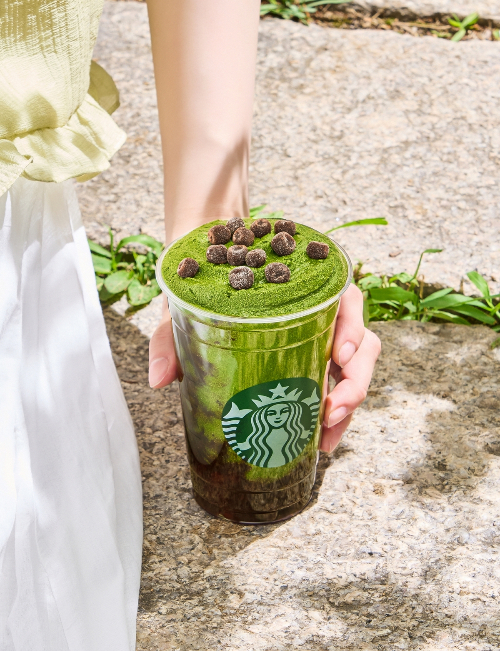
As the global matcha craze continues, the food industry is rolling out new products featuring matcha one after another. The application of matcha is expanding beyond desserts combined with red bean and chocolate to include protein drinks, makgeolli, and bakery items.
According to the industry on the 29th, Starbucks recently launched 'Red Bean Matcha Coco Frappuccino' as a new menu item in its Coco Frappuccino LINE lineup. The product combines organic Jeju matcha with sweet red bean paste and pearl toppings, adding a coconut base to the familiar matcha and sweet red bean combination.
Tom N Toms introduced 'Eat-in Matcha Choco Crunch Abak.' This is a fusion of the previously popular 'Eat-in Matcha Abak' and 'Eat-in Crunch Abak,' layering matcha mascarpone cream, choco ganache cream, and black cookies.
Capitalizing on its popularity, Tom N Toms recently expanded its matcha drink LINE lineup. It added 'Yuzu Lemon Matcha Tonic' and 'Apple Mango Matcha Latte' to the existing domestic premium matcha-based 'Iced Matcha' and 'Matcha Latte.' Additionally, a new topping option allowing customers to add fresh cream to matcha drinks was introduced. According to Tom N Toms, the matcha LINE lineup exceeded cumulative sales of 2.3 million cups within three months of its launch last July.
Shinsegae Food also launched two bakery items utilizing Boseong matcha from Boseong County, South Jeolla Province. 'Eat-in Boseong Matcha Choco Cake' layers Boseong matcha cream and ganache, while the 'Boseong Matcha Choco Croissant' is filled with matcha cream containing chocolate chips inside a croissant. Both are sold at E-Mart Bakery for 8,980 won each.
Matcha is expanding beyond desserts into daily menus. Orion launched the high-protein drink 'Dr. Yu PRO Protein Drink 62g Matcha.' One bottle provides 62 grams of protein and is designed to be low-sugar, low-fat, and low-cholesterol.
The alcohol industry has also joined in. Jihong Brewing officially launched 'Jihong Matcha' in Korea, combining the bitter flavor of Boseong matcha with the sweetness of makgeolli. The company explained that it was first released for export to the U.S., Japan, and Southeast Asia last April, gaining word-of-mouth popularity among Hallyu fandoms before being re-exported back to the domestic market.
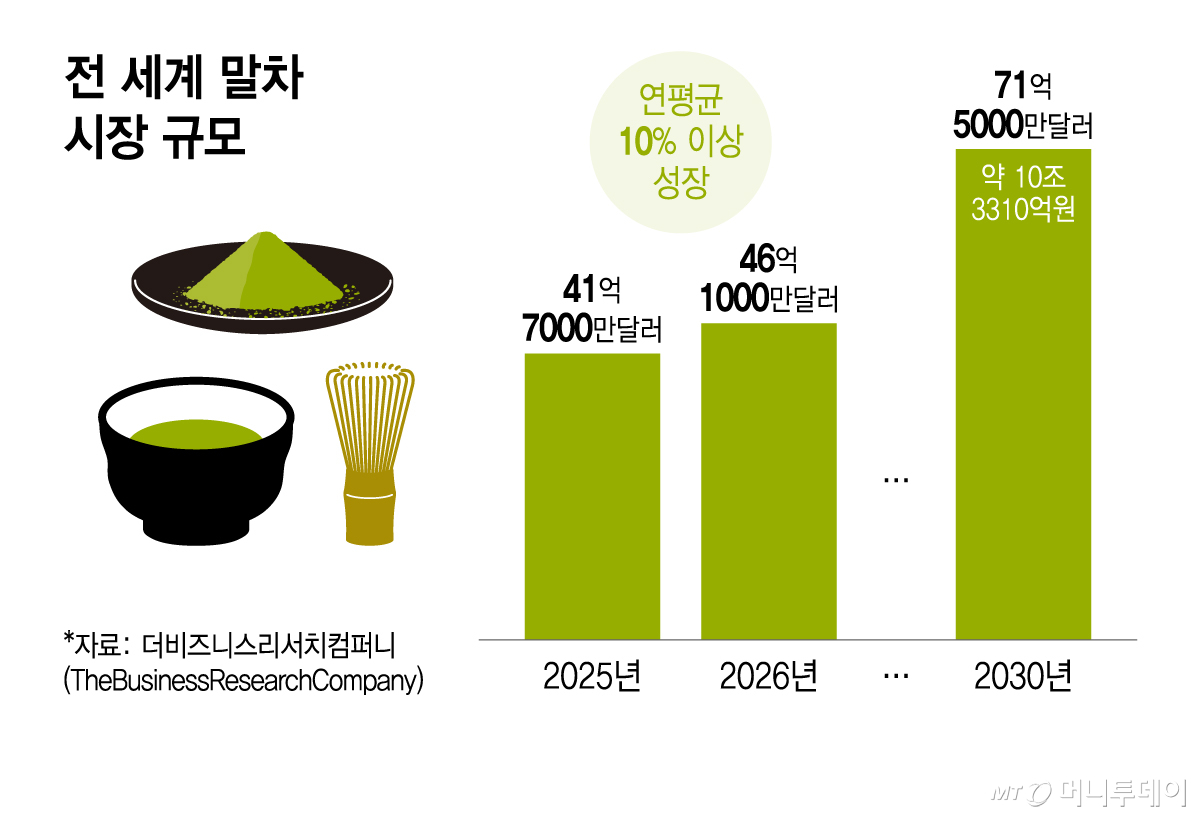
The trend in matcha is also reflected in various statistics. According to the Ministry of Food and Drug Safety, imports of 'MATCHA (matcha flavor)' food additives reached 3,510 kg last year, a 290% increase from the previous year's 900 kg. Market research firm The Business Research Company projected that the global matcha market size will grow from $4.17 billion (approximately 6.256 trillion won) last year to $4.61 billion (approximately 6.6614 trillion won) this year, and reach $7.15 billion (approximately 10.331 trillion won) by 2030.
The industry cites increasing demand for food based on natural ingredients and rising consumption of premium tea as reasons for market growth. In particular, there is a growing demand to use matcha instead of artificial colorants to create color and aroma, or to replace caffeinated drinks like coffee with matcha-based beverages.
An industry official from a major coffee franchise stated, "While the recently popular ube had good coloring, it lacked a strong defining characteristic that left a lasting impression. In contrast, matcha has a distinctive bitter aroma that is quite intense." They added, "As more consumers seek out the taste of matcha and it pairs well with various ingredients, it will establish itself not merely as a simple trend but as a distinct product category."

 in LIVING

