

The domestic athleisure market is emerging as a battleground between local and global brands. While Jessimix and Andar are solidifying their dual-leader structure by expanding beyond women's leggings into running, golf, men's wear, and everyday clothing, premium brands such as Lululemon and Alo are also accelerating their efforts to penetrate the Korean market.
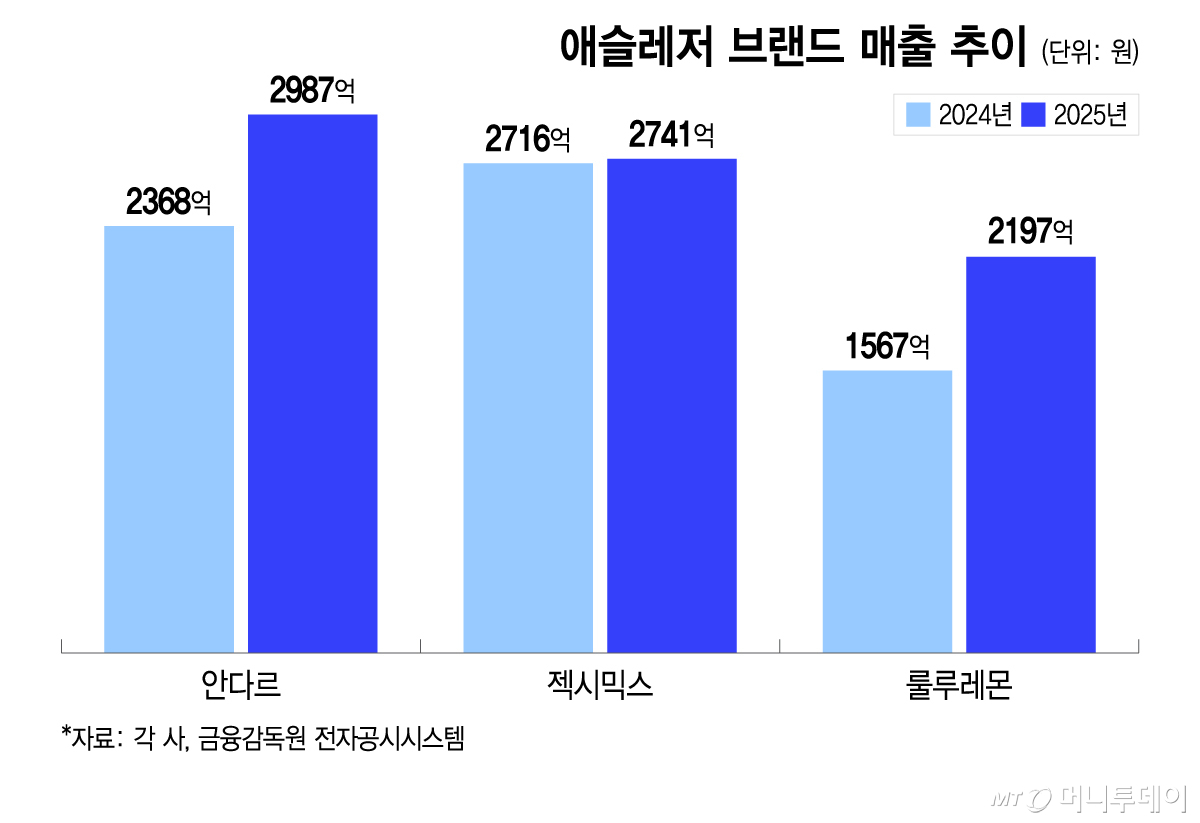
According to industry sources on the 25th, the competitive landscape of Korea's athleisure market is shifting from a "leggings"-centric model to a broader "lifestyle" approach that encompasses everyday wear. Looking at last year's sales, Andar recorded 298.7 billion won and Jessimix reached 274.1 billion won, establishing a dual-leader framework among local brands. Although both brands grew based on women's leggings, they are now expanding their product lines to include items suitable for running, golf, men's wear, and daily life. This strategy aims to broaden consumer touchpoints by offering products that can be worn not only during workouts but also in various situations such as commuting, traveling, and going out.
Global brands are also intensifying their offensive. Canadian brand Lululemon, which entered the Korean market in 2016, has targeted the premium athleisure segment and is known as "the Chanel of leggings." Its domestic sales last year reached 219.7 billion won, surpassing the 200th-billion-won mark. U.S. brand Alo also opened Asia's first flagship store near Dosan Park in Gangnam-gu, Seoul, in the second half of last year. While Japan was considered as a potential location for the store, Korea was ultimately chosen as the Asian hub given its growth trajectory.
These brands maintain higher price points than local competitors while leveraging experience and premium imagery to attract consumers. For leggings, prices range from 100,000 to 200,000 won, contrasting with domestic brands that emphasize relatively affordable pricing and diverse product offerings. Beyond selling sportswear, they differentiate themselves by expanding brand experiences through yoga and running communities.
U.S. brand Vuori, which operates its business in Korea under Shinsegae International, has recently launched its first pop-up store in a street retail area to broaden consumer engagement. With five stores currently operating domestically, the company plans to expand its market presence by introducing pop-up stores and wellness classes.
As the market grows, polarization among brands is also becoming evident. Mulawear, the operator of Korea's first-generation brand Mulawear, recently received a bankruptcy ruling from the court. Industry analysts suggest that intensifying competition is widening the growth gap between brands.
Industry observers expect competition among brands to become even fiercer given the continued high growth potential of Korea's athleisure market. As exercise culture diversifies into running, fitness, Pilates, tennis, yoga, and interest in wellness rises, demand for related apparel and equipment is increasing. An industry executive stated, "As athleisure evolves from functional sportswear designed for specific activities to everyday wear, the market available for brands to target is expanding. Both local and global brands are broadening their product lines and experiences, leading to intensified competition over market leadership."

 in LIVING
