

As K-beauty strengthens its presence in the global market, the competitiveness of 'Made in Korea' products is also growing. With domestic cosmetic brands expanding overseas rapidly, manufacturer-developed production (ODM) companies that have grown alongside them are increasing their footprint in the global market. Cosmax and Kolmar Korea have climbed to the top ranks of global ODM revenue, demonstrating South Korea's cosmetic manufacturing capabilities.
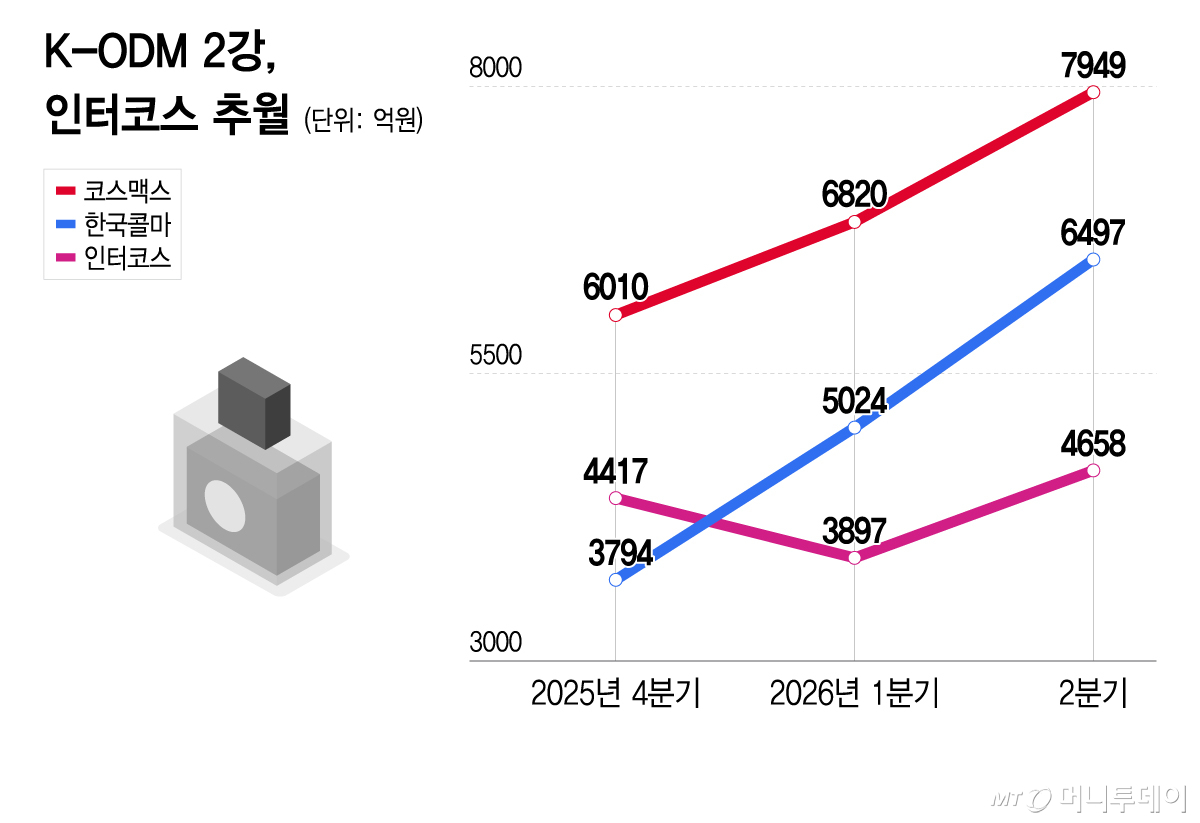
According to the beauty industry on the 24th, second-quarter ODM sales for cosmetics were ranked as follows: Cosmax at 794.9 billion won, Kolmar Korea at 649.7 billion won, and Italy's Interkos at 465.8 billion won. Following its first-quarter performance, Kolmar Korea surpassed Interkos again in the second quarter, widening the gap.
Kolmar Korea's upward trend is particularly notable. In the fourth quarter of last year, Kolmar Korea's cosmetics business unit reported sales of 379.4 billion won, trailing Interkos (441.7 billion won) by 62.3 billion won. However, in the first quarter of this year, it surged to 502.4 billion won, surpassing Interkos (389.7 billion won). In the second quarter, sales continued to rise, widening the gap with Interkos to 183.9 billion won.
Cosmax also solidified its leading position through balanced growth in both domestic and international operations. Consolidated revenue for the second quarter rose 27.5% year-on-year to 794.9 billion won, marking the highest quarterly total in company history. Revenue from its Korean subsidiary reached 518.4 billion won, surpassing 500 billion won for the first time. Sales from its Chinese and U.S. subsidiaries increased by 32.9% and 79.4%, respectively. The U.S. subsidiary recorded its first-ever quarterly operating profit since inception.
Kolmar Korea also grew primarily through pre-care and skin care segments. Separate revenue for the second quarter reached 430.4 billion won, a 31.2% increase year-on-year, while operating profit rose 44.3% to 70.8 billion won. The company's strong performance was driven by continued orders from global multinational corporations and new product launches, alongside expanding demand for pre-care brands.
The growth of both companies is underpinned by shifts in the global cosmetics market. As emerging indie brands gain influence in a market once dominated by luxury and premium labels, the ability to rapidly develop products and produce diverse varieties has become crucial. Analysts note that domestic ODM firms with strengths in skin care and pre-care are benefiting from the expanding demand in these categories.
In contrast, Interkos' growth pace has been relatively slower. Second-quarter sales reached 465.8 million euros, a modest 4.0% increase year-on-year. With first-quarter sales down 9.3% compared to the same period last year, total revenue for the first half of the year declined by 2.4%. Although sales from emerging brands increased, declining orders from multinational corporations and distributors widened the gap with domestic ODM firms.
The global popularity of K-beauty is seen as driving not only expanded exports of domestic brands but also growth in the ODM industry responsible for developing and producing these products. Domestic ODM companies are accelerating product launches to meet shortened development cycles, diversifying production of high-demand categories such as skin care and pre-care, and expanding their global client base.
An industry executive stated, "As K-beauty brands expand overseas, domestic ODM firms are increasingly collaborating directly with global brands." He added, "The competitiveness of domestic ODMs, which offer not only brand strength but also rapid development and production capabilities, is gradually gaining recognition in the global market."

 in LIVING
