

A racing car speeding around a circuit at a top speed of 250 km/h has transformed into a 'mobile laboratory' for a paint company. This is done to accumulate performance data by directly applying water-based automotive repair paints under extreme conditions such as high-speed driving, vibration, and heat. As growth prospects for general-purpose paints have slowed, paint companies are now competing in the 'automotive paint' technology race, ranging from racing validation to AI-assisted color matching and automated mixing.
According to industry sources on the 30th, a racing car coated with Nolo Paint's water-based automotive repair paint 'Water-Q' made its competitive debut on the 22nd. In the TGR 6000 class of the fifth round of the '2026 O-NE Super Race Championship' held at Everland Speedway in Yongin, Gyeonggi Province, the Water-Q I-Rain Racing Team secured third place.
While racing cars are typically painted using the wrapping method, Nolo Paint developed a dedicated fluorescent color and directly painted the entire vehicle. The paint was exposed to high-speed driving averaging around 200 km/h with top speeds reaching 250 km/h, strong vibrations, and heat from asphalt to validate its performance. The team plans to inspect film thickness, color, gloss, and other factors through all eight rounds to gather real-world driving data for product improvements.
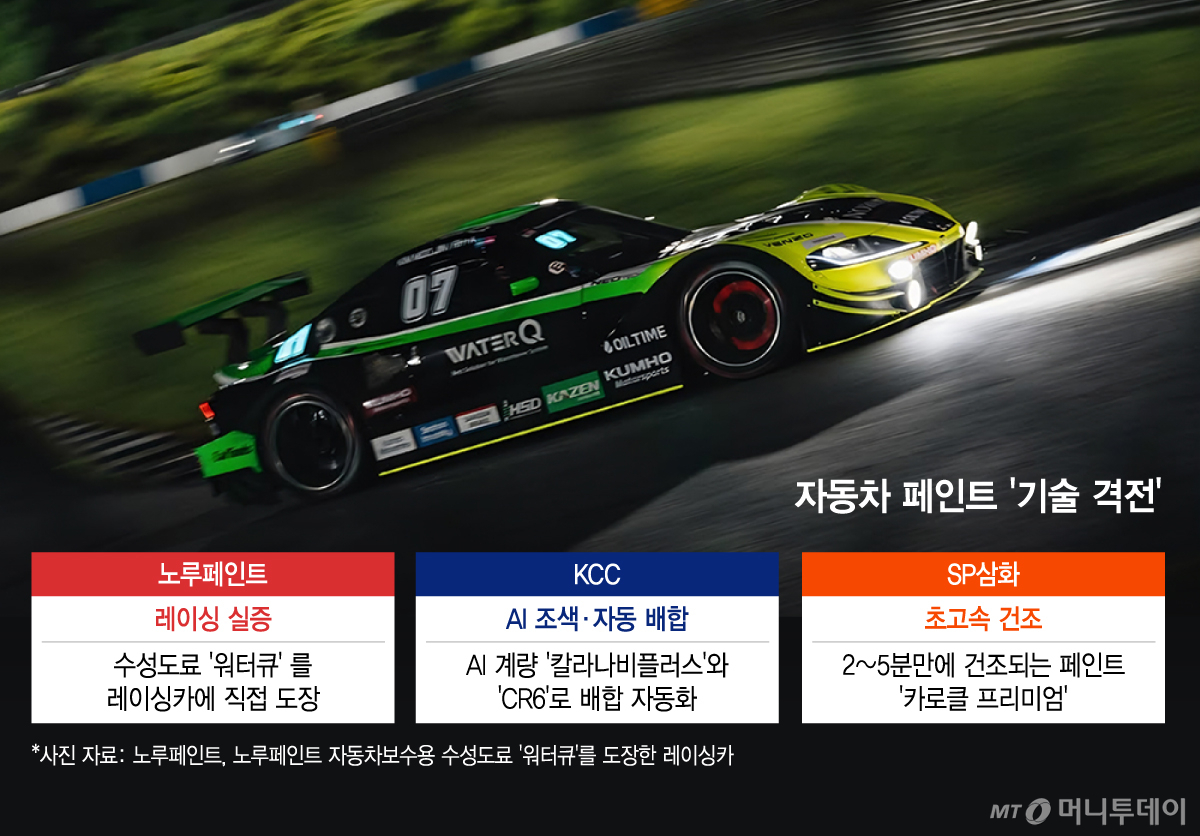
KCC offers an AI-based automotive repair color solution called 'ColorNavi Plus,' which analyzes vehicle colors and metallic or pearl particles to determine the optimal mixing ratio. This has reduced the time required to provide mixing ratios from an average of four days or more to within 24 hours. The 'CR6 Automated Mixing System' automatically measures and mixes paint according to color codes and mixing values, reducing repetitive tasks.
Efforts to shorten overall work times continue as well. SP Samwha's automotive repair product 'Carocle Premium 1K Surfacer' dries in just 2–5 minutes under infrared drying, allowing it to quickly move on to subsequent polishing processes. Nolo Paint also launched its 'Wet-on-Wet F/P System' last year, which reduces the previously required two to three drying steps to a single step.
The automotive repair paint market has been restructured around solvent-based paints and water-based paints with reduced VOCs (Volatile Organic Compounds) content. This shift occurred after the allowable VOCs limit for topcoat basecoats in automotive repair was tightened from 450g/L to 200g/L. The domestic market is valued at 205 billion won, with an expected annual growth rate of approximately 5% through 2030.
The aging of skilled labor is also accelerating the technology race. According to the National Association of Automobile Inspection and Repair Businesses, workers aged 50–60 account for 56.5% of those employed in the painting sector of the automotive repair industry, while those aged 20–30 make up only 4.3%.
An official from the paint industry stated, "With continued growth in automobile production and vehicle premiumization, there is high potential for growth in the special-purpose automotive paint market." They added, "As the general-purpose paint market enters maturity, the automotive sector has become a battleground where companies can differentiate themselves by securing technology and data."

 in LIVING
