

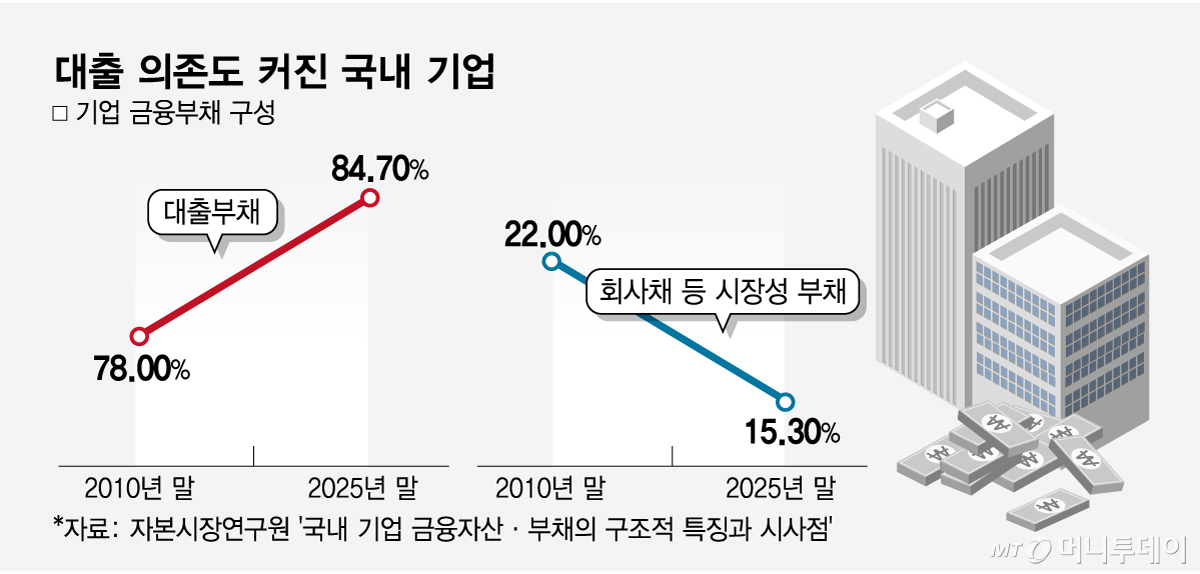
As the base rate enters an upward trend, businesses are expected to face greater funding burdens. More than 80% of domestic corporate financial debt consists of loans, and over 70% of corporate loans carry variable interest rates. Since loans are widely used for funds needed in business operations such as raw material purchases and labor costs, there are concerns that rising interest rates will spread across all aspects of corporate management.
According to the Korea Development Institute's Capital Market Research Institute report released on the 31st, as of the end of last year, loans accounted for 84.7% of domestic corporate financial debt. This represents a 6.7 percentage point (P) increase compared to 78.0% at the end of 2010. Meanwhile, the share of market-based debt such as corporate bonds declined from 22.0% to 15.3% during the same period.
The proportion of variable-rate loans, which are more sensitive to interest rate hikes within total loans, is also rising. According to the Bank of Korea's Economic Statistics System, as of late July, variable-rate loans accounted for 70.5% of outstanding corporate loans at deposit-taking banks, up 9.7 percentage points from 60.8% a year earlier. During the same period, the share of fixed-rate loans fell from 39.2% to 29.5%.
Especially smaller companies show higher reliance on loans. Small and medium-sized enterprises (SMEs) raise more than 90% of their financial debt through loans, while large corporations rely on approximately 50%. Large corporations with high credit ratings can diversify funding sources by utilizing direct financing markets such as issuing corporate bonds, whereas SMEs have relatively fewer options.
Even during the interest rate hike period in 2022, burdens on SMEs (small and medium-sized enterprises) increased rapidly. The share of SMEs citing 'high interest rates' as a major management concern rose from 19.3% in September 2022 to 27.5% in October—a jump of 8.2 percentage points within one month—and reached 30.5% by December.
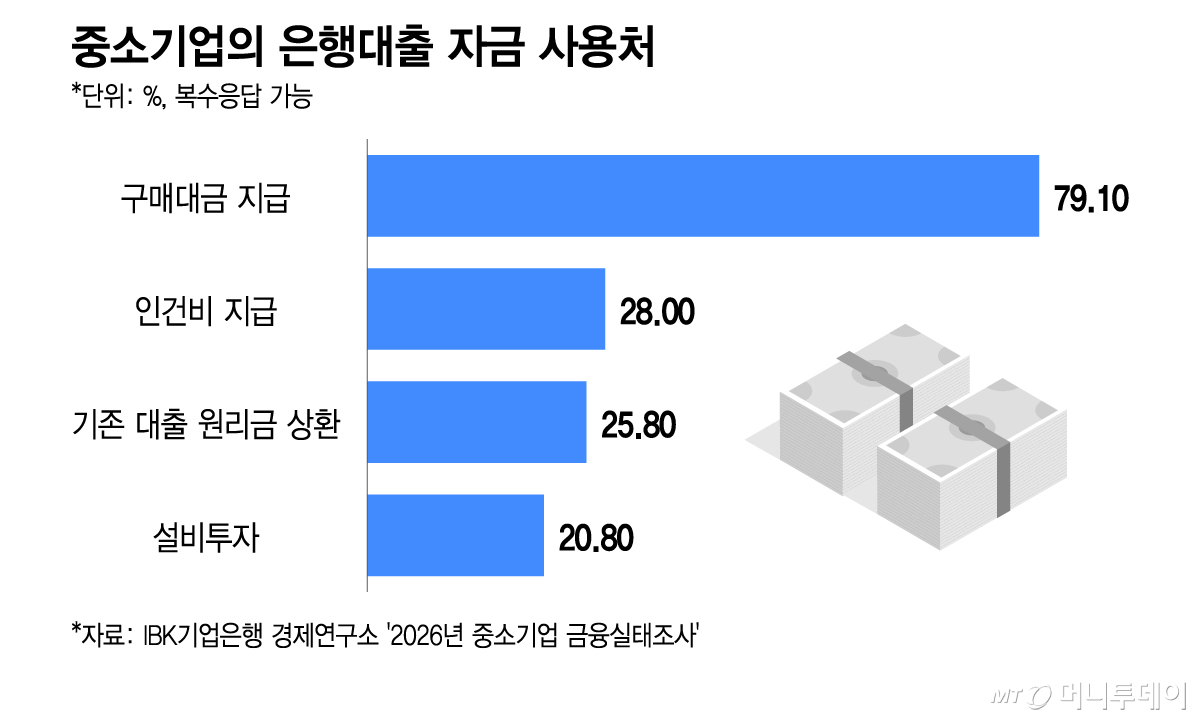
Since funds are immediately needed for raw materials, wages, and other operational costs, reducing loans is difficult. According to the '2026 SME Financial Status Survey' conducted by IBK Industrial Bank of Korea's Economic Research Institute, which surveyed 4,500 SMEs, the most common use (multiple responses allowed) of new bank loans last year was for purchase payments at 79.1%. Labor costs followed at 28.0%, and repayment of principal and interest on existing loans came in third at 25.8%.
The impact of rising interest rates is expected to manifest differently across industries. For manufacturing, where equipment maintenance is critical, higher borrowing costs increase burdens. A representative of a food manufacturer stated, "Since we must purchase raw materials first, produce goods, and then collect sales revenue, the interest on working capital loans needed to secure purchase payments will become a burden."
The home appliance rental business could also be affected by rising interest rates. Rental companies typically produce or purchase products first, install them for customers, and then recover rental fees over several years. The explanation is that as businesses expand, the amount of capital required upfront increases; thus, if reliance on external funding is high, rising interest rates will lead to higher funding costs.
For industries where domestic demand trends are crucial, such as retail and food service, slowing household consumption could also become a burden. If households reduce spending to cope with increased interest payments, companies may face both rising funding costs and sluggish sales.
A representative of the SME Central Association stated, "Since most SMEs utilize loans for working capital needs such as raw material purchases and labor costs, rising interest rates are an extremely sensitive factor for management." He added, "As interest expenses increase, more companies may respond by delaying facility investments, business expansion, or new hiring."

 in LIVING

