

"The government's excessive 'punishment' suppresses corporate 'innovation'. As the 'harsh punishment' stance of investigative institutional investors intensifies, companies shrink back. The spirit of challenging future industries is crushed before the sharp blades of government-affiliated institutional investors, including the Fair Trade Commission (Korea Fair Trade Commission), which is often called the Economic Prosecution Service, weakening even growth drivers. Critics point out that excessive sanctions against companies force them to concentrate resources on defense rather than new investment, dampening 'entrepreneurial spirit' and potentially lowering 'national competitiveness'.
"According to relevant ministries on the 6th, the Korea Fair Trade Commission imposed a total of 1.8146 trillion won in fines for three cases: sugar collusion (396 billion won) in February, flour collusion (671 billion won) in May, and starch/starch syrup collusion (747.6 billion won) in July. This exceeds five times the Korea Fair Trade Commission's fine amount of 340 billion won last year and has already surpassed the annual record high of 1.3308 trillion won set in 2017. In particular, the starch/starch syrup case represents the largest fine ever imposed in a Korea Fair Trade Commission collusion sanction case.
"The Personal Information Protection Commission (PIPC) also imposed fines at a record-breaking level. The PIPC levied a fine of 624.681 billion won on Coupang last June for responsibility regarding the personal information leak and unauthorized collection of online information, marking the largest amount among fines imposed by the PIPC. The Financial Supervisory Service (FSS) also approved a 1.4 trillion won fine for five banks — KB Kookmin, Shinhan, Hana, NH Agricultural Cooperative Bank, and Standard Chartered Bank Korea — in February this year due to massive losses from Hong Kong H-Index-linked equity securities (ELS), but the Financial Services Commission (FSC) rejected it, resulting in a decision of around 600 billion won.
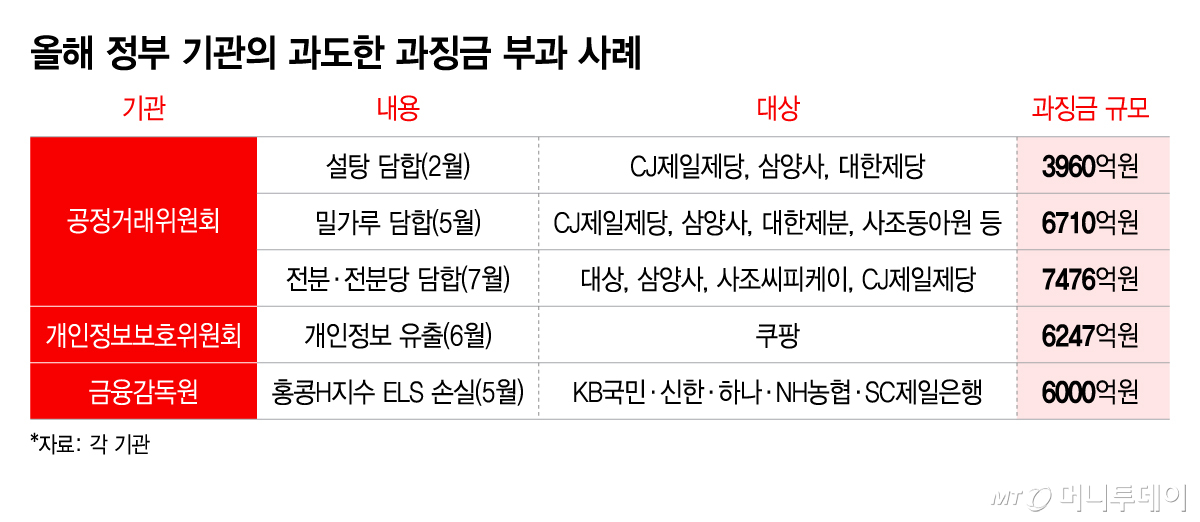
"The fines imposed on companies by these institutional investors exceeded 3 trillion won as of last month, and including major cases awaiting approval before the end of the year, projections suggest that the total fine amount for this year could far exceed a record-breaking 10 trillion won.
"Such 'harsh punishment' sanctions by the government are feared to have side effects that force companies to spend astronomical legal defense costs instead of investing in future new industries or creating jobs. While the government aims to enhance the effectiveness of sanctions, the burden and uncertainty felt by companies increase. As the cap on fines rises, companies calculate potential sanction sizes before considering profitability and growth prospects. If corporate focus shifts from product development and market expansion to legal review and regulatory response, efficiency across the entire ecosystem will also decline.
"Most importantly, it is a problem that many decisions by investigative institutional investors are overturned in court. A vicious cycle continues where fines imposed on companies are refunded again due to reasons such as losing administrative lawsuits. According to data received from the Korea Fair Trade Commission by Democratic Party of Korea lawmaker Heo Young, fines returned to companies totaled 625 billion won from 2017 through August 2025.
"Even if a company receives a final not-guilty verdict or a court ruling canceling sanctions, during the several years the trial proceeds, the company is branded as an 'immoral enterprise,' suffering fatal damage to its brand value. Criticism arises that reckless 'hit-or-miss' sanctions are shaking the lifeline of companies for this reason.
"A business circle official said, 'Harsh punishment in a "shoot first, ask questions later" manner often leads to court rulings canceling sanctions or finding the government at fault, inflicting irreversible financial and reputational damage on companies,' and expressed concern that 'nationally, it will result in significant waste of administrative power and burden of litigation costs.'

 in LIVING

