

"A Decade of Record-Breaking Fines Exceeding 10 Trillion Won": The "Strict Punishment Doctrine" That Stifles Corporate Innovation
Excessive government "punishment" is stifling corporate "innovation." As the crackdown stance of institutional investors intensifies, companies are shrinking back. The spirit of challenging future industries and even growth drivers among businesses is being crushed before the sharp edge of government-affiliated entities known as the Prosecution Service, including the Fair Trade Commission (Korea Fair Trade Commission). It is pointed out that excessive sanctions against companies divert resources from new investment to defense, dampening "entrepreneurial spirit" and potentially lowering "national competitiveness."
According to relevant ministries on the 6th, the Korea Fair Trade Commission imposed total administrative fines of 1.8146 trillion won on three cases: sugar collusion in February (39.6 billion won), flour collusion in May (67.1 billion won), and starch and starch syrup collusion in July (74.76 billion won). This amount exceeds five times the Korea Fair Trade Commission's fine of 34 billion won last year and has already surpassed the previous annual record of 1.3308 trillion won set in 2017. Notably, the starch and starch syrup case represents the largest administrative fine ever imposed by the Korea Fair Trade Commission for a collusion violation.
The fine imposed by the Personal Information Protection Commission (PICC) is also record-breaking. In June, the PICC levied a fine of 624.681 billion won on Coupang for its responsibility in the personal data breach and unauthorized collection of online information. This is the largest fine ever imposed by the PICC. The Financial Supervisory Service (FSS) also approved a fine of 1.4 trillion won for five banks—KB Kookmin, Shinhan, Hana, NH Nonghyup, and Standard Chartered Bank Korea—in February this year due to massive losses from equity-linked securities (ELS) tied to the Hang Seng Index in Hong Kong; however, the Financial Services Commission (FSC) rejected the proposal, reducing the fine to approximately 600 billion won.
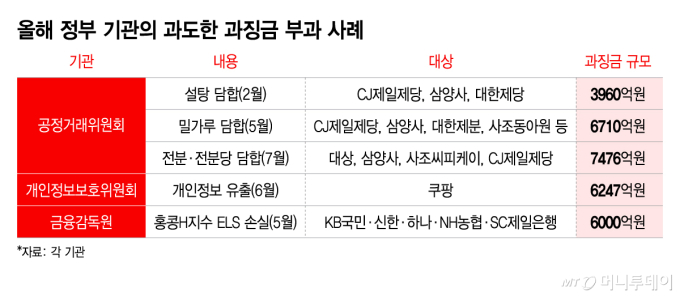
The fines imposed by these institutional investors on companies have exceeded 3 trillion won as of last month, and projections suggest that with major cases awaiting approval by year-end, the total fine amount for this year could far surpass a record-breaking 10 trillion won.
The government's strict punitive approach raises serious concerns that it will force companies to spend astronomical legal defense costs instead of investing in future new industries or creating jobs. While the government aims to enhance the deterrent effect of sanctions, the burden and uncertainty felt by companies will only grow. As the cap on administrative fines rises, companies are more likely to calculate potential sanction sizes before considering profitability and growth prospects. If corporate focus shifts from product development and market expansion to legal review and regulatory compliance, overall ecosystem efficiency will decline.
The main issue is that there are numerous cases where institutional investors' dispositions are overturned by the courts. This has led to a vicious cycle in which penalty fees imposed on companies are refunded due to reasons such as losing administrative lawsuits. According to data obtained from the Korea Fair Trade Commission by Democratic Party of Korea lawmaker Heo Young, penalty fees returned to companies from 2017 through August 2025 totaled 625 billion won.
Even if a court ultimately rules in favor of acquittal or annulment of the penalty, during the years the trial proceeds, the company is branded as an "immoral enterprise," inflicting fatal damage to its brand value. This is also why critics argue that reckless sanctions based on a "do or die" mentality are shaking the very lifeline of corporate survival.
A business circle official warned, "Strict punitive measures taken on a trial-and-error basis often lead to court rulings revoking the penalties or finding the authorities in the wrong, inflicting irreversible financial and reputational damage on companies. It is also likely to result in significant waste of administrative resources and increased litigation costs for the nation."
Excessive fines by the Korea Fair Trade Commission: "Record-breaking fine will soon be broken"
Critics point out that the business burden on companies is increasing due to the Korea Fair Trade Commission's "let's hit them" approach in imposing fines. As more companies challenge the Korea Fair Trade Commission's rulings as excessive, courts are repeatedly overturning the imposition of fines.
According to data received by Song Eon-seok of the People Power Party from the Korea Fair Trade Commission on the 6th, fines imposed by the commission totaled approximately 1.35 trillion won through July this year, reaching four times the annual fine amount of 340 billion won last year. Fines exceeding 1 trillion won were levied in just two cases: sugar collusion (408.3 billion won) and flour collusion (671 billion won).
In particular, the starch and starch sugar collusion case, which has not yet been included in this total because the resolution documents have not been made public, was fined a record-breaking 747.6 billion won for collusion cases.
Interpretations suggest that the expansion of fines by the Korea Fair Trade Commission is not unrelated to the commission's comprehensive investigations, launched under the Lee Jae-myung administration, targeting food items such as sugar and flour, as well as school uniforms and cooking oil, in an effort to stabilize prices. Critics also argue that the Korea Fair Trade Commission has effectively become a price-regulating authority, as it was included among the special management items selected by the government to ensure stability in people's livelihood prices.
Against this backdrop, the level of fines imposed by the Korea Fair Trade Commission is gradually rising. High fines that were once in the range of 100 billion to 200 billion won per single case are now growing in scale, with penalties being levied in the thousands of billions of won. This year alone, multi-billion-won fines have been imposed on collusion cases involving bank LTV (loan-to-value ratio), sugar, flour, printing paper, and starch/starch syrup. The industry widely expects that the record for the highest fine ever imposed by the Korea Fair Trade Commission — 1.0311 trillion won in the 2016 Qualcomm case — will soon be broken.
The actual Korea Fair Trade Commission has introduced a penalty system that raises the lower limit of the surcharge rate for collusion cases from 0.5% to 10%, a 20-fold increase, and sets the minimum surcharge rate for cases involving private benefit acquisition (unfair support and improper benefits provided to special related parties) at 100% or higher. The surcharge standards for sectors such as subcontracting, franchising, and agency agreements have also been strengthened.
The issue lies in the appropriateness of the fines. As companies file more administrative lawsuits claiming that the Korea Fair Trade Commission's decisions are excessive, courts are frequently overturning these rulings.
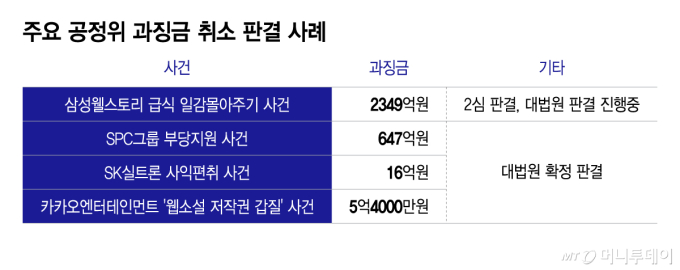
The actual Supreme Court recently issued a ruling canceling the 540th million won fine imposed by the Korea Fair Trade Commission on Kakao Entertainment, citing "web novel copyright abuse."
The Seoul High Court also ruled in April that the Korea Fair Trade Commission's decision to impose a 234.9 billion won fine on Samsung Electronics and other Samsung Group affiliates for funneling in-house cafeteria food supply to Samsung Wellstory should be fully annulled. The Korea Fair Trade Commission has appealed this ruling, and the case is now before the Supreme Court.
Last year, the Supreme Court issued a final ruling canceling a total of 1.6 billion won in administrative fines imposed on SK and Choi Tae-won (Chairman) related to the SK Siltron case of misappropriating corporate benefits. Prior to that, the Supreme Court also fully canceled 64.7 billion won in administrative fines imposed by the Korea Fair Trade Commission on the SPC Group for the improper support case.
This same inadequate handling by the Korea Fair Trade Commission has frequently been pointed out during National Assembly administrative audits. According to Democratic Party of Korea lawmaker Heo Young, from 2017 through August last year, the cumulative amount of fines returned to companies by the Korea Fair Trade Commission due to losses in administrative lawsuits or ex officio cancellations (recycled funds) reached 624.7 billion won. Refund surcharges with interest characteristics also amounted to 47.4 billion won.
Industry and legal circles criticize the Korea Fair Trade Commission for imposing excessive fines with a "strike first, leave it to the courts later" approach.
A former official from the Korea Fair Trade Commission stated, "Since the Korea Fair Trade Commission performs a role akin to that of a first-instance court, it is necessary to issue responsible penalties while carefully reviewing legal principles and considering past rulings."
"100 Employee Investigations, Request for 10 Years of Data": The 'Reaper of the Business World' Goes on a Rampage
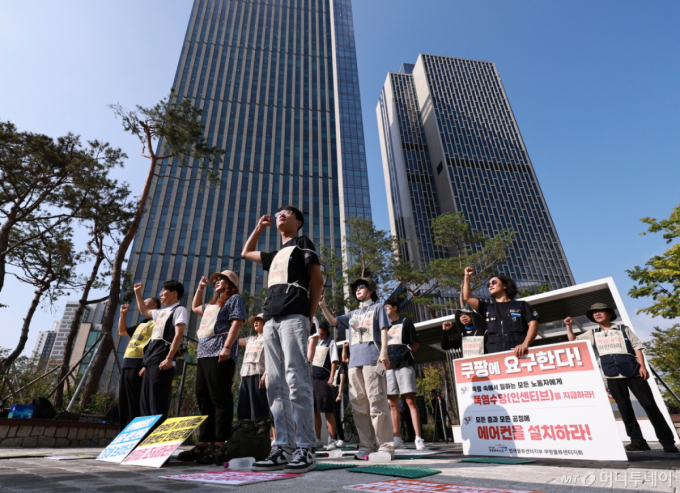
#. On the 1st, more than 30 investigators from the Fair Trade Commission launched a surprise on-site inspection at Coupang's headquarters in Gwangjin-gu, Seoul. The pre-notification procedure required under the Fair Trade Act was skipped due to suspicions of violations. Such a large-scale deployment of investigative personnel to a single company is unprecedented. The inspection took place the day before the hearing date for a lawsuit filed by Coupang with the court last month, challenging the legality of the Korea Fair Trade Commission's on-site inspection procedures. Inside Coupang, terms such as "retaliatory investigation" and "cracking down" were used.
On the 21st of last month, an unprecedented incident occurred in which e-commerce giant Coupang blocked a on-site investigation by the Korea Fair Trade Commission, dubbed the "grim reaper of the business world." Coupang, which refused to cooperate with the Korea Fair Trade Commission's investigation, also filed a lawsuit for cancellation at the court. This action stands in stark contrast to its previous active cooperation with government regulatory institutional investors' investigations.
This is interpreted as the result of long-simmering conflicts between both sides exploding into open confrontation. Even considering the risks associated with Coupang's rapid growth in the domestic market within a short period, the company's internal atmosphere holds that the government's high-intensity joint investigation and the level of administrative fines imposed are excessive. In fact, Coupang Inc., the U.S. parent company, testified to these contents during hearings before the U.S. Congress, escalating the issue into a diplomatic conflict between the two nations.
Since the customer data breach incident erupted at the end of last year, the Jamsil office building that once served as Coupang's headquarters has been nicknamed "Mini Sejong City." This is because the government, which formed a joint investigation team, deployed hundreds of personnel to conduct on-site investigations. Almost all regulatory institutional investors participated, including the Korea Fair Trade Commission, the National Tax Service, the Personal Information Protection Commission, and the police, excluding the Prosecution Service.
During this period, the Korea Fair Trade Commission assembled a large-scale team centered on its Market Surveillance Bureau to conduct intensive investigations. The investigation team conducted more than 100 interviews with Coupang employees and, in addition to the data breach incident, simultaneously investigated matters related to the Monopoly Regulation and Fair Trade Act and the Large-Scale Retail Store Act, requesting hundreds of documents. It is reported that some departments were asked for records spanning ten years. Inside the company, reactions ranged from "it seems like a separate investigation."
In fact, various punitive sanctions against Coupang were subsequently implemented. In June, the Korea Fair Trade Commission imposed a fine of 624.7 billion won for the data breach incident, and in the same month, the National Tax Service notified Coupang Inc. to pay an additional tax amounting to $208 million (approximately 300 billion won) through a tax audit of its Korean subsidiary. In the second half of this year, it is expected that the Korea Fair Trade Commission will impose a fine in the range of 200 billion won for allegations of bundled selling and other violations.
Since the second half of last year, the total amount of administrative fines and taxes imposed on Coupang for over a year has exceeded 1 trillion won. Even if an administrative lawsuit is filed, the structure requires payment first followed by reimbursement, inevitably causing disruptions in fund management. In particular, delays in building domestic and international Rocket Delivery logistics networks requiring large-scale additional investments could slow down the company's growth, raising concerns about negative side effects such as a contraction in local employment, reduced order volumes for small and medium-sized suppliers, and delayed payments to them.
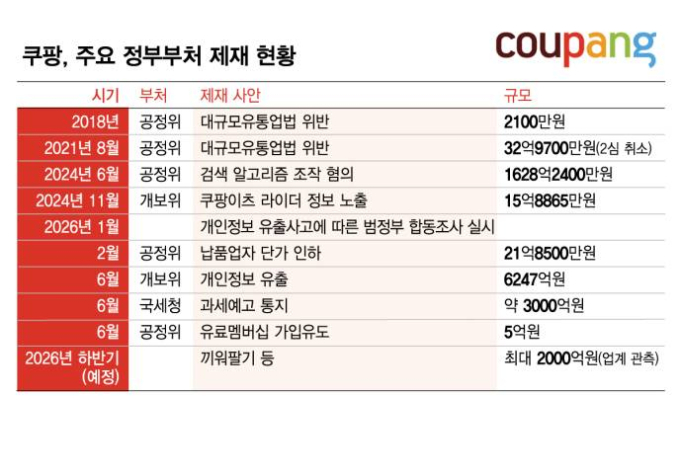
The scale of economic sanctions against Coupang has increased noticeably since the current administration took office. In June 2024, a fine of 162.8 billion won was imposed on Coupang for allegedly manipulating search algorithms for its private label (PB) products, marking the largest single-case penalty ever levied against the company up to that point. The previous largest fine was approximately 3.2 billion won in August 2021 for violations of the Large-Scale Retail Store Act; however, Coupang won both levels of administrative litigation regarding that case and received a full refund.
Industry sources say that while the scale of Coupang's administrative fine has increased by dozens of times compared to before, partly due to the company's growth in sales volume, it cannot be ignored that the company also took a confrontational stance with the government through its own investigation and announcement of compensation plans following last year's data breach.
In particular, since the Korea Fair Trade Commission holds immense authority to adjust the level of sanctions by overseeing investigations and first-instance rulings from on-site inspections through to plenary meeting decisions, it is widely believed that companies have no alternative but to adopt a 'low-key' strategy to minimize risks.
President Lee Jae-myung previously stated that "punitive sanctions of a high intensity are needed, to the extent that companies could collapse if they commit violations such as large-scale personal information leaks, repeated industrial accidents, and unfair trade practices—going beyond criminal punishment." The Korea Fair Trade Commission and other government regulatory bodies are expected to continue their stance on imposing stringent penalties.
National Tax Service announces first-half tax audits surge fourfold year-on-year; tax disputes also rise
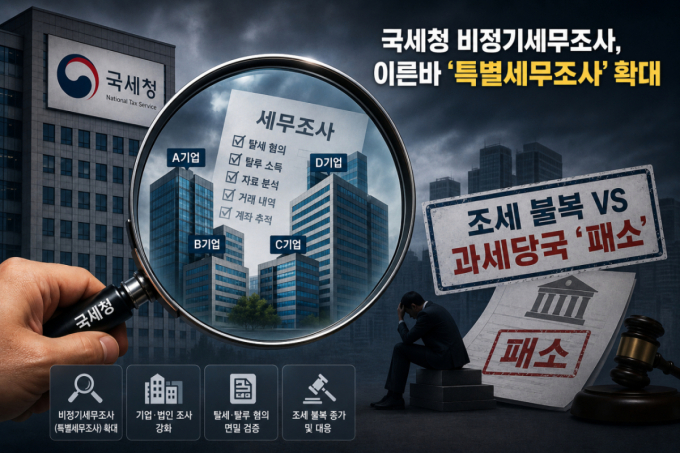
It has been confirmed that the number of irregular tax audits (special investigations) conducted by the National Tax Service from 2023 to 2025, covering the recent three years, has increased. Press releases related to tax audits also rose to approximately four times the previous year's level in the first half of this year alone.
While there is a positive view that the government will meticulously investigate allegations of illegal tax evasion by companies, there is also significant backlash against the mass tax audits conducted with a "hit first and see" approach. This is why tax dispute lawsuits are following one another. Furthermore, as courts continue to rule in favor of taxpayers in these disputes, the reputation of the tax authorities is being tarnished.
According to the National Tax Service, irregular tax audits increased from 2,928 cases in 2023 to 3,095 in 2024 and 3,323 in 2025.
In particular, the number of public disclosures (announcements) related to tax audits by the National Tax Service in the first half of this year surged to nearly four times that of the same period last year. This change occurred after Lee Jae-myung assumed office and the leadership of National Tax Service Commissioner Im Kwang-hyun began. The number of regular and irregular tax audits conducted by the National Tax Service in the first half of this year has not yet been released.
However, even looking only at the number of press releases related to tax audits published on the National Tax Service website, there is a clear difference from the first half of the previous year.
Under the leadership of former National Tax Service Commissioner Kang Min-soo, who emphasized rigorous tax audits with a clear directive to "investigate properly," there were only three announcements and press releases regarding tax audits in the first half of 2025. Typically, audit bureau briefings, where audit bureaus carefully examined cases before disclosing results, occurred once per quarter on an issue-by-issue basis.
Subsequently, the expansion of rigorous tax audits was already anticipated when Im Kwang-hyun, known as a "tax audit veteran" who served six times in various positions including Jo Sa (Director), took office in July last year, alongside the so-called "grim reaper of the business world," Director Joo of the Tax Investigation Division 4.
This is evident as tax audit briefings and press releases from July to the end of last year totaled six, a sharp doubling compared to the first half of the previous year. Immediately upon taking office, the administration launched an expansion of tax audits. This year alone, 12 announcements related to tax audits were made through early September.
The National Tax Service has continued to apply warning pressure regarding suspected tax evasion through messages about the disclosure of investigation details. In this context, the increase in public "show of force" (announcements) related to tax audits serves as evidence that the level of cracking down on illegal corporate activities is rising. Strict investigations into illegal acts are something to be welcomed.
The problem is that the tax audit announcement was made hastily. When Cheong Wa Dae sends a message on a specific issue, the National Tax Service immediately follows up with the initiation and announcement of results of a tax audit. While it may seem understandable in terms of aligning policy support with government messaging, criticism arises that such frequent immediate responses appear to focus too heavily on the government's direction.
The same applies to the Public Procurement Corruption Briefing released by the National Tax Service on the 3rd. Ten days after President Lee Jae-myung held his first Anti-Corruption Policy Coordination Meeting (on the 21st of last month) and ordered a comprehensive response to various forms of corruption, including public contract corruption and improper subsidy receipt, the National Tax Service hastily inserted a briefing on public corruption bidding into its weekly plan that was not originally scheduled. It appears that after Cheong Wa Dae issued a message, the National Tax Service responded once again.
A National Tax Service official explained, "The investigation is already ongoing continuously, just like previous investigations," and added, "It was simply omitted from the weekly plan due to a staff member's oversight; there was no rush to include a briefing."
Since the Lee Jae-myung administration took office, the National Tax Service has consistently responded immediately following messages from Cheong Wa Dae.
Since the second half of last year, there have been cases where the National Tax Service immediately launched investigations following messages from Cheong Wa Dae, including tax audits on stock market unfair tax evaders (July), foreign tax evaders acquiring high-priced apartments in Gangnam 3 Districts (August), tax evasion in industries closely linked to daily consumer prices under the pretext of rising raw material costs (September), tax audits on ultra-high-priced homes in the Han River Belt (October), ticket scalpers (November), and market-disturbing price-fixing activities (December).
This year, from the investigation into the inheritance practices of large bakeries in January to the announcement of the Emperor's Residence survey in August, all releases were made immediately following the Cheong Wa Dae message throughout the first half of the year.
This is a stark contrast to the National Tax Service, which quietly operated within its one-year plan last year. The reason for criticism that it may be moving too in lockstep with the government, rather than being viewed positively as conducting rigorous tax audits, lies here.
In this situation, lawsuits challenging the tax assessments and defeats for the tax authorities are also occurring one after another.
For instance, a court ruled this year that the tax authorities must cancel approximately 12.9 billion won in taxes levied on SM Entertainment. The National Tax Service lost the corporate income tax lawsuit, which was based on the authorities' argument that the amount paid to former chief producer Lee Soo-man was too large.
In the case of Netflix Korea, although the first-instance loss does not constitute a final ruling, it secured a court decision canceling 68.7 billion won out of the 76.2 billion won in taxes imposed. Google Korea also won its second-instance administrative lawsuit challenging corporate taxes exceeding 150 billion won filed in May this year. In a corporate tax lawsuit exceeding 310 billion won filed by Oracle Korea against the National Tax Service, the National Tax Service lost, resulting in reputational damage.
An industry insider pointed out, "While we support the National Tax Service's strict tax audits on various issues facing companies and individuals, rushed investigations and public announcements can also become a burden for the National Tax Service." The insider added, "If pushed too hard, loopholes may be discovered, ultimately leading to appeals and defeats—a painful boomerang that could backfire."
Meanwhile, another official from the National Tax Service explained, "As an institutional investor responsible for enforcing tax laws, we conduct tax audits consistently at all times in accordance with the law and principles." They added, "However, to firmly convey a message of strong response against loopholes and tax evasion and to prevent the psychology of tax evasion, we periodically inform the public about tax audit-related matters."

 in LIVING


