

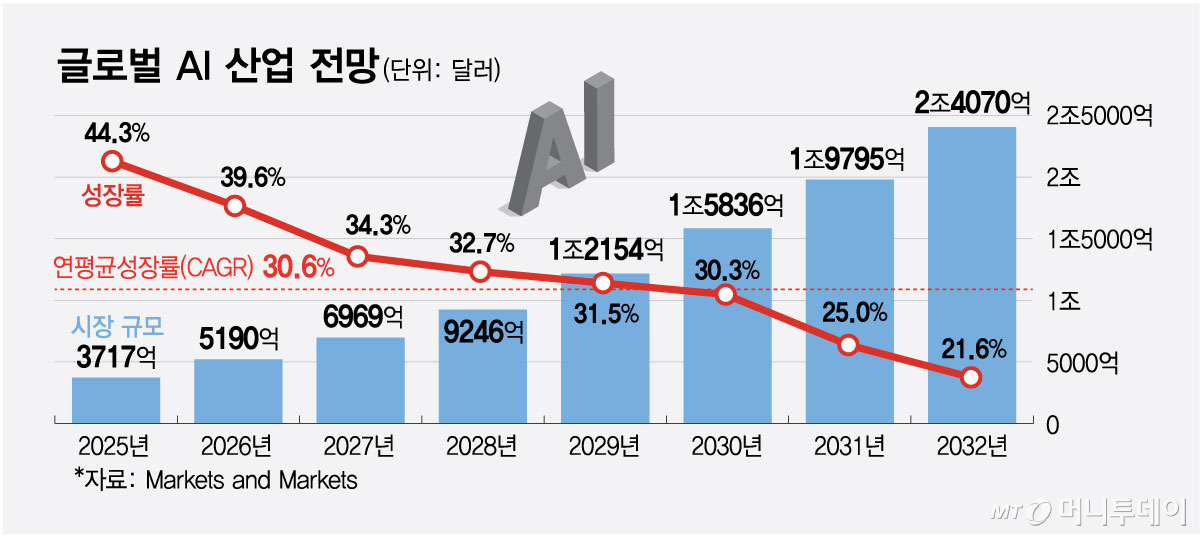
The global AI (artificial intelligence) market is a "hyper-growth" market projected to expand at an annual average rate of more than 30% over the next five years. At the same time, it exhibits a "winner-takes-all" characteristic, making it difficult for laggards to catch up once they fall behind the leading group. The government's rush to push forward three mega-projects—semiconductors, AIDC (AI data centers), and physical AI—reflects a sense of crisis that failing to ride this growth wave could cost South Korea its growth engine.
According to an AI industry outlook released on the 26th by market research firm Markets and Markets, the global AI market size is projected to reach $2.407 trillion (approximately 3,203 trillion won) by 2032. Compared with last year's estimated AI industry scale of $371.7 billion (approximately 495 trillion won), this means the market will grow six and a half times in seven years.
The AI market is characterized by technology gaps translating directly into competitiveness. It requires massive capital investment in areas such as GPUs (graphics processing units), data centers, and power infrastructure. Moreover, it features a "cyclical" structure in which once a specific model secures high-quality data and users, it can produce even better models. Limited production factors, including high-performance chips, top-tier talent, and high-quality training data, also serve as barriers to entry that hinder the pursuit by latecomers.
According to the OECD (OECD), the AI infrastructure market is characterized by rapid innovation but high barriers to entry and concentration. NVIDIA's market share in AI GPUs is estimated at over 80%, while in some segments of the supply chain, the top three companies account for more than 60% of the market share.
The government's announcement in June this year that it would push forward three mega-projects to enter the global top three in AI is also interpreted as stemming from the judgment that falling behind in today's AI market will inevitably widen the gap with the leading group. It signifies that, given South Korea's economy already possesses semiconductor production capacity and high-quality power infrastructure, it can expect high added value in the AI data center and AI semiconductor manufacturing industries.
Deputy Prime Minister and Minister of Science and ICT Bae Kyung-hoon stated during the 2026 National Audit that "we will further solidify our position as one of the top three AI powers," emphasizing that "the three mega-projects—AI data centers, physical AI, and semiconductors—are core areas that will change the landscape of our economic growth in the AI era."
[Production Support: Ministry of Culture, Sports and Tourism Public-Centered Communication Activation Project]

 in TECH
