

As more foreign tourists visit and spend in provincial areas, the locations for retail store openings are also changing. The trend involves expanding offline LINE stores, previously concentrated in Seoul, to major commercial districts in non-metropolitan areas frequently visited by foreigners, such as Busan and Jeju. Retailers are selecting specific commercial zones where external transient populations, including tourists and people in their 20s and 30s, gather, rather than basing decisions on the total population or consumption scale of the entire province.
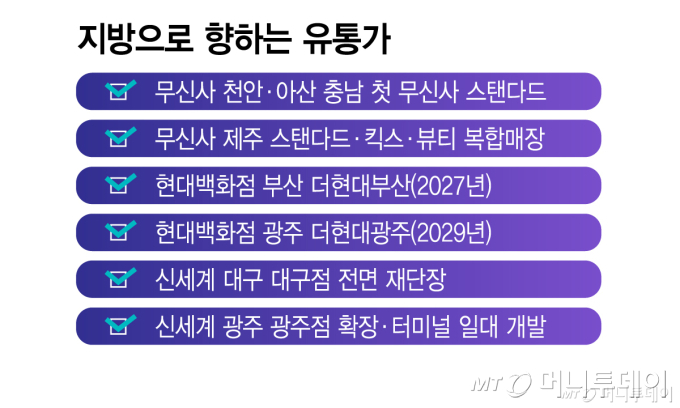
According to the retail industry on the 22nd, Musinsa plans to open a Musinsa Standard and Kick's complex store in Jeju Topdong within this year, alongside a approximately 90-pyeong (about 300 square meters) Musinsa Beauty store. The stores will combine fashion, footwear, and beauty products to target shopping demands from domestic and international tourists visiting Jeju.
Performance is also emerging at Musinsa Standard's non-metropolitan area stores. From January to August this year, combined sales of eight non-metropolitan stores (excluding the Cheonan Asan branch) increased by approximately 44% compared to the same period last year. During the same period, over 4.5 million out of a total of 27 million visitors visited regional hub stores, and the proportion of foreign buyers at the Busan Seomyeon store rose to about 30%, an 11 percentage point increase from one year ago. Currently, nine out of 43 stores are located in non-metropolitan areas.
Other retail companies are also opening large-scale stores in provincial commercial districts frequently visited by tourists. CJOlive Young opened a store covering approximately 900 pyeong (about 3,000 square meters) in Busan Nampo-dong on the 28th of last month. IKEA also opened an urban-type store covering about 300 pyeong (about 1,000 square meters) at Shinsegae Department Store Daegu branch on the 17th.
The retail sector's renewed focus on non-metropolitan areas is also driven by increased consumption by foreigners in provincial regions. According to the Korea Tourism Organization, the number of foreign tourists entering through provincial airports such as Gimhae, Daegu, Cheongju, and Jeju reached 2.38 million from January to July this year, a 39.7% increase compared to the same period last year. During the same period, foreign consumption in non-metropolitan areas amounted to 1.4434 trillion won, a 57% increase.
However, an increase in tourists does not necessarily lead to sales growth across all provincial commercial districts. If visitors only pass through as transit points for travel to other regions, it is difficult to translate into local consumption. This explains why retail companies prioritize whether tourists actually stay and shop when selecting store locations. Commercial districts with consistent tourist visits, such as Busan and Jeju, are representative examples.
Lower operating costs for stores in provincial areas compared to Seoul is another factor driving expansion. According to the Korea Real Estate Board, the average monthly rent per square meter for the first floor of large-scale commercial buildings in central Seoul during the second quarter this year was 56,700 won, higher than Busan's 30,100 won, Daegu's 21,700 won, and Gwangju's 21,500 won. The rent difference has a greater impact on store opening costs for experience-type stores that require larger spaces.
The department store industry is also continuing investments in key commercial districts outside the metropolitan area. Hyundai Department Store plans to launch De-Hyundai Busan next year, followed by Gyeongsan Premium Outlet in 2028 and De-Hyundai Gwangju in 2029. Shinsegae Department Store is also proceeding with a complete renovation of its Daegu branch and expansion and complex development of its Gwangju branch.
A retail industry official stated, "We are not simply increasing store openings just because it is a provincial area." They added, "We are reviewing store locations based on commercial districts where external transient populations, including tourists and young consumers, consistently flow in and can lead to actual store visits."

 in LIVING
