

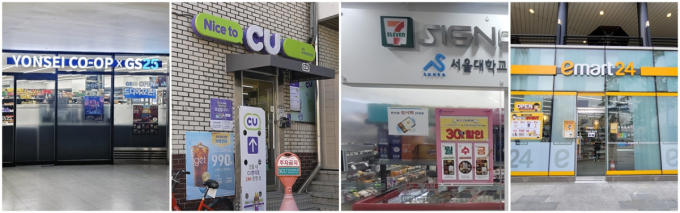
The convenience store industry is engaged in fierce territorial competition over university campuses. The brands entering each university vary, resulting in a clear distinction of the "dominant convenience store" on each campus.
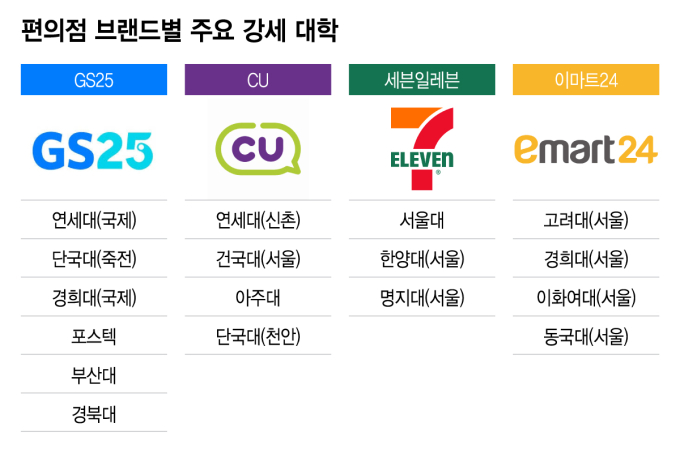
According to the distribution industry on the 5th, GS25 operates 206 stores within university campuses nationwide. CU operates approximately 300 stores, 7-Eleven has 95, and E-Mart24 runs 119 stores. While CU has the highest number of stores across all universities nationwide, the brand presence varies significantly when looking at individual universities.
Convenience stores on university campuses are operated through methods such as individual bidding, where brands bid separately for each store, and bulk bidding, where a specific brand secures operating rights for multiple stores within a campus.
Looking at the entry status by major university, 7-Eleven holds the most stores at Seoul National University with eight. At Korea University’s Anam Campus, E-Mart24 has the most with five stores, while CU operates 10 stores at Yonsei University’s Sinchon Campus.
In addition, GS25 holds the most stores at institutions such as POSTECH and Dankook University’s Jucheon Campus, while CU shows strong presence at Konkuk University’s Seoul Campus and Ajou University. 7-Eleven operates a relatively high number of stores at Hanyang University’s Seoul Campus, and E-Mart24 has a significant presence at Kyung Hee University’s Seoul Campus, Ewha Womans University, and others.
There are also cases where specific brands take charge of convenience store operations within a campus through bulk bidding. GS25 operates all three stores at Yonsei University’s International Campus (Songdo). CU is operating 13 stores at Dankook University’s Cheonan Campus.
University campuses have distinct seasons for the start of terms and vacations, as well as clear daily routines, making them special commercial areas with significant sales fluctuations depending on the time period and hour. Nevertheless, the convenience store industry evaluates university campuses as attractive commercial zones. This is because they can achieve higher sales than regular stores during the term-start period when student foot traffic is concentrated. In fact, sales during the term-start period were found to be up to four times higher compared to regular stores.
However, since student demand decreases during vacation periods, it is important to achieve high sales during the term while reducing the operational burden of the off-season. To this end, the convenience store industry has introduced unmanned and HYBE-lead operating models at university campuses to reduce labor costs and defend profitability during the off-season.
University campuses are also utilized as spaces to test new retail tech. This is because they can apply new technologies and services, such as unmanned payment, to college student customers who are familiar with digital devices and non-face-to-face services, and verify operational results.
An industry official stated, "Universities are a representative commercial area with high potential customer demand, and the actual performance is good," adding, "Operational experience accumulated at university stores can be expanded and applied to other commercial areas and stores."
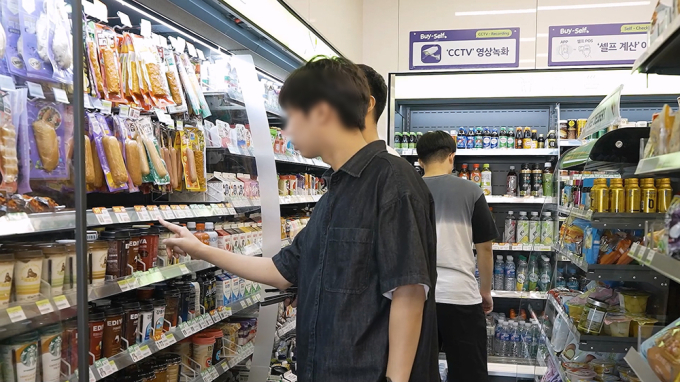
Convenience stores within universities are drawing attention as spaces to glimpse the consumption tendencies of Generation Z. This is because, in addition to cost-effective simple meals that reduce price burdens, sales of recently trending products significantly exceed those of regular stores.
According to the distribution industry on the 5th, it was found that sales of simple meals at university stores of major convenience stores such as GS25, CU, 7-Eleven, and E-Mart24 are two to a maximum of ten times higher than the daily average of regular stores. In fact, at a GS25 store located in a university in Seoul, an average of 200 bento boxes were sold per day during the term.
Sales performance for other food items besides bento boxes is also high. At university stores of the four convenience store companies, sales of noodle products such as ramen were found to be more than twice as high as regular stores. Bakery items, salads, and cut fruits are also popular products, recording sales volumes two to three times higher than regular stores. In particular, while energy drinks sell steadily as usual, demand rises significantly during exam periods, ranking within the top two in sales.
Not only food, but sales performance for recently trending products is also remarkable. Representative examples include keyrings, keycap goods, and waxpebbles, which have gained popularity among young consumers. In fact, at GS25’s university stores, the daily average sales of these products were found to be approximately 17 times higher than regular stores. At 7-Eleven’s university stores, sales volumes of Kadayif Chewy Choco Balls and KBO Pro Baseball collection cards were also more than 2.5 times higher compared to regular stores.
These consumption characteristics are also seen in beauty products. Amid growing interest in K-beauty, sales of beauty and clothing items at university convenience stores are three to ten times higher than regular stores.
The industry analyzes that the sales performance of university convenience stores simultaneously reflects Generation Z’s price sensitivity and interest in trends. It is explained that as high prices persist, with meal prices at university cafeterias approaching 7,000 won, convenience store simple meals that can solve a meal for around 4,000 won are emerging as an alternative. Along with this, high demand is also seen in non-food areas such as recently trending goods and beauty products, revealing consumption characteristics unique to university convenience stores.
An industry official said, "Many college students have not yet started full-time economic activities, so they are price-sensitive and prefer cost-effective products," adding, "Since they are also sensitive to trends, university convenience stores can be seen as a barometer showing the trends of young consumers."
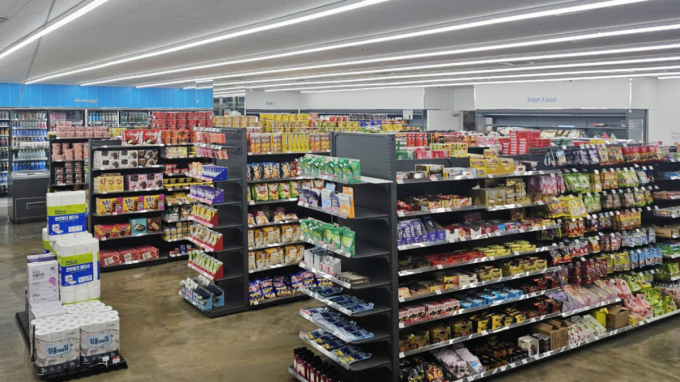
The convenience store industry is deploying campus-specific store operation strategies to secure college student customers, who can help understand Generation Z consumption trends. They are differentiating themselves not only by securing ample dining spaces but also through product assortments and store configurations tailored to the demands of each university.
According to the distribution industry on the 5th, four convenience store companies—GS25, CU, 7-Eleven, and E-Mart24—are differentiating their store spaces and product assortments to reflect the characteristics of the university commercial area. First, GS25 installs more refrigerated showcases than regular stores to increase the display volume of simple meals. Maximizing dining space within the store is also a feature distinct from regular stores.
CU specializes in targeting women’s universities, where a clear target demographic of women in their 20s is concentrated. A characteristic feature is concentrating products aimed at this demand in convenience stores within women’s universities such as Ewha Womans University. For simple meals, they focus on placing low-salt triangle kimbap, low-fat kimbap, and protein bento boxes, and stock salads at more than 60% of the level found in regular stores. The beauty corner features basic and functional cosmetics, skincare, beauty accessories, and sanitary products to reflect the consumption trends of young women.
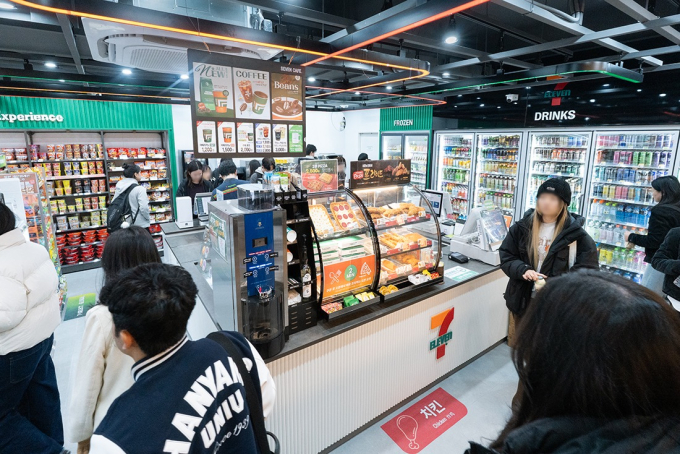
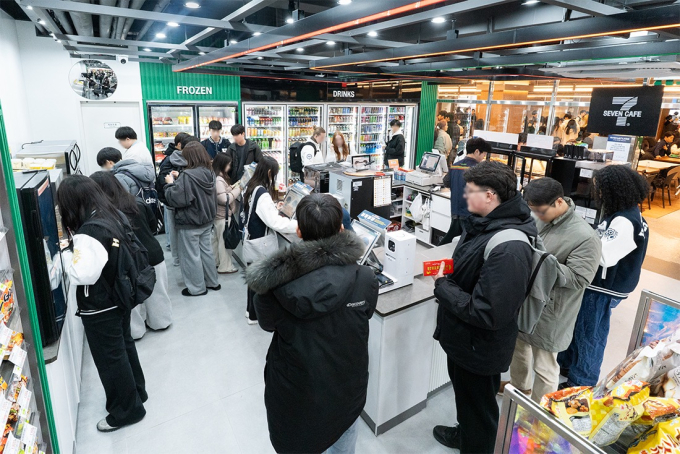
7-Eleven has also launched university-specific stores. A representative example is the "New Wave Hanyang University Plaza Store" opened within Hanyang University’s Seoul Campus. It has set up a food station selling square-shaped chicken, ready-to-eat pizza, and roasted sweet potatoes, and additionally placed four self-checkout counters around the counter to respond to payment demand concentrated at specific times. Ramen shelves have been increased threefold compared to regular stores. It also places products aimed at Generation Z demand, such as IP (intellectual property) collaboration items and daily beauty products.
E-Mart24 is characterized by its cooperation with university Student Cooperatives (Sokyo). It operates "COOPSKET" stores in partnership with the College Student Cooperative, alongside its own brand. COOPSKET is a cooperation model being promoted for 35 universities registered with the College Student Cooperative. Its feature is combining E-Mart24’s products, marketing, and operating systems while maintaining the brand identity of the College Student Cooperative. E-Mart24’s HYBE-lead store operation know-how is also applied to COOPSKET stores. They operate with staffed service during the day and unmanned service late at night to enhance convenience for students.

 in LIVING


