

"Sold on Hallyu, What's Next?"… Key to K-Brands' "Local Settlement" Overseas
-Expert Advice
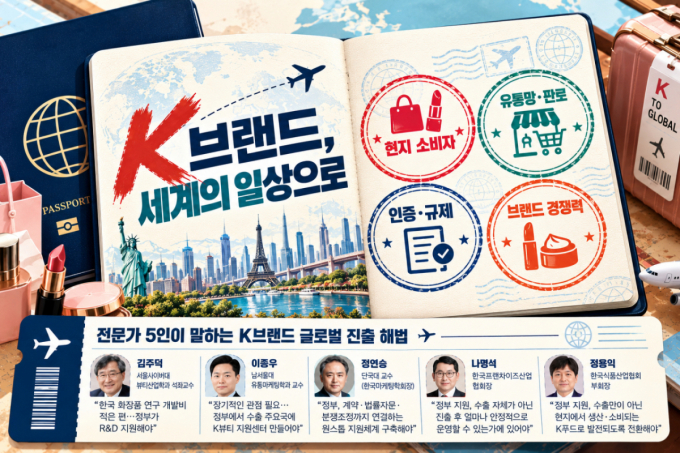
As the K-Wave (Hallyu) expands into a "K-Initiative" (initiative·leadership) in K-food, fashion, beauty, and retail, "localization" is cited as a key challenge for the sustainable growth of K-brands. Experts emphasized that while maintaining the identity of Korean brands, product and production, distribution, and operational methods must be tailored to each country's consumer culture and business conditions. They suggested connecting the interest generated by Hallyu into repeat purchases and urged the government to support settlement after overseas entry.
According to industry sources on the 8th, cosmetics exports from January to September this year totaled $11.1 billion, a 31.1% increase from the same period last year, marking the highest cumulative total for the third quarter in history, based on preliminary data from the Ministry of Food and Drug Safety. In the "2025 Survey on Overseas Expansion of Food Service Companies" by the Ministry of Agriculture, Food and Rural Affairs and the Korea Agro-Fisheries & Food Trade Corporation, the number of overseas stores operated by domestic food service companies increased by 922 (24.8%) in five years, from 3,722 in 2020 to 4,644 in 2025. This serves as evidence that demand for K-brands is rising across the global market every year.
◆ "Next K-Food is Sauces and Convenience Foods"… Store Management Capability Also a Challenge
Experts suggest that strategies for long-term growth are needed. First, the localization challenge for K-food is to establish Korean cuisine as a menu item that consumers in each country regularly enjoy. Na Myung-seok, Chairman of the Korea Franchise Association, said, "Interest formed through Hallyu is leading to actual consumption by people worldwide and the growth of food service brands," adding, "It has begun to establish itself not just as a one-time experience of Korean food, but as a category for daily meals and snacks."
To this end, it is explained that the range of product groups frequently consumed in daily life must be expanded. Jeong Yeon-seung, Professor at Dankook University Gyeong Yeong-hak-bu (Prof.) (Korean Ma Ke-ting-hak (Chairman)), said, "Items such as sauces, convenience foods, frozen foods, and health foods that local consumers can purchase repeatedly on a daily basis will become the 'Next K-Food,'" adding, "A strategy to let people experience Korean taste and food culture together in connection with K-content is important."
Production and supply methods also need to be adjusted to fit the market. Jeong Yong-ik, Vice Chairman of the Korea Food Industry Association, said, "Rather than relying solely on exporting finished products made in Korea, we must pursue methods suitable for each market's conditions, such as local production and licensing." He emphasized that while maintaining Korean identity, products must be developed to suit each country's taste and food culture. This means possessing a taste that other brands cannot easily imitate along with the ability to adapt to local lifestyles.
The food service industry must also possess operational capabilities to implement consistent quality at each store, alongside changing menus. Although the number of overseas stores has increased, the same survey showed that the number of companies expanding overseas decreased from 134 in 2020 to 122 in 2025, and the number of brands dropped from 147 to 139. Last year, these companies entered 56 countries. To continue the results of store expansion, a model is needed that allows for consistent store operations tailored to business conditions in each country.
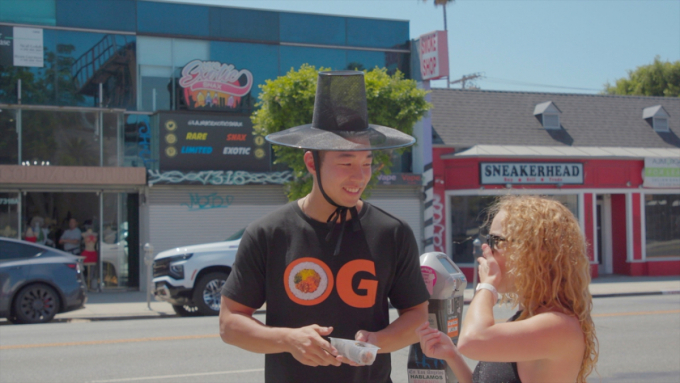
◆ K-Beauty Exports at Record High… "Must Overcome Certification and Tariffs"
K-beauty also faces the challenge of connecting export growth to long-term customer acquisition. According to the Ministry of SMEs and Startups, SME (small and medium-sized enterprise) cosmetics exports in the first half of this year were $5.07 billion, a 30.7% increase from the same period last year. It is pointed out that to maintain this growth trend, consumer preferences by country must be reflected in products and marketing, and responses to certification and regulations are necessary.
Lee Jong-woo, Professor of Distribution Marketing at Seoul National University, said, "Understanding of concepts, marketing, local consumers, and trends determines success or failure." It is explained that cosmetics used directly on the skin have high consumer sensitivity, and brand value has a significant impact on purchases. The professor stated, "Currently, the European market is noteworthy, but the key is meeting local certification procedures and the high standards of discerning consumers."
When entering new markets, trade conditions affecting price competitiveness must also be examined. Mexico raised tariffs on some items from countries without Free Trade Agreements (FTAs), such as Korea, starting in January this year. The professor said, "Since Mexico is a market with intense interest in K-beauty, the government should focus its diplomatic efforts to achieve tariff exemptions there."
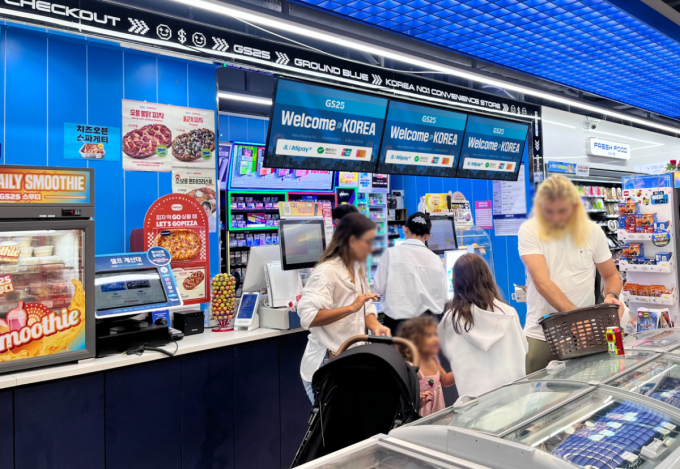
◆ Regulation is Key for Retail… Government Support Also Focuses on "Sustained Operations"
Localization in retail and franchising begins with reflecting consumer purchasing habits and logistics/payment infrastructure. Professor Jeong said, "Rather than simply bringing over successful retail models from Korea, product and store operation models and logistics systems should be standardized but adjusted to local characteristics," adding, "Building key countries as bases and gradually expanding to neighboring countries is also a method." He proposed an "omnichannel" strategy in Southeast Asia, where the online market is active, connecting offline stores, online platforms, and logistics/payments to allow consumers to conveniently move between multiple channels.
Country-specific retail regulations, foreign investment restrictions, and licensing systems must be reviewed from the business design stage. Professor Jeong emphasized that when entering via Master Franchise (MF) or Joint Venture (JV) methods, one must verify the partner company's credibility, financial status, and legal risks, and clearly define the decision-making structure. It is explained that establishing a system to operate stably with local partners is as important as selling products well.
Criteria for selecting entry countries and products must also be clear. Na (Chairman) said, "If the brand's core value disappears or operating costs become excessively high during the process of local entry, it is rational to reconsider the entry market or product composition." This implies that brand identity and profitability should be considered together even in the process of expanding markets.
There are also suggestions that the goals and evaluation criteria for government support should reflect operational performance after entry. Na (Chairman) said, "The top priority goal of government support should be how stably K-brands can operate after entry." Indicators for evaluating this include local sales, along with royalties, service fees, and exports of domestic sauces and food ingredients.
Opinions also emerged that practical support should be expanded to help companies adapt to each country's systems. Professor Jeong said, "If the government provides information on local companies' credibility and financial/legal data, and connects standard contracts, legal advice, and dispute resolution, trial and error can be reduced." Kim Ju-deok, Chair Professor of the Beauty Industry Department at Seoul Cyber University Graduate School, said, "Because regulations differ by country, the government's role in providing local information and responding to regulations is important," adding, "In particular, for K-beauty, support for Research and Development (R&D) costs must be strengthened."
"K-Brand Export Market Expands"… Government to Increase 'K-Consumer Goods' Budget by 2-3x Next Year
-2027 Budget Proposal Reflecting Will to Activate K-Brands
"K-pop fandoms are growing into K-beauty maniacs. K-drama ratings are boosting K-food sales rates. We will ensure K-content permeates the world more broadly and deeply."
President Lee Jae-myung emphasized the linkage between K-content and industry in his New Year's address this year, stating that "culture is the economy and future food source, and a core pillar of national competitiveness." The strategy is to connect the interest led by the popularity of Hallyu content such as K-pop and K-dramas to Korean consumer goods like K-beauty and K-food into exports.
The government included K-food export vouchers, overseas logistics infrastructure, cultivation of K-consumer goods companies, and restructuring of the export support system in next year's budget proposal. It expanded the scope of policy support by assisting the entire export process, from product discovery to market opening, logistics, and finance.
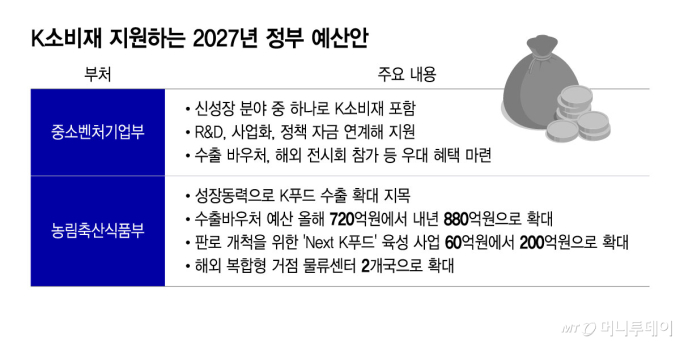
Support for K-brand consumer goods companies was specified in next year's budget proposal. The Ministry of SMEs and Startups (Ministry of SMEs and Startups) plans to discover innovative companies in the K-consumer goods sector and provide bundled support including R&D, commercialization, and policy funds. This goes a step further than the previous method where companies applied for support for overseas exhibition participation fees or marketing costs. It is a structure that links support according to growth stages from securing competitiveness to overseas entry.
![[Mexico City=NEWSIS] Reporter Kim Jin-a = President Lee Jae-myung and First Lady Kim Hye-kyung listen to an explanation by Binglee CEO Kim Gwang-soo at the K-Expo Binglee exhibition hall held at the Mexico City World Trade Center (WTC) on the 25th (local time). September 26, 2026.](https://thumb.mt.co.kr/cdn-cgi/image/f=avif/21/2026/10/2026101222492573794_5.jpg)
The "K-Export Strategic Items" cultivation project operated by the Ministry of SMEs and Startups this year also shows this policy direction. The Ministry of SMEs and Startups recently selected 188 companies in four major consumer goods sectors: beauty, fashion, life, and food. It provides customized programs for each sector utilizing the infrastructure and networks of large retailers such as Shinsegae Department Store, Musinsa, Lotte Mart, Gmarket, and Olive Young.
The Ministry of Agriculture, Food and Rural Affairs presented K-food export expansion as one of the future growth drivers in its budget proposal. The export voucher budget will increase from 72 billion won this year to 88 billion won next year, and the "Next K-Food" cultivation project for opening markets in promising areas will expand from 6 billion won to 20 billion won. The number of support targets will also expand from 100 to 200.
Support is also being prepared to reduce financial burdens such as logistics costs incurred during the export process. To connect the supply of domestic food ingredients to overseas Korean restaurants with agricultural and food exports, the Ministry of Agriculture, Food and Rural Affairs will introduce a "K-Food Ingredient Overseas Entry Support Fund" of 136 billion won. It plans to expand overseas complex hub logistics centers from one country to two and increase the budget from 5 billion won to 10 billion won to reduce storage and transportation burdens.
Financial support for company scaling will also be added. The agricultural and food fund of funds (Korea venture fund) will expand from 50 billion won to 55 billion won, and a 30 billion won scale-up fund will be introduced to help with production facility expansion and scaling for fund of funds (Korea venture fund) graduate companies, etc.
A retail industry official said, "It is a completely different issue whether a K-brand becomes a topic once overseas or settles stably in local distribution networks," adding, "To lead to actual export expansion, support must extend beyond initial promotional costs to include local logistics and inventory management, accumulating sales data after entering distribution networks, and supplying follow-up quantities."
[Visiting the Frontlines of K-Initiatives Riding the 2026 K-Wave] General Overview (Part 1)
Mandu with Abalone a Hit in the US… "Will Lead $1 Trillion in Exports" The Secret to K-Brands

 in LIVING


