

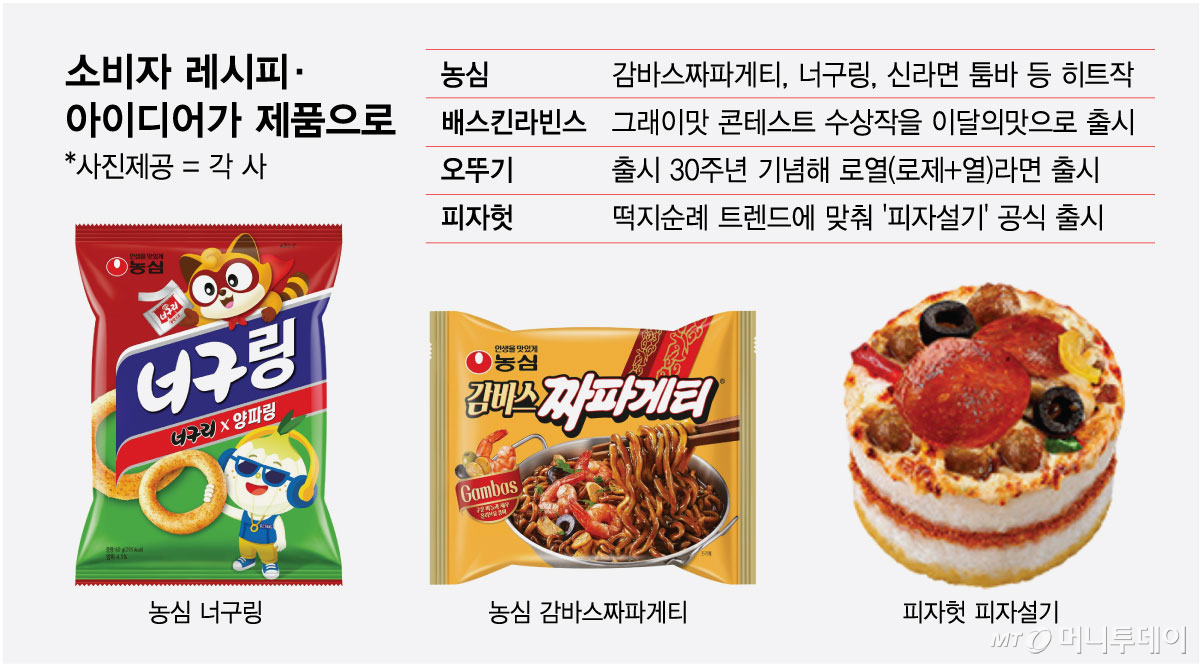
Unusual combinations that consumers have been making and eating on social media services (SNS) are being successively launched as new products by food companies. Ideas that were previously consumed only as limited-edition or event-based menus are now being widely used for new product development and market validation, causing “consumer R&D” to emerge as a key product development strategy in the food industry.
According to the food industry on the 13th, Nongshim will launch its new product “Gambas Chapagetti” on the 27th. The company has commercialized a consumer recipe that won first place at last year’s “Chapagetti YoLisa Contest.” It incorporated the unique flavor of gambas into Chapagetti using ingredients such as roasted garlic, shrimp, and olive oil.
Nongshim also began selling “Neoguring” on the 12th. Inspired by an SNS consumer recipe that involves putting Neoguri soup into onion rings and shaking them to eat, the product combines the texture of onion rings with Neoguri’s uniquely spicy seafood flavor. Since its launch, reviews on SNS have continued under keywords such as snacks and bar food.
Baskin-Robbins develops new products through consumer contests. This year’s “Great Taste Contest” received approximately 43,000 ideas, and about 648,000 votes were cast in the first and second rounds of consumer voting. The winning entries, “Monster Crunch Cookie” and “Matcha with Banana,” were launched as the flavor of the month and a delivery-exclusive product, respectively.
Consumers even directly choose the final products to be released. To mark the 40th anniversary of Shin Ramyun’s launch, Nongshim is conducting consumer voting and tasting evaluations until the 18th for “Shin Ramyun Cheese & Doenjang” and “Shin Ramyun Seafood & Fish Cake,” which were co-developed with Chef Edward Lee. The company plans to release a new product next month based on the evaluation results.
The reason the food industry is paying attention to consumer ideas is that it can reduce the uncertainty of new product development. According to an analysis by global market research firm NielsenIQ of approximately 250,000 new products across 130 consumer goods categories, including food and beverages, last year, only half of the products saw revenue growth up to their second year on the market. Commercializing combinations that have gained interest among consumers can help secure demand in the early stages.
Changes are also being detected in product development methods. In the past, consumer ideas were used as a tool to boost buzz by applying them to event-based menus, but recently, the frequency of launching them as official products has increased. There is a movement to develop them into hit products that generate continuous revenue rather than using them on a one-time basis.
A representative example of achieving success by launching an official product in this way is Nongshim’s “Shin Ramyun Tumma.” Inspired by cooking methods shared by consumers, it was launched in 2024 and has become a mega-hit that gained popularity overseas, surpassing 100 million units in cumulative global sales by the end of last year. Ottogi also referenced a recipe involving adding milk, cheese, and other ingredients to Ramyeon (spicy noodle soup) to eat, launching “Royal Ramen” in May last month and selling over 2 million units within one month.
The trend of wanting to directly experience products and recipes that have become topics on SNS is also boosting “consumer R&D.” According to a survey by DMC Report of 1,000 people who had purchased food and beverages last year, 56.1% of respondents said they purchased products that were trending on SNS or followed related recipes.
A food industry official stated, “In the process of making modisumer recipes suitable for mass production, there are many cases where the original concept cannot be fully realized,” adding, “The biggest advantage of ‘consumer R&D’ is that consumers voluntarily post reviews and cooking videos, which then lead to marketing.”

 in LIVING
