

South Korea's rental industry is accelerating its efforts to capture the corporate and public institution market, including hotels, schools, and military bases. This move aims to secure demand through large-scale supply contracts as the household rental market approaches saturation. Companies are strengthening their stable revenue base by leveraging products and maintenance services tailored for corporate clients.
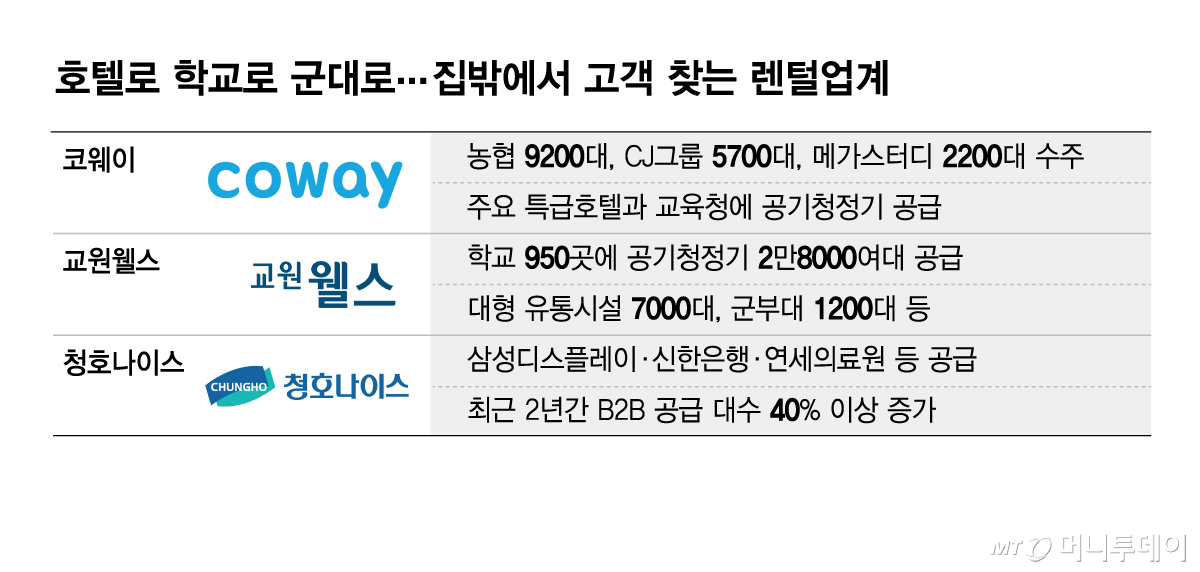
According to the rental industry on Tuesday, Kyowon Wells' sales performance in the business-to-business (B2B) and business-to-government (B2G) sectors last year increased by 138% compared to the previous year. The company also recorded double-digit growth in the third quarter of this year compared to the same period last year. Kyowon Wells is supplying approximately 7,000 household appliances, including water purifiers, air purifiers, and bidets, to major domestic distributors, and has supplied about 1,200 units to military bases.
Coway rented out approximately 2,200 units to Megastudy in the first half of this year. Last year, it secured orders for a total of 14,900 units from Nonghyup and CJ Group affiliates. Luxury hotels such as Conrad Seoul, Grand Hyatt Seoul, and Jeju Shinhwa World are also key clients. In the B2G sector, Coway won air purifier procurement projects with the Seoul, Ulsan, and Jeju offices of education.
Cheongho Nice has also secured B2B clients such as Samsung Display, Hansung Automotive Group, Shinhan Bank, and Yonsei Medical Center. The company supplies products to multi-user facilities including daycare centers, kindergartens, and senior citizen centers. By leading with products suitable for environments where group-unit consumers share usage, such as large-capacity ice water purifiers, Cheongho Nice's B2B supply volume has grown by more than 40% over the past two years.
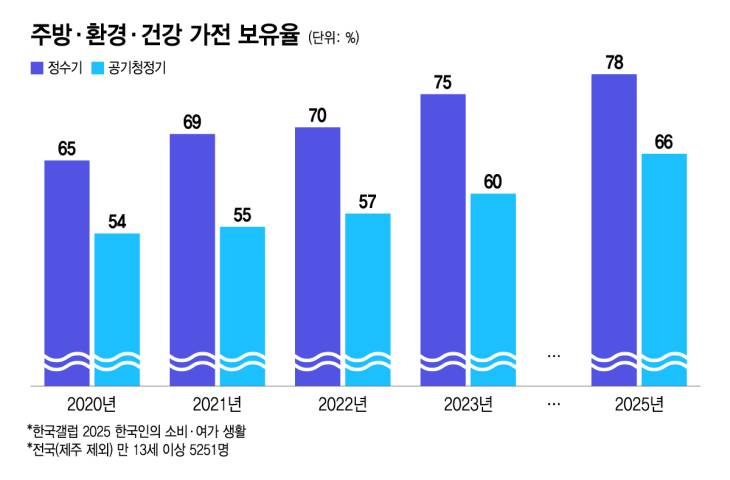
The reason the rental industry is turning its eyes to corporations and public institutions lies in the judgment that growth potential in the household rental market is limited. According to a survey on appliance ownership rates conducted by Korea Gallup last year, 78% of households own water purifiers and 66% own air purifiers, indicating that the adoption of major appliances has already reached a considerable level.
The corporate and public institution market is attractive because a single contract can result in the bulk supply of thousands of units. While the rental fee per unit may be lower than contracts with individual households, stable revenue can be expected through long-term contracts and renewals. A strength is also the ability to expand business by utilizing an already established nationwide management network.
However, systematic maintenance is a common explanation from industry players as a source of competitiveness. Because unspecified large numbers of people use the products, hygiene is more important than in households, and there is a possibility that large-scale contracts could be lost to competitors depending on service quality. As price competition intensifies during the bidding process, efficiently managing costs is also a factor determining profitability.
Companies have each strengthened their competitiveness with specialized products and services. Coway operates a B2B-dedicated installation team and a service organization dedicated to corporate clients, while Kyowon Wells introduced customized products such as medium-to-large water purifiers with a storage capacity of 20 liters or more. Cheongho Nice has also designated corporate sales representatives to unify the point of contact from contract to termination and is operating a consultation channel exclusively for enterprises.
A rental industry official said, "Just as important as securing large-scale new orders is continuing the revenue base through reorders or additional contracts after existing contracts end." The official added, "Another expected factor is that experience using products in schools or workplaces can later lead to the purchase of household products."

 in LIVING

