

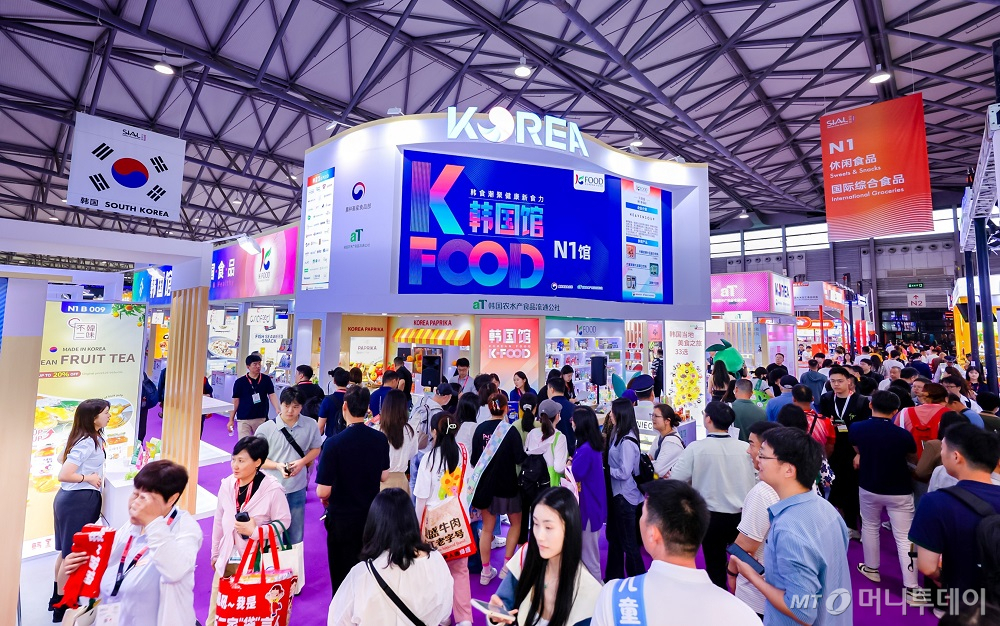
The world has begun placing K-food on its dining tables. People are challenging themselves with the spiciness of Buldak Bokkeummyeon, filling their freezers with Bibigo dumplings, and now they do not hesitate to line up at opening time to eat Korean-style chicken, kimbap, and tteokbokki. Hallyu creates curiosity, and food drives repeat purchases, forming a virtuous cycle. What MoneyToday confirmed on the ground through its special feature "Going to the scene of K-Initiative riding the 2026 K-Wave" is also the changed status of K-brands. CJ CheilJedang's overseas food business revenue last year was 592.47 billion won, surpassing domestic revenue for the first time, and Samyang Foods' overseas revenue share grew to 84%. The number of overseas stores by domestic restaurant companies increased from 3,722 in 2020 to 4,644 last year, a 24.8% increase over five years.
The next opportunity lies in franchise businesses that transfer Korean taste and operating methods as a whole. There is ample reason for the world to fall in love with Korean-style menus, service, interior design, and delivery systems. Now, when local consumer interest is high and they are seeking Korean brands, is the prime time to secure the initial market. If interest becomes routine and competing brands flood in, entry costs will rise and distinctiveness will fade.
Yet, franchise headquarters' gaze is turned inward. Responding to the Franchise Business Act, which takes effect next year, is their most urgent task. If a store owner group registered with the Fair Trade Commission requests consultation with the headquarters, the franchisor must respond, but the registration requirements for store owner groups are loose. A group can sit at the table if it consists of more than 10% of franchisees and has at least 30 members. The headquarters may have to respond to consultations from up to 10 store owner groups in extreme cases. Failure to respond to consultations makes one subject to corrective orders. While the intent to protect store owners' rights and enhance bargaining power is understandable, if brand competitiveness declines and profits cannot be made, it causes greater harm to store owners.
There is also another shackle: litigation. Korea Pizza Hut's loss in the lawsuit filed by 94 store owners for the return of differential franchise fees was finalized at the Supreme Court. It must return 21.5 billion won in differential franchise fees that were not specifically agreed upon in the contract. The ruling has sparked similar lawsuits across the industry. The legal profession, whose income has decreased due to delays in judicial administration, fuels the "struggle of the weak" between small franchisors and franchisees. Only social costs are increasing. Franchising is not an industry that grows through confrontation between store owners and headquarters. Mutual benefit is a prerequisite for the sustainability of franchises. Mutual benefit systems should not erode companies' growth opportunities.
Franchise headquarters, busy sorting out legal disputes with store owners, often put aside calls to grow their brands together overseas. They are ignoring the global market, where early entry is competitiveness, and wasting time over responsibilities from past contracts. The door opened before K-food will not remain open forever. If this once-in-a-lifetime opportunity is missed while dealing with internal conflicts, the world market will be occupied by other countries' brands. Chinese counterfeit brands already wearing "K-food disguise signs" have begun to take their place as if they were Korean companies.
Encouraging companies' overseas expansion alone will not achieve the globalization of K-food. In that sense, the package entry strategy proposed by the Korea Franchise Industry Association is worth considering. For example, a method where Olive Young, the vanguard of K-beauty which is hottest overseas, plants its flag on a specific street, and then K-franchises enter in large numbers around it. It is an imagination of moving Hongdae to Los Angeles, Myeong-dong to London, and Seongsu-dong to Ho Chi Minh City. Now that K-food has captured the world's palate, the government should be more active in removing obstacles to going global rather than raising regulatory hurdles. If one expects to see K-food standing tall on the path laid by Hallyu.


 in LIVING


