

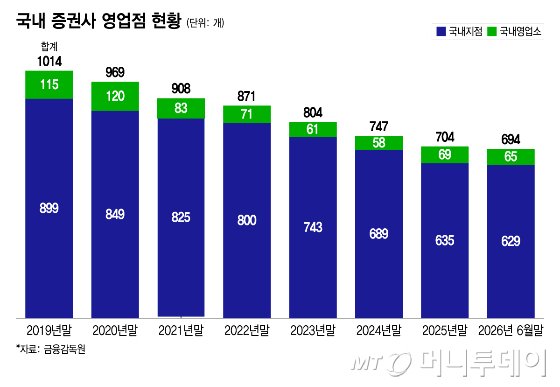
The number of branches and sales offices operated by domestic securities firms has declined by more than 30% over the past six years. This trend is attributed to the spread of mobile stock trading and the activation of offline-free financial services, which have reduced the need for traditional face-to-face sales networks. Meanwhile, major securities firms are showing a move to restructure existing branches into specialized outlets focused on wealth management (WM) for high-net-worth individuals.
According to the Financial Supervisory Service, as of the first half of this year, domestic securities firms operated a total of 694 branches and sales offices, down by approximately 32% from 1,014 at the end of 2019. In just over six years, more than three out of every 10 securities firm outlets have disappeared.
The number of securities firm branches fell by 30%, from 899 to 629, while sales offices decreased by 43.5%, from 115 to 65. Securities firm branches are locations where customer-facing services such as stock trading, financial product sales, and asset management are conducted. Sales offices have primarily been operated in a format where securities firm employees are stationed at the outlets of other financial institutions, such as banks, to handle related business. It is notable that the decline rate for sales offices, which are relatively smaller in scale and easier to withdraw from, is higher than that for branches.
By major securities firm over the same period, Shinhan Investment Corp’s outlets decreased by 53.2%, from 124 to 58; KB Securities’ by 34.8%, from 112 to 73; Korea Investment & Securities’ by 26.1%, from 88 to 65; Mirae Asset Securities’ by 28.0%, from 82 to 59; NH Investment & Securities’ by 33.3%, from 84 to 56; Samsung Securities’ by 54.0%, from 63 to 29; and Hana Securities’ by 14.0%, from 57 to 49.
The primary background for the decline in outlets is cited as the expansion of online stock trading through MTS (Mobile Trading System) and HTS (Home Trading System). As most financial transactions can now be conducted via smartphones, securities firms have seen a reduced need to maintain offline branches that incur fixed costs such as rent and labor.
Changes in face-to-face sales strategies are also closely linked to the decline in branches. While reducing outlets centered on stock brokerage for general investors, firms are concentrating efforts on strengthening asset management capabilities for high-net-worth individuals. Consequently, analysts note a trend where the total number of outlets is decreasing, but individual locations are becoming larger and more specialized.
An official from a securities firm stated, "As the trend in face-to-face sales shifts toward providing advice in specialized areas such as inheritance, taxation, and pensions, there is a tendency for branches to be merged or closed." The official added, "Since most other services can now be handled offline-free, it should be viewed not simply as a reduction in branches, but as a situation where outlets are being selected and concentrated according to service demand."
In fact, Shinhan Investment Corp, which reduced its outlets the most over the past six years, has expanded its dedicated PB centers for wealthy clients from just two in 2022 to six currently. In some regions, the firm is changing its face-to-face sales strategy by merging three hub sales offices into one while separately operating a dedicated outlet for wealthy clients.
An official from another securities firm said, "The selection and concentration of outlets aligns with recent revenue structure strategies in the securities industry." The official explained that this is part of efforts to lower reliance on brokerage revenue, which fluctuates significantly with market volatility, and to expand the share of relatively high value-added businesses such as asset management and investment banking (IB).
Nevertheless, the issue of financial consumer accessibility resulting from the reduction and consolidation of outlets remains a challenge. This is because the inconvenience for elderly customers who are not accustomed to offline-free transactions or regional investors who prefer face-to-face consultations may increase, regardless of the convenience of digital finance. The rate of decline in securities firm outlets is steeper than that of banks. According to data from the Financial Supervisory Service, the decline rate for domestic commercial bank outlets over the same period was 18.9%, lower than that of securities firms (approximately 32%).
Following criticism regarding branch closures during this year’s National Assembly audit, banks expressed their intention to carefully review outlet closures and minimize inconvenience for financially vulnerable groups. It appears that the securities industry also needs to consider ways to maintain service accessibility for financially vulnerable groups, such as the elderly, while streamlining its sales network.

 in STOCK
