

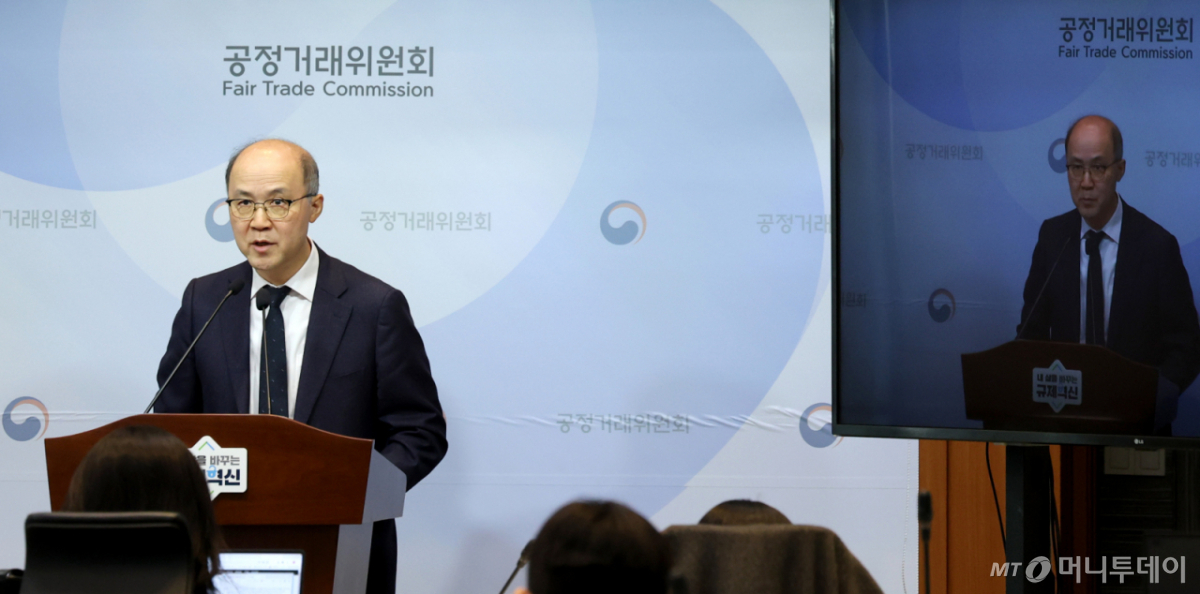
Controversy is intensifying over "related revenue," the basis for calculating fines by the Fair Trade Commission (Korea Fair Trade Commission). This is because the Korea Fair Trade Commission has broadly included revenue with little direct connection to legal violations or applied a uniform standard that ignores industry-specific characteristics, resulting in fines that are excessively inflated compared to actual illicit gains.
According to relevant government ministries on the 15th, Article 13 of the Enforcement Decree of the Monopoly Regulation and Fair Trade Act currently defines "related revenue," the basis for imposing fines, as the revenue from related goods or services sold by the violator in a specific transaction area (or purchase amount in cases of purchase-related violations).
However, criticism continues that the boundaries regarding the scope of direct and indirect impacts of illegal acts are ambiguous, leaving significant room for excessive discretion by the Korea Fair Trade Commission. In fact, "elastic calculations" where related revenue fluctuates by trillions of won between the review stage and the plenary session deliberation stage have been repeated, undermining companies' predictability.
Record-breaking fines recently imposed on delivery platforms and the financial sector vividly illustrate these limitations. The Korea Fair Trade Commission imposed a total fine of 631.9 billion won for Baemin's and Coupang Eats' acts of demanding most-favored-nation treatment. In the case of Coupang Eats, which received a fine of 300.8 billion won, related revenue was calculated at approximately 5 trillion 14.9 billion won by broadly bundling not only some stores directly affected by most-favored-nation treatment but also the sales of merchants in regions where the system was implemented. Coupang has strongly protested, arguing that revenue unrelated to the illegal acts was included.
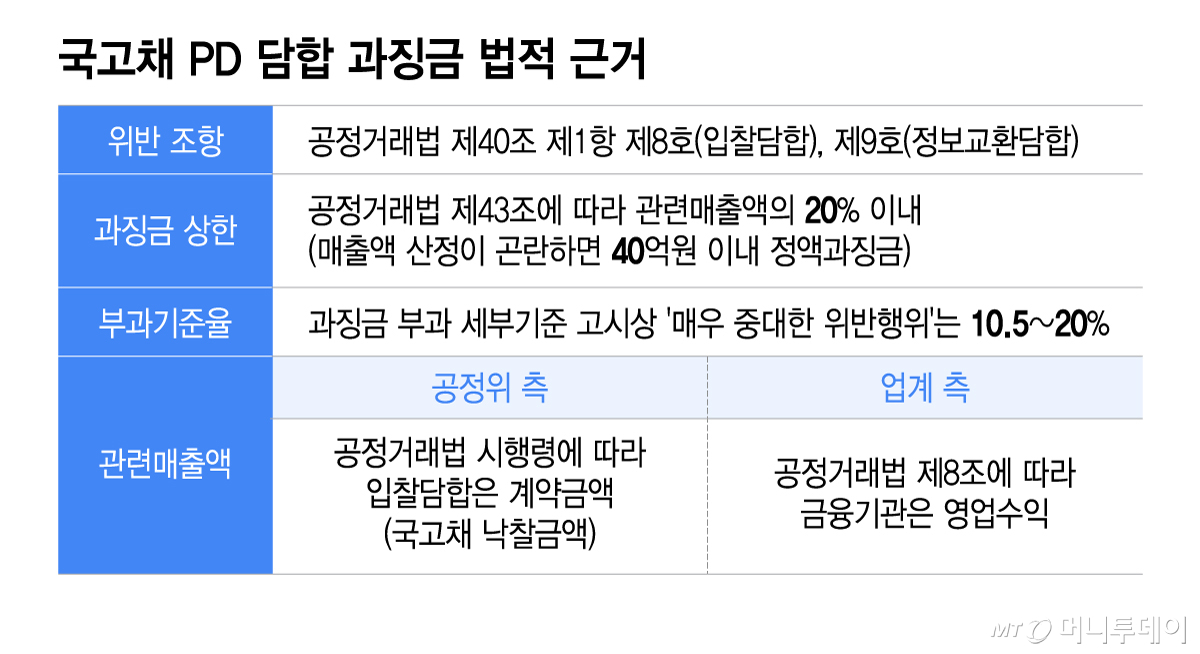
Fifteen banks and securities firms involved in the government bond bidding cartel also faced a total fine of 1 trillion 626.5 billion won. The financial institutions argued that fines should be based on actual operating revenue, but the Korea Fair Trade Commission considered the entire winning bid amount for government bonds involved in the cartel, which was 54 trillion won, as related revenue. By ignoring differences in profit structures across industries and basing calculations solely on gross revenue, the scale of the fine snowballed.
Companies maintain that fines are administrative sanctions intended to correct unfair practices, not a means to collect huge sums proportional to companies' size. If "related revenue" is forcibly expanded under vague criteria, fines risk transforming from punishment into shackles that threaten companies' survival and investment. As the gap between actual illicit gains and fines widens, the legitimacy of the sanction inevitably wavers.
Experts emphasize that for fines to function according to their original purpose of recovering illicit gains and preventing violations, the calculation criteria must be refined. Professor Ji In-yeop of the Department of Economics at Dongguk University stated, "Current regulations determining the scope of related revenue allow for the inclusion of not only transactions directly affected by violations but also sales with indirect impacts, leaving room for interpretation in each case regarding how far that scope should extend." He added, "Because the Korea Fair Trade Commission's discretionary judgment can intervene in this process, academia is currently conducting research on various criteria, including revenue, accounting profits, additional profits from illegal acts, and consumer welfare."

 in LIVING

