

Domestic cosmetics companies continue to see top-line growth driven by the global popularity of K-Beauty, yet their profitability varies widely. Even as expanding overseas demand translates into higher sales, differences in how much of that revenue converts into actual profit arise due to burdens from exchange rates, labor costs, and production expenses. The ability to control costs and secure profits is becoming just as important as the rate at which sales are increased.
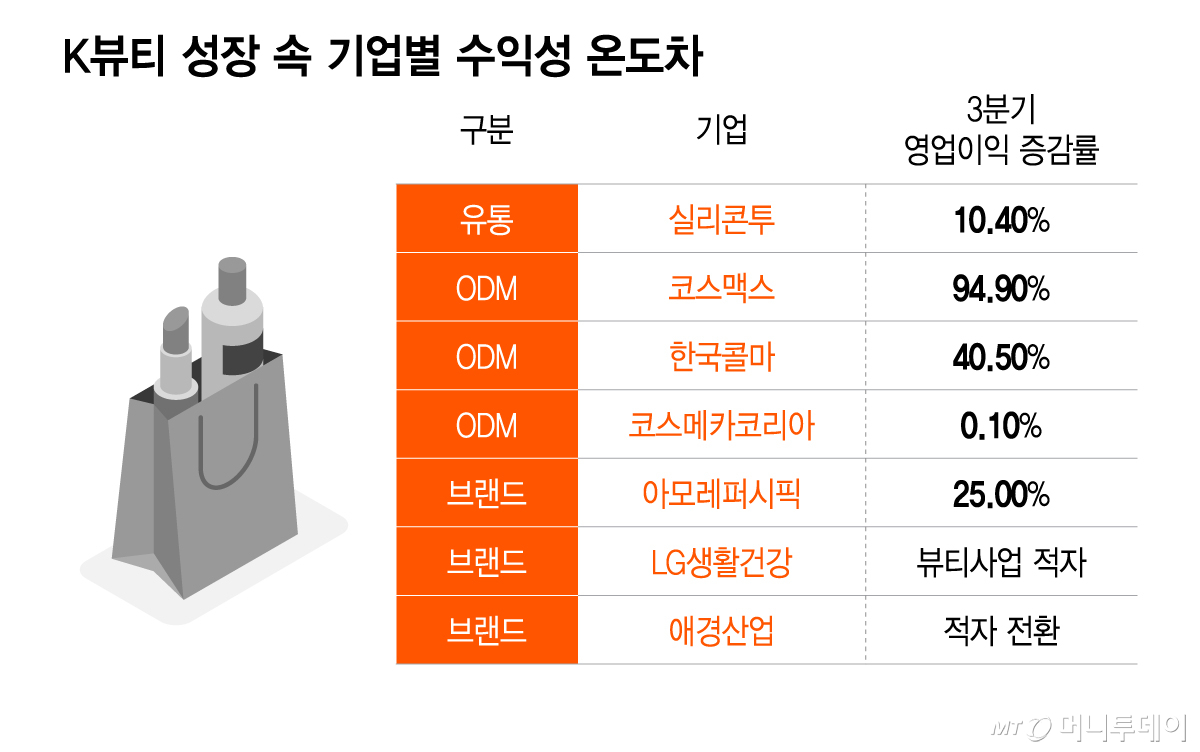
According to industry sources on the 15th, Silicon2, a company responsible for overseas distribution of domestic cosmetics brands, recorded third-quarter revenue of 424.4 billion won, up 41.7% year-on-year. In contrast, operating profit was only 69.6 billion won, an increase of 10.4%. The modest growth in profit relative to the sales expansion meant that operating profit fell short of market expectations by 14.8%.
Exchange rates and investment costs for new business ventures weighed on profitability. Given a business structure heavily reliant on exports, which is significantly affected by a strong won, the third-quarter gross profit margin (GPM) declined by 3.3 percentage points from the previous quarter to 28.7%. Salary expenses also surged 70.7% year-on-year due to proactive hiring for its Japan business and new ventures. The burden of labor costs, which outpaced the sales growth rate, limited profit increases. Kim Myung-ju, a researcher at Korea Investment & Securities, stated that margin improvement and stabilization in the trend of selling, general and administrative expenses need to be confirmed, and lowered Silicon2's target price from 65,000 won to 46,000 won.
Cosmetics manufacturers also showed differences in profitability. Cosmax and Kolmar Korea saw their third-quarter operating profits increase by 94.9% and 40.5%, respectively, year-on-year. In contrast, Cosmecca Korea managed only a 0.1% increase. Even as production orders from K-Beauty brands increased, the extent of profit improvement varied depending on production efficiency and cost structures.
In the ODM business, the key lies in how efficiently production capacity is utilized to match order growth. Higher factory utilization rates can reduce the burden of fixed costs, but reliance on outsourced production due to insufficient facilities can lead to increased expenses. Profitability by product and the performance of overseas subsidiaries also impact operating profit. This is why profitability differs even when benefiting from the same K-Beauty boom, depending on production infrastructure and cost competitiveness.
The situation for brand operators is also mixed. Amorepacific achieved both top-line growth and improved profitability, with third-quarter operating profit up 25% year-on-year. On the other hand, LG Household & Health Care continued to post operating losses in its beauty business, and Aekyung Industrial turned to a deficit. While interest in K-Beauty has grown in overseas markets, performance varied according to the competitiveness and sales results of individual brands.
Amid this trend, there is an atmosphere within the industry that the importance of profitability management is growing alongside sales expansion. An official in the beauty industry said, "As overseas demand for K-Beauty grows, companies' top-line growth continues, but profitability inevitably varies depending on business structure and cost burdens," adding, "The ability to convert sales into profit is becoming just as important as how much sales are increased."

 in LIVING
