

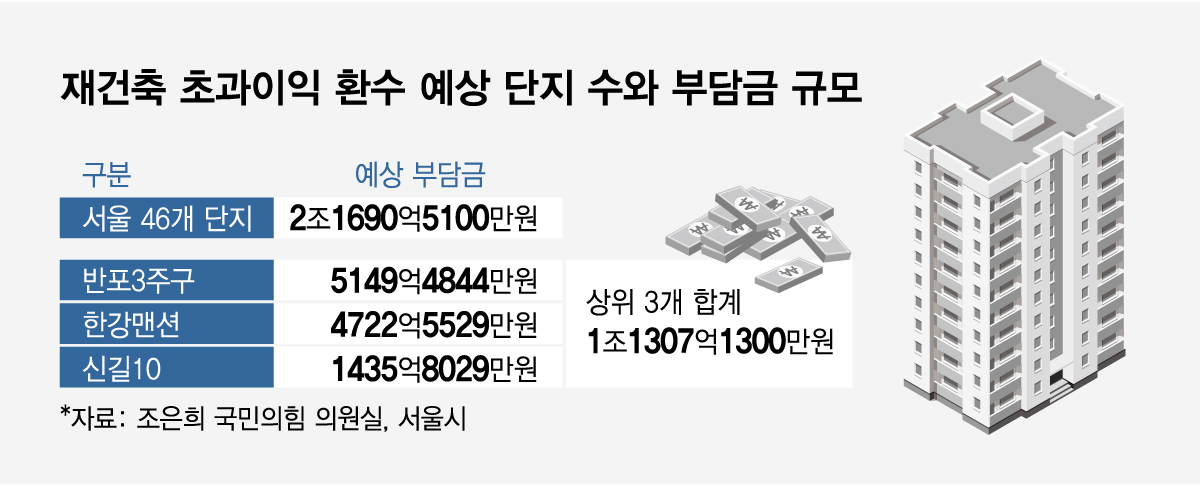
A reconstruction surplus profit recovery fee (recovery fee) of around 2 trillion won is expected to be levied at Seoul reconstruction sites. In some complexes, the per-person burden exceeds 600 million won, showing signs of fueling further rises in housing prices. With reconstruction projects already identified as a bottleneck delaying supply expansion, another cause for delay has emerged. Given that cautious voices were raised even within the ruling party last year regarding the implementation of the recovery fee, it is now time to re-examine the system itself.
According to data submitted by Seoul City to the office of People Power Party lawmaker Cho Eun-hee, as of August, 46 complexes in Seoul are expected to face levies under the recovery fee. The total amount of the fees is 2.169 trillion won, with the per-person burden reaching 680 million won for Han River Mansion in Yongsan. In Gangnam's Banpo 3rd District and Yeongdeungpo's Sin-gil 10th District, the per-person burdens are 320 million won and 260 million won, respectively. Since these fees are highly likely to be fully passed on to buyers as part of the sales price if actually levied, they represent another factor driving up housing prices.
The recovery fee is a system that recovers 10% to 50% of any amount exceeding 8 million won per member from reconstruction development profits. Although first introduced during the Roh Moo-hyun administration in 2006, there have been no actual cases of collection since then, as each change of government led to suspensions and re-examinations of its implementation. Critics also argue that in reconstruction projects taking nearly a decade, actual costs often exceed estimates, making it difficult to plan for funding. Although the law was revised and has been in effect since last year, even within the ruling Democratic Party of Korea (including Bok Ki-wang, Moon Jin-seok (Rep.), etc.), there have been calls for significant relaxation or outright abolition of the fee.
The recovery fee was originally introduced to prevent the privatization of development profits. However, it has long been identified as an artificial measure aimed at curbing housing price increases alongside heavy taxation on comprehensive real estate and capital gains. It is also cited as a cause for skyrocketing housing prices by delaying housing supply in areas preferred by the middle class and promoting the so-called 'one strong property' phenomenon. Those owning high-value homes face suspicion of being potential speculators, punitive taxation, and growing dissatisfaction with real estate policies within the recovery fee framework.
There is consensus on both stabilizing housing prices and the goal of 'supply now.' If housing supply cannot be accelerated through measures such as releasing Yongsan Park or lifting green belt restrictions amid conflicts between the government and ruling party and Seoul City, then reconstruction and redevelopment are the only alternatives. Alongside streamlining approval procedures for reconstruction projects and easing mandatory allocation of rental housing, re-examining the recovery fee from scratch could be the first step toward rapid supply expansion. Currently, three bills related to the recovery fee are pending in the National Assembly.

 in OPINION
