

Steel, petrochemicals, shipbuilding, secondary batteries, electric vehicles, semiconductors. As China's manufacturing resurgence accelerates, competition between Korea and China is intensifying across major industrial sectors. With Chinese manufacturers raising their self-sufficiency rates or even flooding overseas markets with cheap products, pressure on domestic industries to restructure has also grown.
The domestic steel industry continues to face sluggish business conditions due to weak domestic demand compounded by supply surges from China. The petrochemical sector has launched a restructuring plan to reduce naphtha cracking facility (NCC) production capacity by 18–25% by 2030, influenced by China's increased self-sufficiency as its largest export market. In shipbuilding, Chinese companies' orders overwhelmingly dominate Korean shipyards. In secondary batteries and electric vehicles, China has far surpassed Korea in market share. While Korea still holds the lead in semiconductors, companies like Changxin Memory (CXMT) and Yangtze Memory Technologies (YMTC) are rapidly gaining ground amid a semiconductor supercycle.
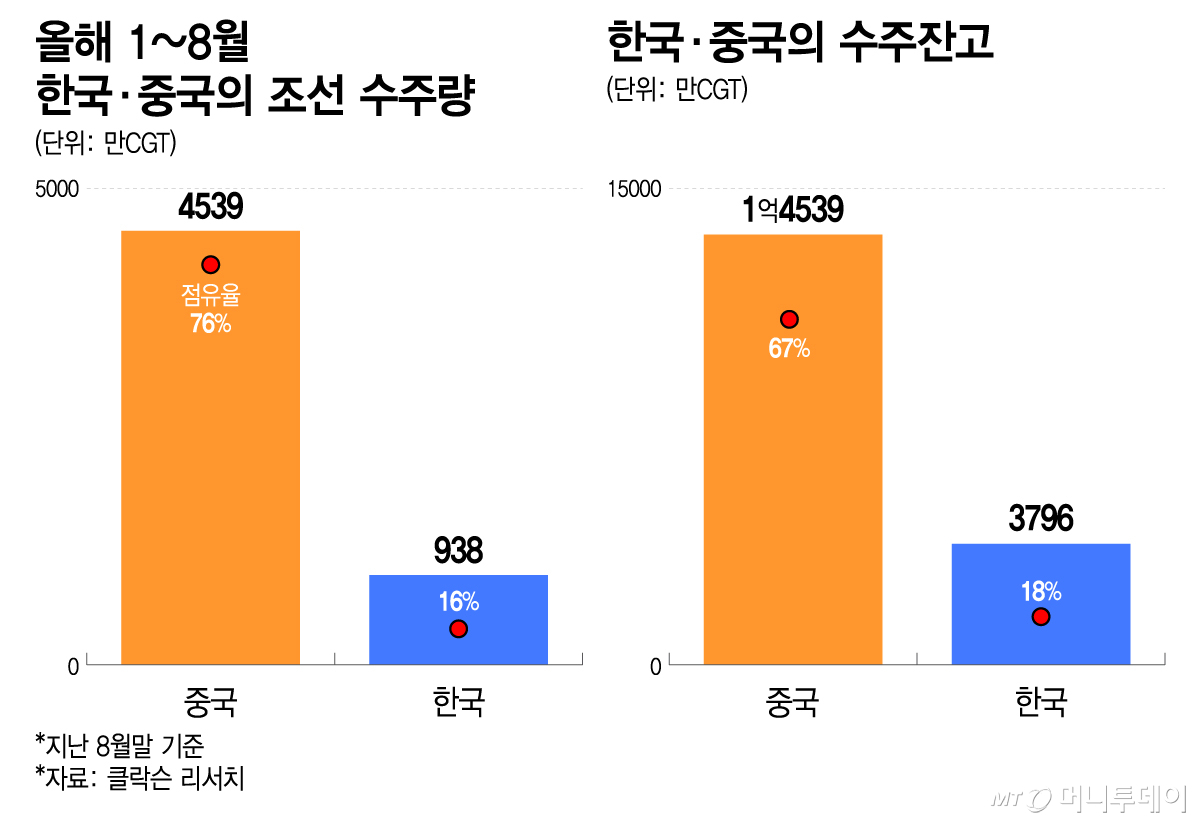
While the domestic shipbuilding industry is focusing on selective orders centered on high-value-added vessels, China leads overwhelmingly in total order volume. According to Clarkson Research, a UK-based shipbuilding and shipping market analysis firm, South Korea's ship orders from January to August totaled 9.38 million CGT (compensated gross tonnage), up 55% year-on-year.
HD Hyundai Heavy Industries' cumulative orders for the year reached $18.08 billion, achieving 77.6% of its annual target. Hanwha Ocean's order volume also reached $7.07 billion, but global shipbuilding orders are increasingly concentrated in China.
China's order volume from January to August this year reached 45.39 million CGT, a 95% increase compared to the same period last year. It captured 76% of total orders, while Korea's share was only 16%. The gap in remaining order backlogs is also significant. As of late August, China's backlog stood at 145.39 million CGT, far surpassing Korea's 37.96 million CGT. China accounted for 67% of total global shipbuilding backlogs, while Korea held just 18%.
Major domestic shipbuilders have secured construction volumes for over three years and are pursuing a strategy to boost profitability by selectively ordering high-value-added vessels such as LNG carriers and large eco-friendly ships rather than competing solely on volume. However, China is also accelerating its in high-value-added vessel segments.
The same applies to secondary batteries and electric vehicles. According to SNE Research, a market research firm, Chinese companies occupied seven of the top 10 positions in the global electric vehicle battery market from January to July this year. Their combined market share reached 72.8%, while the combined share of domestic firms LG Energy Solution (3rd) and SK On (8th) was only 11.4%.
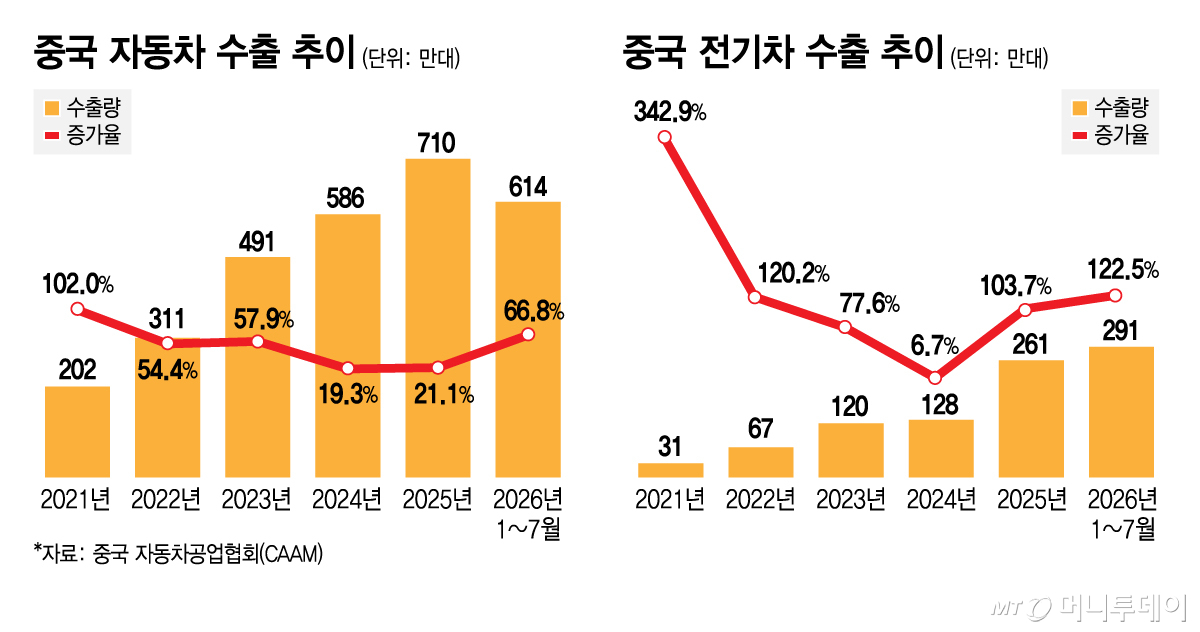
Chinese automakers are accelerating their overseas market penetration by leveraging electric vehicles. From January to July this year, China's automobile export volume reached 6.14 million units, a 66.8% increase compared to the same period last year. After surpassing Japan (4.42 million units) in 2023 with exports of 4.91 million units to become the world's top automobile exporter, China has widened the gap further. Especially as domestic market growth has slowed recently, China has intensified its export drive, increasing automobile exports to 7.1 million units last year.
Electric vehicles are driving China's automobile exports. From January to July this year, China's electric vehicle exports surged 122.5% to 2.91 million units. Among them, Chery exported 1.14 million units and BYD exported 970,000 units. Following BYD's establishment in the upper tier of imported car sales in Korea, Zeekr and Chery are now actively expanding their presence, making it increasingly common to see Chinese electric vehicles on the streets. Chinese manufacturing, known for its cost-performance ratio, is rapidly penetrating our daily lives.
While Korea still holds the lead in semiconductors, China's is fierce. On July 27, China's largest DRAM manufacturer, Changxin Memory (CXMT), simultaneously listed on the STAR Market (China's NASDAQ equivalent) and became the company with the highest market capitalization on the Chinese mainland stock exchange. CXMT plans to use the 66.6 billion yuan (approximately 13.33 trillion won) raised through its initial public offering (IPO) to expand production capacity. China's largest NAND flash manufacturer, Yangtze Memory Technologies (YMTC), is also accelerating its listing preparations. Chinese memory semiconductor companies are now actively expanding their scale amid the semiconductor supercycle.
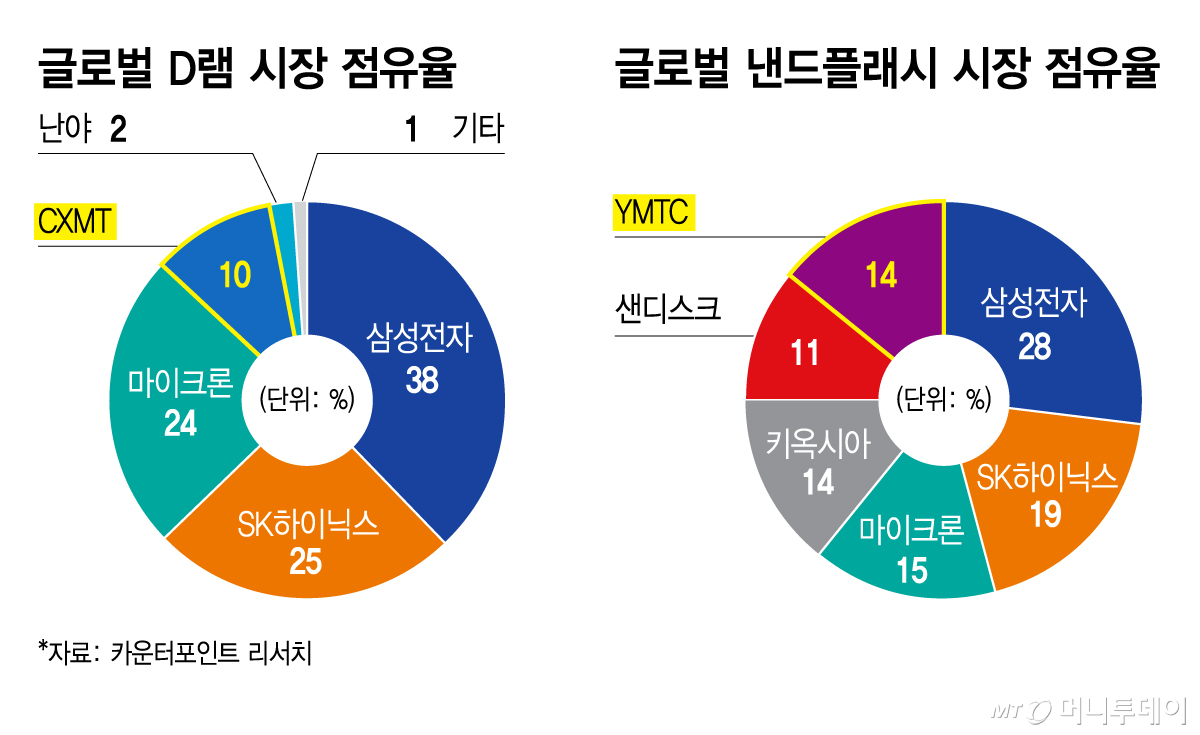
According to Counterpoint Research, CXMT recorded a 10% market share in the global DRAM market in the second quarter of this year, ranking fourth. Samsung Electronics held 38% for first place, and SK Hynix held 25% for second place. What is concerning is CXMT's speed. CXMT's market share rose from 4% in the second quarter last year to 10% within one year. It entered double-digit market share much faster than industry expectations. CXMT's first-half revenue reached 150.3 billion yuan (approximately 30 trillion won), a 874% surge compared to the same period last year.
In late August, CXMT revealed it would supply its self-developed next-generation mobile DRAM, low-power double data rate 6 (LPDDR6), to Xiaomi's new foldable phones, tightening its grip on technological.
YMTC's progress is also noteworthy. In the global NAND flash market in the second quarter of this year, YMTC held a 14% market share, tying with Japan's Kioxia for fourth place. YMTC's market share increased by 3 percentage points within one year. Samsung Electronics held 28% for first place, and SK Hynix held 19% for second place. As the AI market expands from learning to inference, the NAND flash market is growing rapidly. Based on its self-developed stacking technology "Xtacking" architecture, YMTC is mass-producing 267-layer 3D NAND and developing products with over 300 layers.
Korean companies have few cards to play against China's all-around manufacturing challenge. First, they must respond to China's challenge by cultivating advanced products with higher value-added rather than generic products. Samsung Display's decision to exit the liquid crystal display (LCD) market and accelerate its transition to next-generation organic light-emitting diode (OLED) displays is a good example. Additionally, just as Japan survived by dominating bottlenecks in materials, components and equipment after falling behind in finished products, controlling industrial bottlenecks remains an effective strategy. China's manufacturing challenge will intensify further. It is more important to become irreplaceable in one field than to excel in everything.

 in OPINION


