

The government-backed National Participation-type National Growth Fund (hereinafter referred to as the National Growth Fund), which guarantees up to 20% of losses on public investment funds, has become engulfed in concerns over principal loss less than two months after its launch. With the net asset value falling below the initial offering price, there are growing concerns that some sub-funds may have already exceeded the government's guarantee limit of 20%. However, industry experts argue that since this is a product with no redemption option for five years, it would be premature to draw conclusions based solely on current figures.
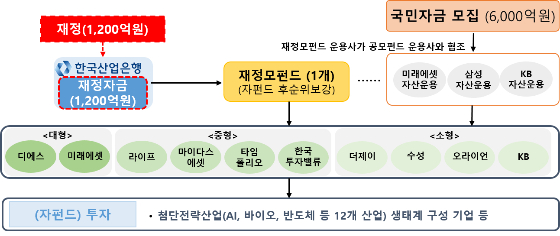
According to electronic disclosures by the Korea Financial Investment Association on the 2nd, as of last month's 31st, the net asset value of the National Growth Fund stood at 961.9 won, approximately 3% below the initial offering price of 1,000 won. The National Growth Fund is structured as a private inter-direct investment fund (SIF), which pools public funds to create a master fund and invests in 10 individual sub-funds. The total fund size includes the sum of 60 billion won in public investment funds, 12 billion won from fiscal resources, and seeding investments from the 10th sub-fund management companies.
The core safety mechanism of this fund is "subordinated capital contribution." In the event of losses, the government and fund managers (subordinated investors) bear losses before public investors (senior investors). Specifically, the government assumes up to 20% of losses for each sub-fund first. Therefore, if a sub-fund's loss rate remains within 20%, the principal of public investment funds should remain intact under normal circumstances.
The problem lies in the fact that the loss guarantee effect is already reflected in the net asset value calculation method itself. Fund managers do not calculate the net asset value based solely on the current value of underlying assets; they also factor in the government's subordinated loss absorption up to 20%. The fact that the net asset value has fallen below the initial offering price suggests, conversely, that actual losses may have already exceeded the 20th% threshold, raising concerns among investors.
The asset management industry also views it as highly likely that these concerns are materializing. The sluggish domestic stock market is believed to have directly impacted the returns of certain sub-funds with high allocations to listed stocks. Indeed, since the National Growth Fund began operations on the 12th of last month until today, the KOSPI has fallen by 1,528.17 points (18.81%), and the KOSDAQ has dropped by 309.29 points (30.06%).
A representative from an asset management company stated, "The KOSDAQ was at the 1,000-point level when operations began but has now fallen to around 700 points. It appears that returns have been affected primarily by sub-funds heavily invested in the KOSDAQ."
Individual sub-funds of the National Growth Fund must invest at least 60% of their total capital in designated target areas, with more than 30% required to be newly allocated to unlisted companies and technology-special listing companies on the KOSDAQ. In contrast, investments in the KOSPI recognized as primary targets are limited to within 10%. This means that structurally, the fund must maintain a relatively high allocation to volatile assets such as KOSDAQ and unlisted company investments.
However, there are also counterarguments against definitively labeling current returns as principal losses. The National Growth Fund is a closed-end fund, meaning redemption is only possible after five years, making it difficult to evaluate performance based solely on current figures. In particular, since infrastructure investment projects have not even begun execution, considerable time will be needed before their returns can be properly assessed.
Another asset management company representative explained, "In individual sub-funds, investments in unlisted companies among advanced technology firms or mezzanine financing only generate returns when funds are withdrawn after successful investment. Whether the actual investments have been successful will become clear over time. Given the closed-end nature of the fund, it is structurally designed for long-term investment, so patience is required."

 in STOCK
