

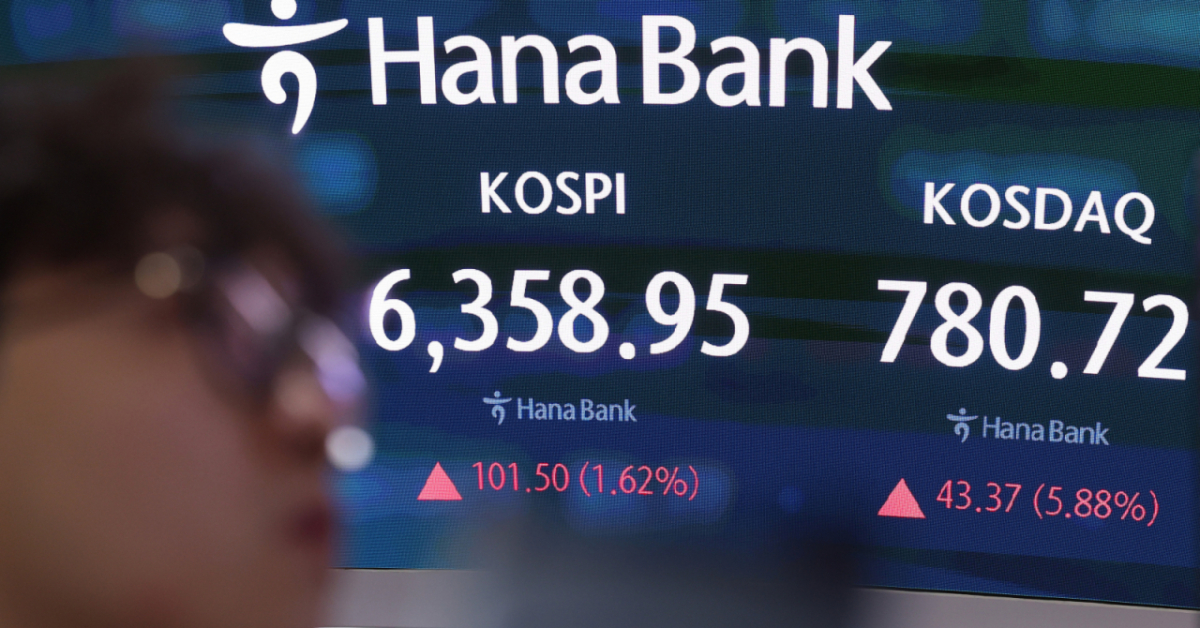
The domestic stock market regained the KOSPI 6300 and KOSDAQ 780 levels on the 4th. A non-semiconductor rotation trade, buoyed by favorable winds from the U.S. stock market, pushed both major indices higher. Amid lingering concerns over memory oversupply stemming from China, market attention is focused on whether a semiconductor rally will resume based on second-quarter earnings of U.S. technology stocks.
On this day, the KOSPI closed at 6358.95, up 101.50 points (1.62%) from the previous trading session. The index opened at 6351.38, slipped to 6080.25 within 60 minutes of the opening, and after repeated sharp fluctuations, finished on a rebound trend.
Samsung Electronics and SK Hynix closed with weak flat trends, contributing less than a total of 14 points to the index rise. Among stocks related to their holdings, Samsung Life Insurance fell by over 3%, Samsung C&T declined by over 1%, while SK Square rose by over 3% to close trading.
Among top market capitalization stocks, Hanwha Aerospace surged by over 9%. LG Energy Solution, Samsung Biologics, and SK Square rose by over 3%, and HD Hyundai Heavy Industries gained by over 2%. KB Financial Group and Shinhan Financial Group closed with weak flat trends, while Kia remained flat.
By sector, construction rose by over 8%, IT services, telecommunications, and metals by over 5%, machinery equipment by over 4%, chemicals, pharmaceuticals, general services, medical precision, and paper/wood products by over 3%. The only sector to close with a decline was insurance (-1.52%).
In the Korea Exchange KOSPI spot market, individuals made net purchases of 818.5 billion won, institutional investors bought 539.4 billion won, and foreign investors sold 369.9 billion won.
Lee Kyung-min, a researcher at Daishin Securities, stated, "News that China's CXMT is considering building a new factory in Beijing has highlighted the possibility of expanded memory supply, strengthening downward pressure on semiconductor stocks."
The researcher added, "Although U.S. semiconductor stocks managed to rebound during trading last night amid analysis that hyperscalers' AI investments are generating profits, profit-taking continued in the domestic memory sector, leading to clear decoupling, and demand-supply dynamics spread to other sectors."
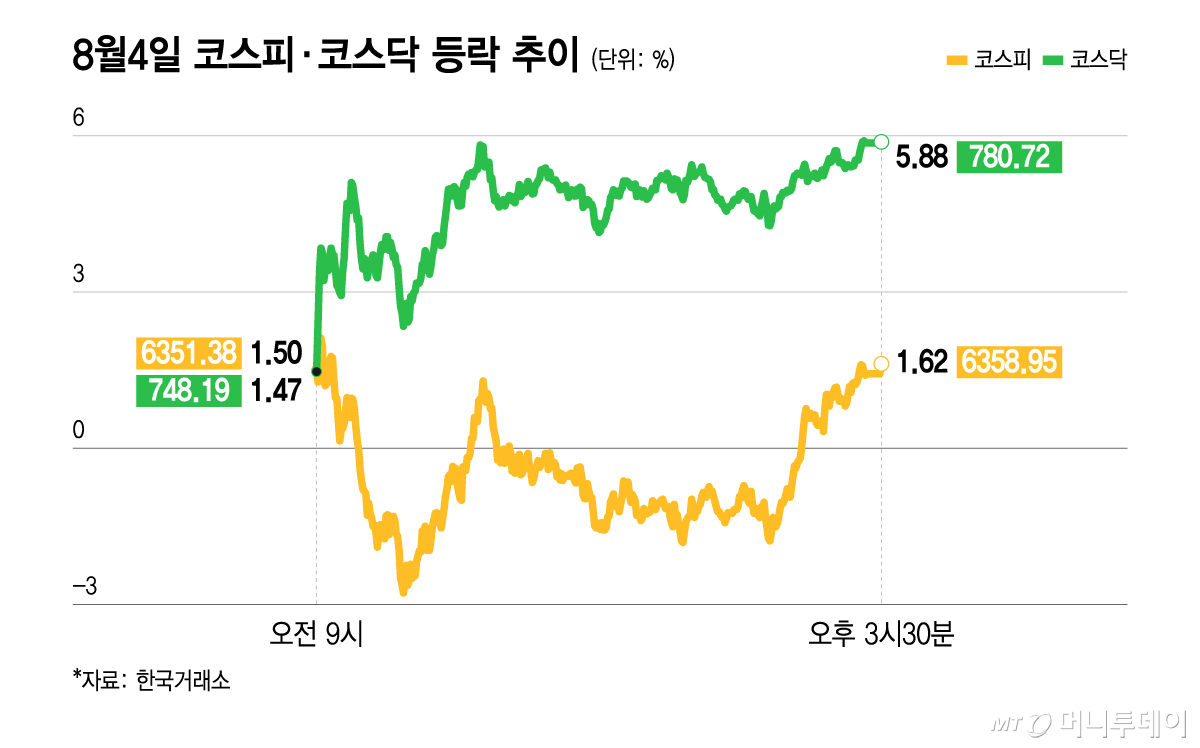
The rotation trade fervor was particularly evident in the KOSDAQ market. The index closed higher for three consecutive days at 780.72, up 43.37 points (5.88%) from the previous session. As spot and futures prices surged continuously during trading, the exchange activated a program buy order temporary suspension (buy sidecar circuit breaker) at 10:47 a.m.
The top 10 stocks by market capitalization all closed with upward trends. RIGAKEM Bio rose by over 15%, AVL Bio by over 13%, HLB by over 11%, Altheon by over 9%, and Juseong Engineering surged by over 6%. EcoPro and EcoPro BM rose by over 5%, Reino Industrial by over 4%, Wonik IPS by over 2%, and RAINBOW Robotics showed strength of over 1%.
By sector, general services rose by over 8%, pharmaceuticals by over 7%, medical precision by over 6%, IT services, metals, electrical/electronics, manufacturing, finance, construction, and entertainment/culture by over 5%, non-ferrous metals, distribution, chemicals, machinery equipment, and publishing/media by over 4%, and transportation equipment and other manufacturing by over 3%. There were no declining sectors.
While foreign investors sold 277.2 billion won net and individuals sold 258.6 billion won net, institutional investors drove the market with net purchases of 543.4 billion won. Among institutional investor accounts, financial investment firms that handled exchange-traded fund (ETF) volumes led with 332.8 billion won in net purchases, followed by securities companies (102.2 billion), pension funds (46 billion), and insurance companies (10.9 billion).
Im Jeong-eun and Tae Yoon-seon, researchers at KB Securities, stated, "Although large semiconductor and automotive stocks performed relatively poorly, limiting the KOSPI index's upside, with the proportion of rising stocks reaching over 83%, rotation trades spread across sectors including defense, nuclear power plants, and cosmetics. With bio and robot stocks continuing to show strength day after day, expectations for measures to activate the KOSDAQ further boosted the index rise."
KB Securities researchers noted, "AMD is scheduled to announce its earnings early on the 5th Korean time, so it will be important to watch whether semiconductor stocks, which have recently shown relatively weak upward momentum, can shift market sentiment."

 in STOCK

