

Another active exchange-traded fund (ETF) is set to be delisted for failing to meet the correlation coefficient standard. Following the delisting of five active ETFs for not meeting the correlation coefficient benchmark, the HANARO Global Physical AI Active ETF will be delisted on the 4th. Controversy has arisen as cases continue in which funds are delisted despite generating higher returns than their benchmark indices.
The HANARO Global Physical AI Active had its trading suspended on the 3rd ahead of its delisting on the 4th. The correlation coefficient is an indicator that shows how closely an ETF moves in tandem with its underlying index. Passive ETFs must maintain a coefficient of 0.9 or higher, while active ETFs must maintain 0.7 or higher. Funds are subject to delisting if they fail to meet the standard for three consecutive months. However, sanctions are suspended for one year after listing. The HANARO Global Physical AI Active failed to meet the correlation coefficient standard (0.7) for three consecutive months from July 31 to October 30 of last year.
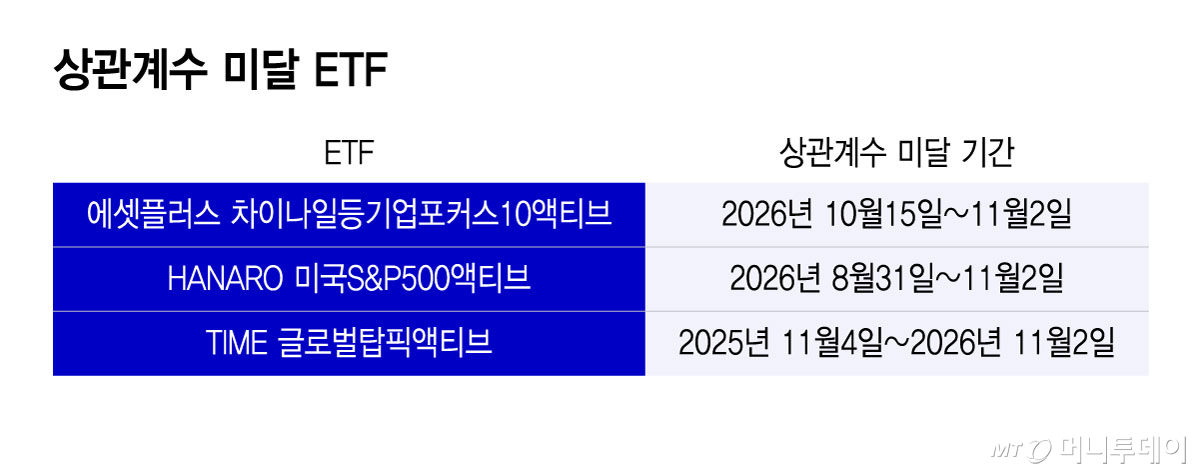
In addition to the HANARO Global Physical AI Active, funds such as Asset Plus China Top 10 Companies Focus Active, HANARO US S&P 500 Active, and TIME Global Top Pick Active are also continuing to fall below the correlation coefficient standard. Among these, the TIME Global Top Pick Active has failed to reach a correlation coefficient of 0.7 for nearly a year, from November 4 of last year to the 2nd of this month. Although it was listed on October 28 of last year and received a one-year exemption from regulation, it could be delisted if the failure to meet the standard continues for three months after the exemption period ends. The HANARO US S&P 500 Active, which was listed on August 4 of last year, is not subject to regulation for one year.
The controversy centers on the fact that these are ETFs delivering superior performance compared to their benchmark indices. The HANARO Global Physical AI Active’s return over the past year was 32.8%, which was 40.8 percentage points higher than its benchmark index. The TIME Global Top Pick Active and Asset Plus China Top 10 Companies Focus Active also recorded returns that were 7.3 percentage points and 2 percentage points higher, respectively, than their benchmark indices. The five ETFs previously delisted for failing to meet the correlation coefficient standard—ACE TDF 2030 Active Eligible, ACE TDF 2050 Active Eligible, ACE TDF Long-term Asset Allocation Active, ACE Apple Value Chain Active, and TIME US Dividend Dow Jones Active—also significantly outperformed their benchmark index returns.
Delistings due to failing to meet the correlation coefficient standard may continue in the future. This is because the correlation coefficient is a cumulative figure over the past year, making it difficult to recover in the short term. An industry official said, "Even if an ETF fails to meet the correlation coefficient standard and is managed identically to the index to correct this, it is not easy to recover the cumulative figure from the past year."
For this reason, the asset management industry is waiting for the introduction of fully active ETFs that are not subject to correlation coefficient regulations, but their implementation within the year has effectively fallen through. The official added, "Correlation coefficient regulations fail to reflect the unique characteristics of products and management, making it difficult to utilize management capabilities," and noted, "Given that delisting cases have emerged, there is a need for improvement."

 in STOCK
