

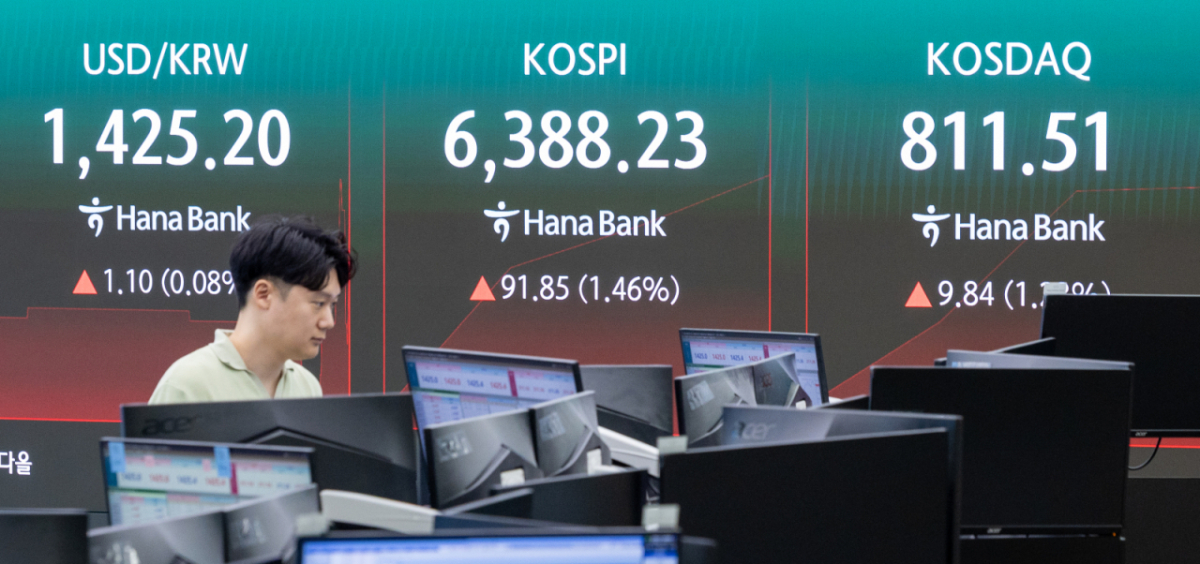
The KOSPI showed mixed performance with fluctuations in the 1st% range early on the 7th. This is interpreted as a ripple effect of foreign investors repeatedly buying and selling to realize short-term profits, following continued weakness in semiconductor stocks after SanDisk provided earnings guidance below market expectations.
As of 1:50 p.m. today, the KOSPI was trading at 6,226.20, down 70.75 points (1.11%) from the previous trading day. Earlier in the session, the KOSPI rose to as high as 6,415 before falling again, continuing to fluctuate within the 1st% range.
Weakness in semiconductor stocks seen in overnight New York markets influenced the mixed performance of domestic markets. After the market closed on the 5th (local time), SanDisk announced second-quarter revenue of $8.97 billion, exceeding the market forecast of $8.6 billion. The company also released positive factors such as long-term supply agreements (LTA) and shareholder return policies.
However, weakness continued into the next day after SanDisk provided third-quarter revenue guidance of $10.3–10.8 billion, slightly below market expectations. Western Digital also saw its stock price plummet after failing to meet market expectations for first-quarter earnings next year. As of the 6th, SanDisk and Western Digital stocks fell by 6% and 13%, respectively.
Experts in the financial investment industry diagnosed that recent domestic market movements are largely driven by supply-demand factors, in addition to weakness in U.S. semiconductor stocks. They noted that foreign investors are not engaging in long-term investments but rather buying and selling based on daily market conditions, primarily focusing on realizing profits by purchasing at low prices and selling at the top. In fact, yesterday foreign investors sold off 3.3114 trillion won worth of KOSPI stocks. While they initially bought net 108.8 billion won early in today's session, they switched to net selling, pushing sell pressure up to 604.9 billion won.
Heo Jae-hwan, Executive Director at Eugene Investment & Securities, stated, "Foreign investors are not actively buying, and retail investors also tend to sell immediately when indices rise, so there is no clear buying momentum." He added, "With no visible factors supporting stock price increases following the second-quarter earnings releases of Samsung Electronics and SK Hynix, it feels like there are no leading stocks."
Trend-based buying momentum is not appearing in futures markets either. Lee Sang-yeon, a researcher at Shinhan Securities, said, "Buying futures usually indicates expectations that stock prices will rise further later, but foreign investors have not bought for three consecutive business days or more since last month." He noted, "However, the total amount of selling has decreased compared to the first half of the year, and foreign ownership rates are slightly below the 10th-year average, so there is still room for buying."
Foreign investors unanimously emphasized that shareholder return policies, represented by dividends, are necessary for long-term investment. Particularly, while there is expectation that dividend yields will rise as market capitalizations of Samsung Electronics and SK Hynix have increased significantly, no concrete shareholder return policies have been announced so far. This means foreign investors lack incentives for long-term investment.
Na Jeong-hwan, a researcher at NH Investment & Securities, said, "Everyone knows that Samsung Electronics and SK Hynix are earning significant profits, and they are proceeding with investments in domestic and overseas semiconductor factories and performance-based pay increases, but no concrete alternatives for shareholders who have taken risks have emerged." He added, "It appears there is growing disappointment over the lack of active announcements regarding shareholder return policies."

 in STOCK
