

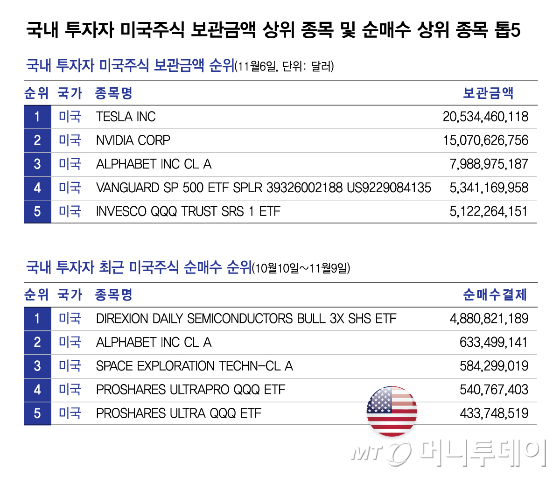
Domestic investors have net purchased $4.88082 billion (approximately 6.6 trillion won) worth of SOXL, a leveraged exchange-traded fund (ETF) that tracks three times the daily returns of the U.S. semiconductor index, over the past month. This amount is nearly eight times the net purchases of Alphabet, which ranked second. While major tech stocks such as Tesla and NVIDIA continue to dominate the top ranks in terms of total holding value in U.S. equities, short-term buying has concentrated on high-risk leveraged products, raising concerns about potential investment losses.
According to the Korea Securities Depository (KSD) on the 10th, SOXL was the most net-purchased U.S. stock by domestic investors from the 10th of last month to the 9th of this month. The net purchase amount for Alphabet, which ranked second, was only $633.5 million (approximately 850 billion won).
SOXL is a high-risk product that can yield approximately 9% returns if the U.S. semiconductor index rises by 3% in a day, but conversely, it may incur losses of about 9% if the index falls by 3%. While profits are substantial in a rising market, losses expand proportionally when the index fluctuates significantly.
The concentration in leveraged ETFs is not limited to SOXL. TQQQ, which tracks three times the daily returns of the NASDAQ100 index, ranked fourth with net purchases of $540.77 million (approximately 730 billion won), while QLD, which tracks two times the daily returns of the same index, ranked fifth with $433.75 million (approximately 590 billion won). It appears that high-risk leveraged products are becoming a major investment target for domestic investors.
This trend differs from that of stocks held for the medium to long term. As of the 6th, Tesla topped the list of U.S. stock holdings by domestic investors with $20.53446 billion (approximately 27.6 trillion won). NVIDIA ($15.07063 billion · approximately 20.3 trillion won) and Alphabet ($7.98898 billion · approximately 10.74 trillion won) followed. VOO, which tracks the S&P 500 ($5.34117 billion · approximately 7.2 trillion won), and QQQ, which tracks the NASDAQ100 ($5.12226 billion · approximately 6.9 trillion won), ranked fourth and fifth, respectively, while Apple and the U.S. dividend ETF SCHD also appeared in the top ranks. The total holding value of U.S. stocks is calculated by aggregating the valuation of U.S. equities held by domestic investors in dollars.
While investors are diversifying risk by mixing large-cap tech stocks with index and dividend ETFs in their holdings, purchases over the past month have been concentrated in leveraged products.
Capital market experts advise caution regarding leveraged ETF investments, noting that volatility is increasing not only in the domestic market but also in the U.S. market. Opinions also suggest being wary of uncertainty in the semiconductor industry outlook.
Park Seung-jin, a researcher at Hana Securities, stated, “As Big Tech companies continue to expand their AI infrastructure investments, high interest rates and the time lag in monetization are compounding burdens on cash flow and funding.” He added, “Funding conditions are deteriorating first for companies with low credit ratings and high dependence on external capital, leading to increased volatility in earnings and stock prices across the entire AI value chain.”

 in STOCK
