

As investors' dissatisfaction with the government's restructuring of the ISA (Individual Comprehensive Asset Management Account) grew, President Lee Jae-myung ultimately ordered a comprehensive review. Investors pointed out that the government was reducing existing benefits by changing the payment period and limits for the tax-exempt ISA account, while also forcing investments in the domestic stock market.
On the 7th, President Lee received reports on investors' backlash over the proposed ISA restructuring during a situation check meeting with his staff. President Lee reportedly criticized the move, asking, "Why did you do it like that without proper preparation?" and ordered a review.
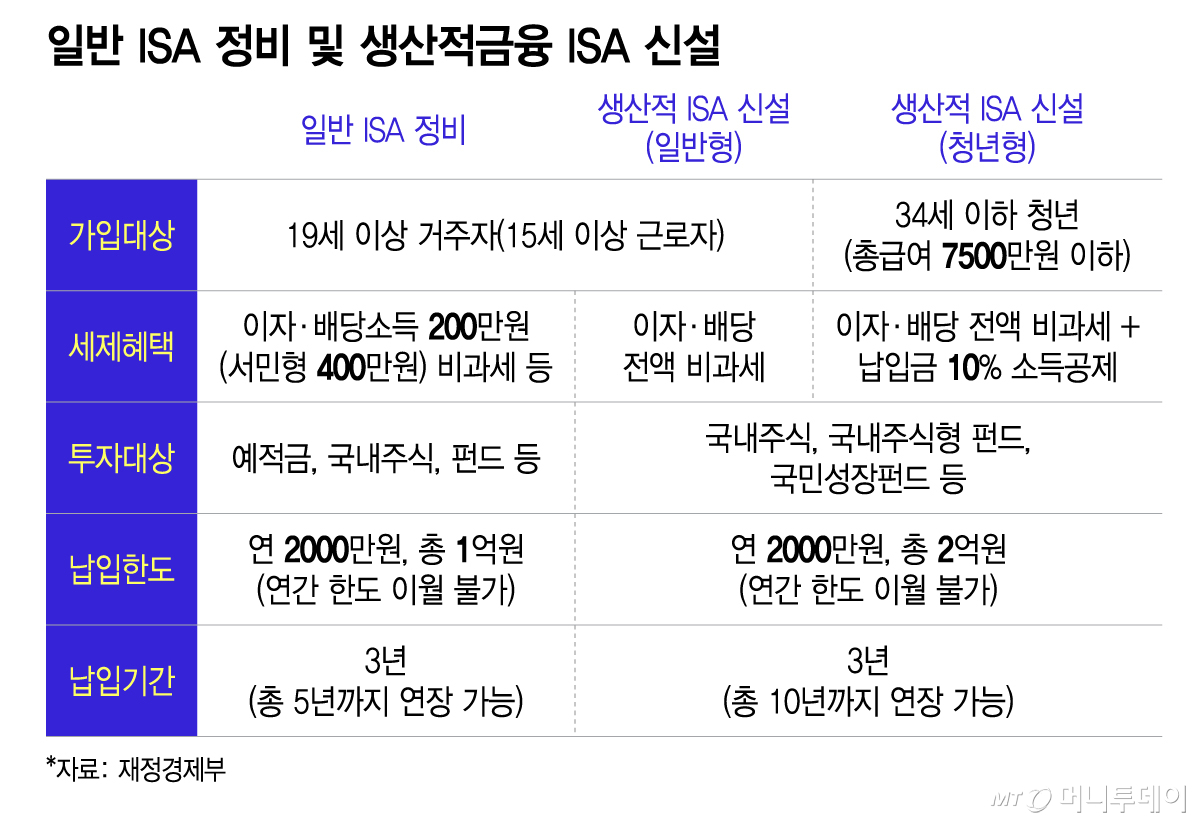
On the 3rd, the Ministry of Economy and Finance announced the '2026 Tax Reform Plan,' which includes measures to revise the payment period and limits for the tax-exempt ISA account and establish a new Productive Finance ISA.
Following the announcement, criticisms of the ISA restructuring continued among investors. The most significant issue pointed out by investors is the abolition of unlimited maturity extensions and the carryover of contribution limits.
Under the existing ISA rules, once the mandatory enrollment period (three years) had passed, maturities could be extended indefinitely. As a result, investors continuously extended their maturities, delaying tax payments until maturity and enjoying the effect of deferred taxation.
However, under the restructuring plan, starting January 1 next year, new enrollments or maturity extensions for ISAs will no longer allow unlimited extensions. The maturity period for general ISAs will be limited to a maximum of five years—three years as the base plus up to two additional years of extension. From next year, taxes must be settled every five years, and accounts must be re-enrolled. However, existing account holders who set their maturity periods to long-term before January 1 next year will not be subject to the new regulations.
The carryover of contribution limits for general ISAs will also be eliminated. Previously, any unmet portion of the annual 20 million won limit could be carried over to the following year. For example, if an investor contributed 5 million won in the first year, they could carry over the remaining 15 million won and contribute up to a maximum of 35 million won the following year. However, from next year, neither existing nor new account holders will be able to carry over contribution limits.
The government plans to introduce a new Productive Finance ISA, where all interest and dividends are fully tax-exempt, with a maturity extension period of up to 10 years in total. However, investor reactions have been cold. This is because the investment targets for the Productive Finance ISA are limited to domestic stocks, domestic stock-type funds, and National Growth Funds.
Following the announcement of the restructuring plan, critical posts about the ISA changes began appearing primarily on online communities. In particular, investors who had used ISAs to make regular investments in U.S. index ETFs expressed strong dissatisfaction. They pointed out that the government reduced existing ISA benefits to encourage enrollment in the Productive Finance ISA and promote investment in the domestic stock market. With the domestic stock market experiencing high volatility, they argued that the government ignored investors' choices and forced them into domestic stock investments.
Before the implementation of the restructuring plan, tips on how to effectively enjoy indefinite maturity extensions by setting general ISA maturities to 9999 were also spreading through online communities.
A representative from the financial investment industry stated, "Limiting ISA maturities to five years contradicts the ISA's purpose of encouraging long-term investments." They added, "The abolition of contribution limit carryovers could disadvantage young people with limited funds." The representative further noted, "Restricting the investment targets for the Productive Finance ISA and limiting investors' choices is also problematic."

 in STOCK
