

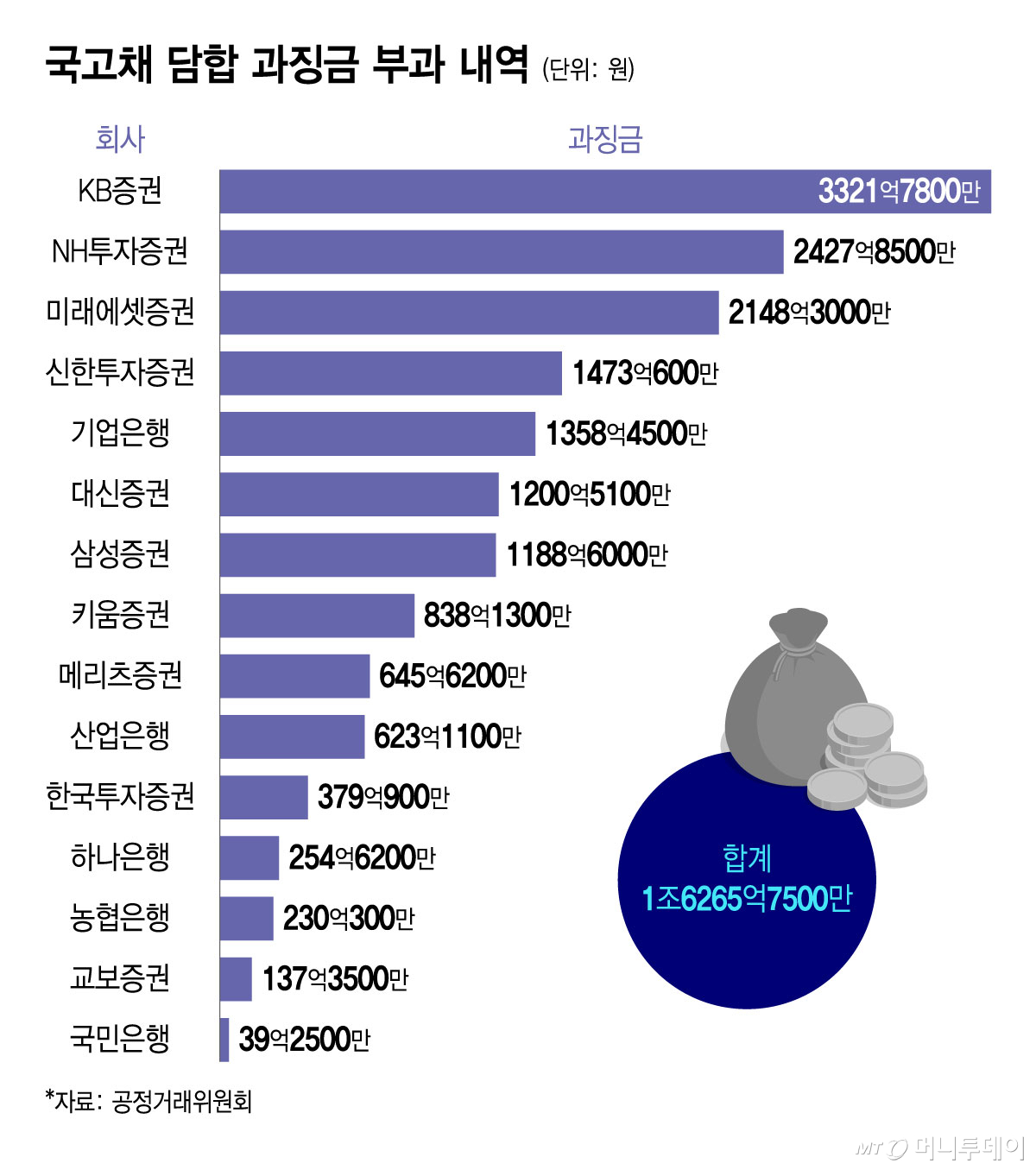
The Korea Fair Trade Commission (KFTC) imposed a record-high fine of 1.6 trillion won on 15 primary dealers (PDs) for colluding in government bond auctions. The PDs, arguing that business practices were unfairly labeled as collusion, have signaled plans to file administrative lawsuits, while market participants express concerns that the underwriting and distribution of government bonds could be stifled.
According to the KFTC on the 11th, 10 securities firms and five banks were ordered to cease their conduct and fined a total of 1.6266 trillion won. Of this amount, 1.376 trillion won is attributable to the securities firms. The commission decided to refer seven institutions—Mirae Asset Securities, NH Investment & Securities, KB Securities, Kiwoom Securities, Korea Investment & Securities, IBK Industrial Bank of Korea, and KDB Industrial Bank—to the Serious Crime Investigation Office. The KFTC determined that between January 2020 and June 2023, the PDs exchanged bidding rate information or agreed on interest rates and volumes in 150 out of 345 government bond auctions. It also disclosed cases where it took only five seconds to align bidding rates via a single phone call.
The PDs maintain that they are being wronged. An official at a major securities firm stated, "In the course of PD operations, this level of exchange is unavoidable. If it were collusion, there would have to be a victim or a beneficiary, but in PD business, (specific institutional investors' losses or gains) were virtually nonexistent." Another official at a large securities firm said, "This is an industry-wide issue, and everyone feels aggrieved," adding, "It is a business we participate in as market makers because the government assigned us that role." The industry argued that information exchange actually lowered winning bid rates, but the KFTC concluded that the PDs failed to prove this.
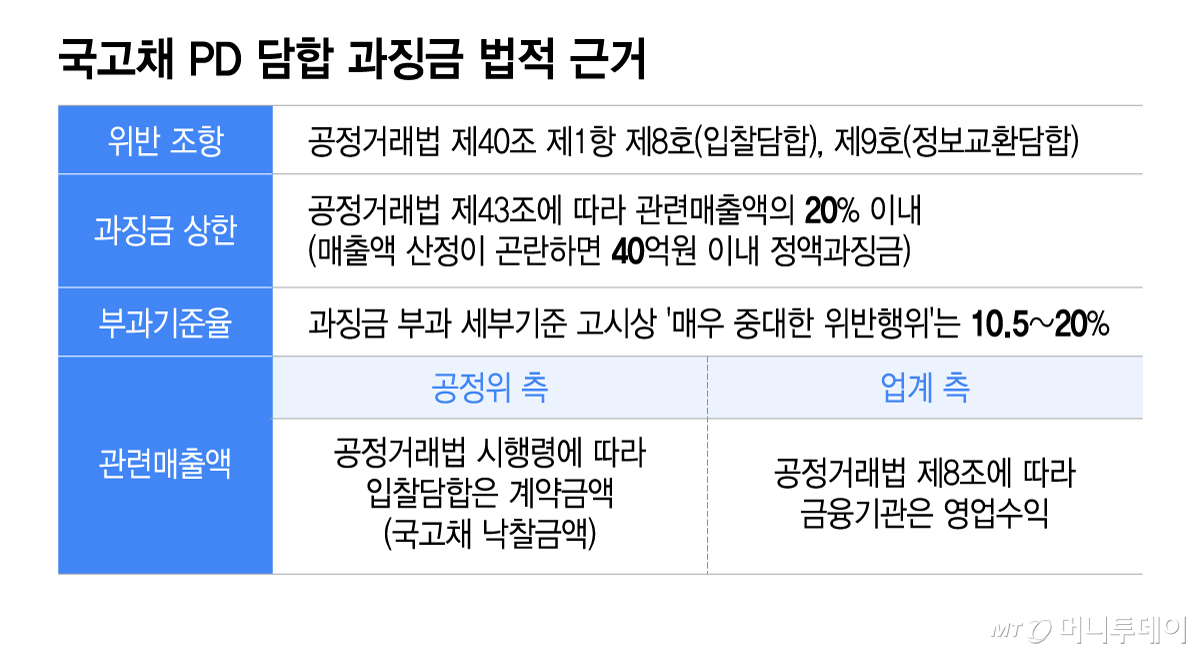
The industry also criticizes the calculation method, arguing that fines should be based on operating revenue rather than the winning bid amount. A financial investment industry official said, "Most companies will likely proceed with administrative litigation." Whether information exchange constitutes an unfair joint action and whether the fine calculation is lawful are expected to become key points of contention in court.
Market attention is shifting to the potential ripple effects on the bond market. PDs are core participants in the government bond market who, in exchange for obligations to underwrite 8% of competitive bidding volumes and duties to distribute and hold bonds, receive benefits such as non-competitive purchase rights and financial support. The KFTC expects that this sanction will revitalize bidding competition and reduce the government's funding costs.
Conversely, the industry worries that PDs may become passive in underwriting. After underwriting government bonds, PDs bear interest rate fluctuation risks when selling or holding them in the secondary market. If interest rates rise, the value of held bonds falls, resulting in losses. This is why analysts suggest that financial institutions, facing increased capital burdens due to fines, might reduce underwriting beyond mandatory volumes or shrink their holdings to mitigate risk.
If competition weakens in the primary market, the government may have to pay higher interest rates to secure desired funding volumes. Even if bidding competition intensifies, winning bid rates could actually rise if PDs' actual underwriting demand is insufficient. The secondary market also presents variables. If PD trading decreases, investors looking to buy or sell bonds will find it harder to locate counterparties, and the spread between bid and ask prices may widen. Since government bond yields serve as a benchmark for the domestic bond market, concerns arise that liquidity changes in the government bond market could spill over into trading conditions for other bonds. Another financial investment industry official expressed concern, "If market participation by government bond PDs is restricted, it could hinder not only government bond issuance but also the government's budget procurement and execution." The Ministry of Economy and Finance (MOEF) also conveyed to the KFTC its opinion requesting consideration of the impact on the bond market.
Retail investors are also within the sphere of influence. If interest rates rise, valuation losses will expand for long-term government bonds with long maturities and high duration (price sensitivity to interest rate changes), as well as long-term bond ETFs (exchange-traded funds). Bond ETF investors should also monitor trading volumes, bid-ask spreads, and the divergence from net asset value.
However, it is difficult to definitively state that the sanction will immediately lead to rising interest rates. Whether PD qualifications are suspended or revoked is a matter for the MOEF to decide separately, so bidding participation is not immediately restricted. The market view is that the extent to which market-making functions will be weakened must be assessed by monitoring future government bond auction bid response rates, winning bid rates, and secondary market trading volumes. There are also calls to revise the PD evaluation system, including the actual performance assessment regime, to block information exchange while maintaining underwriting participation.

 in STOCK

