

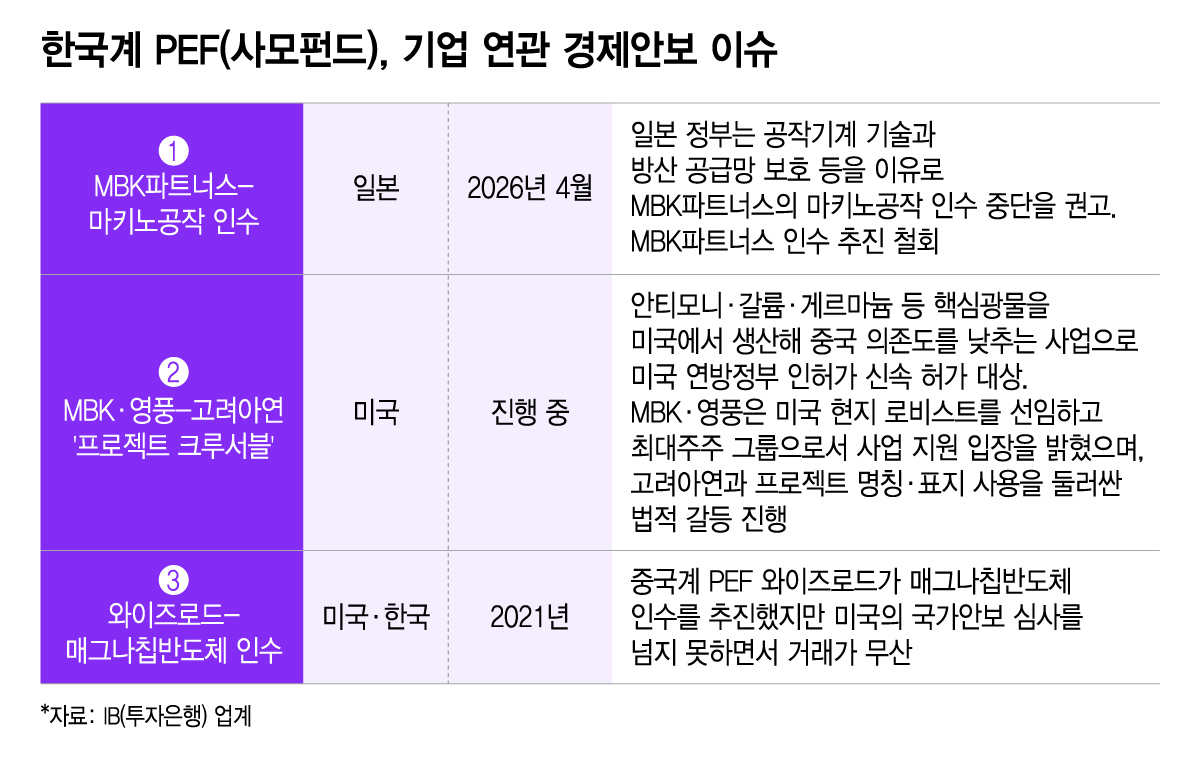
In overseas mergers and acquisitions (M&A) by private equity funds (PEFs), U.S. and Japanese containment of China has emerged as a key variable. It is observed that the U.S. and Japanese governments have intervened in permits for strategic industry M&A involving semiconductors, defense, and critical minerals with China in mind. Some PEFs are attempting to be recognized as strategic partners under U.S.-led supply chain policies.
According to the investment banking (IB) sector on the 7th, "Project Crucible," being pursued by Korea Zinc in Tennessee, is an integrated smelting project producing non-ferrous metals such as gallium, germanium, and antimony. These items are minerals that China has virtually led in refining and supply. With China imposing a full ban on exports to the U.S. from December 2024 until November of last year (currently subject to a temporary exemption allowing exports only through November), the U.S. regards them as strategic materials. Project Crucible was designated under the FAST-41 (Federal Permitting Improvement Steering Council) program by the U.S. government in April. This has led to interpretations that the U.S. is accelerating its efforts to restructure supply chains away from China.
MBK Partners and Youngpoong, engaged in a management rights dispute with Choi Yun-beom Ko Ryeo-a-yeon (Chairman), announced their support for the project by introducing themselves as the largest shareholder group in the U.S. Recently, they have also been involved in conflicts over the use of names and signage related to Korea Zinc and Project Crucible. After Korea Zinc filed criminal complaints against Youngpoong and MBK for unauthorized trademark use and business interference, MBK and Youngpoong countered by accusing them of suppressing shareholder rights. MBK and Youngpoong argued, "Project Crucible is not a registered trademark exclusively owned by Korea Zinc, and we clarified the organizer's identity and held communication events to cooperate with local stakeholders in the U.S. Claiming this as impersonation or infringement of business signs is far-fetched."
The IB sector views this conflict as signifying that competition to secure representation rights for strategic U.S. projects has officially begun. There are also interpretations that, during the management dispute, whichever side is accepted by the U.S. government as an official negotiating partner will gain a favorable position in terms of external perception.

MBK Partners was advised by the Japanese government in April to halt its acquisition of Makino Milling Machine and subsequently withdrew from the deal.
The Japanese government cited as grounds that Makino is a world-class machine tool manufacturer whose products are widely used by Japanese defense companies, thereby blocking MBK Partners' acquisition.
Observations suggest that due to China-related variables, Japan has taken a hardline stance on security issues. This comes amid the U.S. Trump administration showing a more lukewarm approach to alliance defense compared to the previous administration, while tensions with neighboring China are escalating.
In the U.S., there have been precedents where PEF acquisitions were derailed due to China-related variables.
Chinese PEF Wise Road attempted to acquire Korean semiconductor company MagnaChip Semiconductor in 2021 but failed when it could not obtain approval from the Committee on Foreign Investment in the United States (CFIUS). CFIUS reportedly determined that the acquisition posed national security risks. It is interpreted that concerns arose over potential transfer of semiconductor technology to China via a Chinese PEF, which could compromise U.S. national security.
Other PEFs are also closely monitoring trends in economic security-related projects such as Project Crucible. In overseas M&A, there is growing need to consider not only acquisition prices but also the target country's technology protection, supply chain stability, and national security policies. An IB sector official stated, "Protection of strategic technologies may determine whether a deal succeeds, more so than acquisition price or shareholder judgment." He added, "Pre-deal review scope has expanded beyond financials and business viability to include the latest regulations in the target country as well as the security environment."

 in STOCK

