

Amid easing volatility, shares of semiconductor leaders Samsung Electronics and SK Hynix rose only marginally, fueling investor anxiety as the market trend continues. Despite posting modest gains on this day, both Samsung Electronics and SK Hynix have recorded evaluation losses exceeding 30% compared to their respective peaks in June. The securities industry forecasts that a second rally could be possible if these companies' profitability continues to grow sustainably.
As of 10:05 a.m. on the 12th, Samsung Electronics was trading at 248,000 won, up 8,500 won (3.55%) from the previous day. Although Samsung Electronics rose for two consecutive days, its price remains down 33.7% compared to June 19, when it reached a peak of 374,500 won.
At the same time, SK Hynix was trading at 1,448,000 won, up 23,000 won (1.61%) from the previous day. Despite rising for two consecutive trading days, SK Hynix's share price has halved compared to June 25, when it reached a high of 2,987,000 won.
At the market's opening on this day, stocks related to Samsung Electronics and SK Hynix surged sharply. These stocks are companies that saw relatively smaller gains during the rapid rally driven by Samsung Electronics and SK Hynix, but they have recently begun rallying again. SK Square, which has equity and business ties with Samsung Electronics and SK Hynix, rose 9.58% from the previous day as of this moment; Samsung Life Insurance rose 3.97%, and Samsung C&T rose 3.05%.
Within the semiconductor and semiconductor equipment sectors, supply and demand are shifting toward small- and mid-cap companies listed on KOSDAQ. As of this moment, Ji-A-Es rose 11.06% from the previous day. This was followed by TKC (9.98%), Hydeep (9.97%), FST (8.33%), GNB Eco (7.55%), KX Hi-Tech (7.54%), and GeoElement (7.39%), which all posted significant gains.
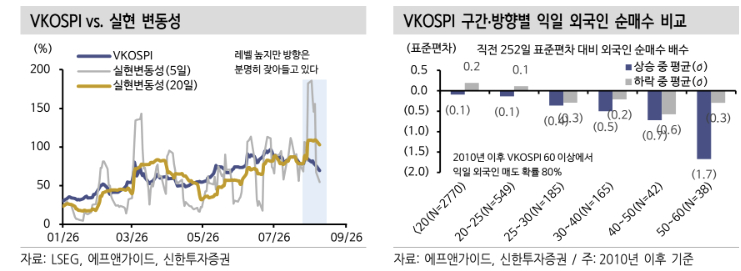
Investor sentiment toward Samsung Electronics and SK Hynix appears to have contracted due to over a month of sluggish stock performance. However, the securities industry analyzes that as capital inflows previously concentrated on Samsung Electronics and SK Hynix ease, a rotation trend is emerging where momentum is spreading to small- and mid-cap stocks. In fact, VKOSPI, which measures volatility in KOSPI 200, has fallen to around 70 points this month, down from the spike to 95 points at the end of June.
Outlook for the semiconductor sector remains positive. Since late last month, as major U.S. tech companies released earnings, concerns regarding AI (artificial intelligence) industry profit forecasts and CAPEX (capital expenditure) investments have largely dissipated, leading to sustained expectations across the entire sector.
Kim Jae-seung, a researcher at Hyundai Motor Securities, stated, "Through LTA (long-term supply agreements), if volatility in profit margins is reduced and production volumes increase, revenues and profits will expand, potentially triggering a second strong phase for Korea's semiconductor sector." He added, "As the domestic semiconductor sector has entered its final stage of rapid stock price increases driven by margin expansion, it is necessary to monitor whether sales continue to grow while maintaining current profitability levels."
Noh Dong-gil, a researcher at Shinhan Investment Corp, said, "Given that corporate profit consensus estimates have not been significantly impaired so far, the recent one-month correction appears to be influenced by high volatility and supply-demand imbalances." He noted, "When assessing an index rebound, it is equally important to verify how normalized the supply-demand structure—which drove up volatility—has become, just as much as reviewing profit forecasts."
Meanwhile, on the eve of the CPI (consumer price index) release, the overnight New York market saw a decline centered on semiconductor stocks. At the New York Stock Exchange, the Dow Jones 30 Industrial Average fell 0.34% from the previous session, the S&P 500 Index dropped 0.32%, and the NASDAQ Composite, focused on technology stocks, declined 0.60%. The market anticipates that July's headline CPI year-over-year increase and core CPI increase will be lower than the previous month.

 in STOCK

