

Net cash jumps from 35 trillion to 69 trillion won in three months... SK Hynix unveils record-breaking shareholder returns
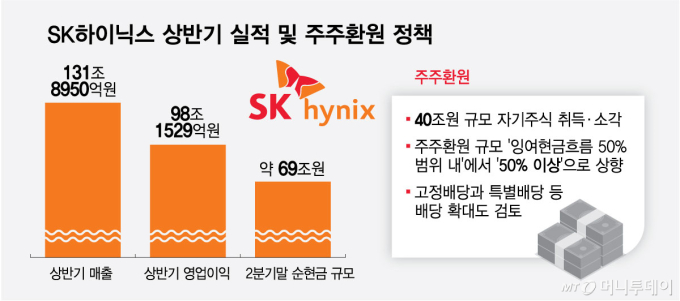
SK Hynix has unveiled a record-breaking shareholder return card: the acquisition and cancellation of its own shares worth 40 trillion won. Thanks to the boom in AI (artificial intelligence) memory, net cash increased by more than 34 trillion won in just three months, creating room to simultaneously pursue large-scale investments, ensure financial stability, and deliver shareholder returns. Evaluations suggest that the weight of capital allocation has shifted from a "investment-first" approach to one that pursues both investment and shareholder returns.
SK Hynix held a board meeting on the 19th and decided to expand its shareholder return scale from "within 50% of cumulative free cash flow (FCF)" to "50% or more," alongside acquiring and retiring shares worth 4 trillion won. The company is also considering expanding dividends by concurrently implementing share buybacks and retirements along with cash dividends, including fixed dividends and special dividends. Additional shareholder return plans are expected to be announced in conjunction with the third-quarter earnings announcement.
The 40 trillion won figure represents the largest share buyback and cancellation case among domestic listed companies in history. This amount is more than double the 16th trillion won self-share cancellation plan announced by Samsung Electronics for the first half of this year through its "2025 Business Report" released last March. Analysts suggest this signals a direct breakthrough against the undervalued stock price situation through large-scale share buybacks and cancellations.
SK Hynix appears to have substantial capacity for shareholder returns. Previously, Mirae Asset Securities estimated SK Hynix's free cash flow (FCF) for this year at approximately 180 trillion won. Even with a simple calculation, returning just 50% of that amount would reach 90 trillion won. With the return threshold raised to "50 percent or more" this time, there is also a possibility that the scale of shareholder returns will grow further depending on future performance and cash flow.
The background behind the record-breaking shareholder return decision is the surge in cash reserves driven by the AI memory boom. Initially, SK Hynix had set a target of maintaining over 100 trillion won in net cash, prioritizing the securing of a stable financial structure and future business investments over short-term shareholder returns. Even during last quarter's earnings announcement, the company emphasized that "reinvesting the generated cash into businesses is currently the best method for capital utilization."
However, as cash accumulated faster than expected, the calculation changed within three months. SK Hynix reported an operating profit of 98.1529 trillion won in the first half of this year alone. Net cash, which stood at 35 trillion won at the end of the first quarter, increased by more than 34 trillion won to reach 69.4 trillion won by the end of the second quarter within just three months.
If this cash generation capability continues, the company can quickly approach its financial stability target of 100 trillion won in net cash. In addition, long-term supply contracts (LTA) with key customers have increased medium- to long-term demand visibility. With reduced uncertainty in investment and production plans, there is now greater capacity to expand long-term capital allocation and shareholder returns.
Furthermore, market voices grew louder that shareholder returns were insufficient relative to the scale of profits. Given that 10% of operating profit is utilized as a source for employee performance bonuses, there was a demand to expand shareholder returns commensurate with the profit scale. The declining stock price also posed a burden. On this day, SK Hynix shares closed at 1.5 million won. Compared to the all-time high closing price of 2.919 million won on June 22 last year, this represents roughly half that level.
The decision was influenced by the judgment that the stock price does not fully reflect corporate valuation despite record-breaking performance and cash generation capabilities. An SK Hynix official stated, "The company's intrinsic value, including business competitiveness, cash generation capacity, and medium-to-long-term growth potential, has not been sufficiently reflected in the current stock price."
This also signifies the early implementation of the shareholder return policy announced in November 2024. At that time, SK Hynix stated it would conduct shareholder returns within a range of 50% of cumulative free cash flow (FCF) from 2025 to 2027, and if FCF increased significantly due to improved performance, it would consider early return even before the policy's expiration. The boom in AI memory caused the conditions for early return previously outlined to be met faster than expected.
The market has already shown strong interest in additional shareholder returns since the second-quarter earnings release last month. This is due to capital inflows from the sale of Kioxia shares and the issuance of American Depositary Receipts (ADRs), as well as a significant increase in cash generated from core operations. However, the company did not disclose specific details regarding the method, scale, or timing of these shareholder returns.
There were restrictions on information disclosure due to the ADR listing. SK Hynix noted that the 25th-day prospectus delivery period following its ADR listing on July 10 overlapped with the timing of its second-quarter earnings announcement. The company explained that it was constrained from disclosing new material information not previously revealed during the public offering process, which prevented it from detailing specific shareholder return plans at the time.
Indeed, during the conference call at that time, SK Hynix drew a line by stating, "Due to regulatory and procedural constraints related to the ADR offering, there are certain limitations on providing additional new material information not disclosed during the offering process at this current moment." Once that period concluded in early this month, the board of directors convened and decided on the acquisition and cancellation of treasury shares worth 40 trillion won, as well as an expansion of shareholder returns.
SK Hynix delivers record-breaking shareholder returns; securities firms cite "strong stock momentum"
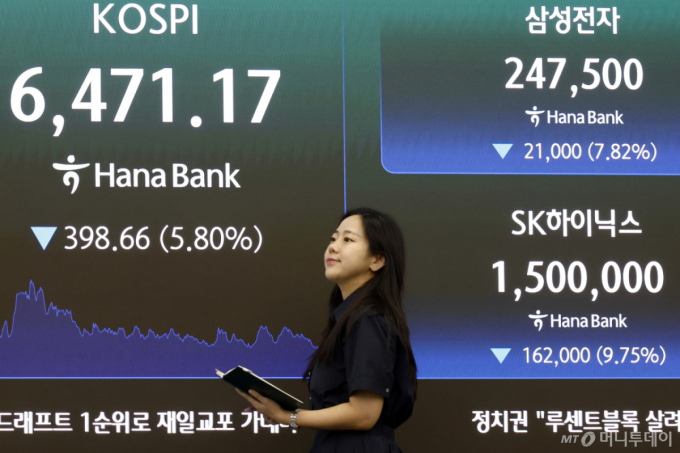
Analysts expect SK Hynix's 40 trillion won shareholder return plan to have a generally positive impact on future stock prices. The key point is that the scale of the return plan has increased compared to previous ones.
Lee Jae-won, a researcher at Yuanta Securities, evaluated on the 19th that SK Hynix's decision to acquire and retire shares worth 4 trillion won serves as a material for revaluation of its strong stock defense, confirming that performance improvements are translating into actual shareholder returns at a time when valuation pressures have increased due to rising market interest rates.
SK Hynix announced at its board meeting on this day that it will return more than 50 percent of its cumulative free cash flow (FCF) by 2027, implementing both share buybacks and cancellations as well as dividends.
The total amount planned for the acquisition of treasury shares is 40 trillion won. Based on the closing price of 1.662 million won per share on the day before the board resolution, this corresponds to approximately 3.3% of the issued shares (totaling 730.49 million shares), amounting to 24.07 million shares. The planned acquisition period is from August 20 for about three months, and all acquired shares are scheduled to be cancelled after the acquisition concludes. This represents the largest case of treasury share cancellation among domestic listed companies.
The researcher said, "(after the announcement of the shareholder return plan) NextTrade is currently rebounding with most of the day's sharp decline being recovered, and NASDAQ futures are also recovering most of their losses," adding that "expectations that Samsung Electronics will expand its shareholder return are also being reflected."
Some experts suggest that a key point of this shareholder return plan is the change from a previous commitment to implement shareholder returns within a range of up to 50% of the cumulative free cash flow (FCF) for the three-year period (2025–2027) to an updated plan covering more than 50% of FCF.
No Geun-chang, head of the Research Center at Hyundai Motor Securities, emphasized that "a commitment to return more than 50 percent to shareholders by 2027 reflects confidence in market conditions" and added that it is expected to become a strong momentum for stock prices. Kim Young-geon, a researcher at Mirae Asset Securities, also stated that "the plan to return more than 50 percent of free cash flow (FCF) is a more positive point than the 40th trillion won shareholder return plan."
A securities firm research center official, who requested anonymity, said, "SK Hynix's 40 trillion won share buyback and cancellation is likely to serve as a catalyst that reduces the gap between its target price by alleviating some of the valuation discount recently reflected in the stock price. However, reducing this gap also requires restoring market confidence in AI memory demand, supply shortages, and earnings growth."
On the other hand, some argue that it is difficult to determine whether SK Hynix's recent shareholder return will have an unequivocally positive impact on short-term stock prices. Choi Bo-young, a researcher at Kyobo Securities, stated, "Theoretically, this is good news, but event-driven buying may also occur, making it hard to predict the short-term impact on stock prices."
Another securities firm research center official, who requested anonymity, said, "It is not so much a huge positive development as it raises expectations that Samsung Electronics might increase its shareholder returns."
Jung Woo-sung, a researcher at LS Securities, said, "We believe this will serve as an opportunity to enhance market confidence in SK Hynix's shareholder return and partially alleviate valuation discount factors," while also noting that "expanding shareholder return alone is unlikely to fundamentally resolve the gap between the current target price and the stock price."
Will Samsung Electronics issue a special dividend? Outline of shareholder return measures expected as early as this month
Following SK Hynix's announcement of a 4 trillion won shareholder return policy, attention is also turning to whether Samsung Electronics will declare a special dividend.
According to the electronics industry on the 19th, Samsung Electronics plans to announce specific shareholder return measures, including a special dividend, as early as this month, along with related policies to be applied from 2027 onward.
Samsung Electronics' current shareholder return policy is structured to pay regular dividends of approximately 9.8 trillion won annually, funded by 50% of the free cash flow (FCF) generated over the three-year period from 2024 to 2026, with additional returns made if residual funds remain thereafter.
First, sufficient financial resources have been secured. According to Samsung Electronics' semi-annual report, as of the end of June, consolidated cash and cash equivalents totaled 92.9164 trillion won, while short-term financial products amounted to 97.0366 trillion won. After deducting short-term borrowings, current portions of long-term debt, corporate bonds, and long-term borrowings, net cash is estimated at approximately 167 trillion won. Previously, Samsung Electronics stated that it could flexibly announce and implement a new shareholder return policy before the termination of the current policy, taking into account the scale of its cash holdings. Accordingly, the increased cash reserves are considered one of the key variables in determining the next policy.
Samsung Electronics has also taken precedent-setting steps for additional returns. In last year's final dividend, the company distributed an extra 1.3 trillion won in dividends, taking into account tax reforms and projected dividend funding sources. The company also carried out share cancellations twice. Of the 3rd trillion won acquired as part of its 10 trillion won share buyback plan announced in 2024, all shares were cancelled last year. Additionally, shares acquired subsequently for the purpose of enhancing shareholder value were also cancelled in April this year. Shares allocated for employee compensation were excluded from cancellation. The total scale of cancellations amounted to approximately 5.3461 trillion won based on acquisition cost.
The key now is how Samsung Electronics will allocate its available resources between growth investments and shareholder returns. During last month's second-quarter earnings announcement conference call, the company emphasized that "the current board of directors and management are actively discussing concrete implementation plans for this year's shareholder return policy, including special dividends," and added that "in-depth discussions are also underway regarding the next shareholder return policy." It further promised to "develop a plan that maximizes the effect of enhancing shareholder value and secures an optimal balance between reinvestment for future growth and shareholder returns, which will be shared with shareholders shortly."
In this process, advance payments for long-term supply agreements (LTAs) with memory semiconductor customers and share buybacks aimed at compensating employees may act as variables in the calculation of free cash flow (FCF). This is because an increase in cash holdings alone cannot be viewed entirely as a source for return to shareholders. However, given that the scale of net cash has expanded ahead of the termination of current policies, the industry is closely watching whether additional return measures will emerge in the shareholder return policy to be announced going forward.

 in STOCK


