

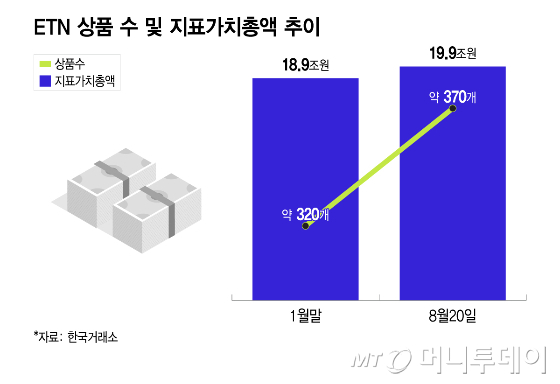
Analysis indicates that assets under management for index-tracking products operated by securities firms, known as ETNs (Exchange Traded Notes), have effectively contracted this year. While the number of products increased by about 15%, asset growth remained at just 5%, contrasting sharply with ETFs (Exchange Traded Funds) managed by asset management companies, which grew nearly 30% in size over the same period. Even for securities firms posting record-breaking profits, the chronic underperformance of ETNs remains an unresolved concern.
According to Korea Exchange information data as of the 20th, the total index value of ETNs stood at 19.8928 trillion won as of January 30, representing a 5% increase from that date. The total index value of ETNs is conceptually similar to the net asset value of ETFs and reflects the overall scale of assets.
Considering that the KOSPI index followed an upward trajectory during the same period and the number of ETN products rose from around 320 to approximately 370—an increase of over 15%—the assessment is that the ETN market has effectively contracted in size.
In contrast, ETF net assets grew by more than 100 trillion won (approximately 30%), rising from 348 trillion won at the end of January to 452 trillion won as of the 20th. ETF net assets even briefly exceeded 500 trillion won in June.
Both ETFs and ETNs are non-principal-guaranteed indirect investment products listed on exchanges that track the performance of underlying indices. They also share a common feature: investors can lock in returns through real-time trading without requiring any early redemption procedures.
However, unlike ETFs, which have firmly established themselves as a primary indirect investment vehicle for investors, ETNs continue to struggle with low recognition. ETFs are managed by asset management companies, whereas ETNs are operated by securities firms. Securities firms believe that the fact that ETNs were launched approximately 10 years later than ETFs has negatively impacted their brand recognition.
Recently, as investment through retirement pension plans has increased, ETFs have further solidified their position, while ETNs face institutional barriers to inclusion in such investments. ETFs are funds that hold actual underlying assets, whereas ETNs are bonds promising to pay returns, carrying the credit risk of the issuer; thus, they are not eligible for retirement pension investment. This difference in investor preference is a key reason why the gap between the two products continues to widen.
In fact, as of the 20th, the six-month average daily trading volume for KODEX 200, the ETF with the largest net asset value managed by Samsung Asset Management, reached 2.3888 trillion won. In contrast, the same metric for Meritz KIS CD Interest Rate Investment ETN, the ETN with the highest total index value managed by Meritz Securities, was only 160 billion won. Even Samsung Inverse 2X KOSDAQ150 Futures ETN, which had the highest six-month average daily trading volume among ETNs, barely exceeded 396 billion won, highlighting a significant gap compared to ETFs.
Although major securities firms are reporting record profits this year, with first-half net earnings surpassing those of banks, the underperformance of ETNs—products primarily managed by securities firms—is seen as an issue that remains difficult to resolve.
While securities firms have made various attempts in recent years to expand ETN recognition, such as launching new thematic products with strong growth prospects beyond their traditional focus on oil and commodity-tracking products, these efforts are still considered unable to overcome structural limitations.
As derivative-linked products, ETNs face difficulties in advertising and promotion. Unlike ETFs, which must invest in physical assets, ETNs are issued based on the creditworthiness of securities firms. If a securities firm were to go bankrupt, investors might not receive the money they are owed.
A securities firm official stated, "Compared to ETFs, which must hold a diverse range of stocks, ETNs have a narrower scope of underlying assets and are concentrated in specific sectors, resulting in higher volatility and risk that can deter many investors." The official added, "Recently, securities firms are adjusting their strategies to expand market share by targeting institutional investors rather than retail investors."

 in STOCK
