

Forecasts indicate that the recovery in global steel demand will slow down more than initially expected. Concerns over oversupply are growing as China's domestic sluggishness persists. The domestic steel industry is adopting a strategy of finding a breakthrough by targeting demand for high-value-added products driven by expanded investment in AI (artificial intelligence) data centers and related infrastructure.
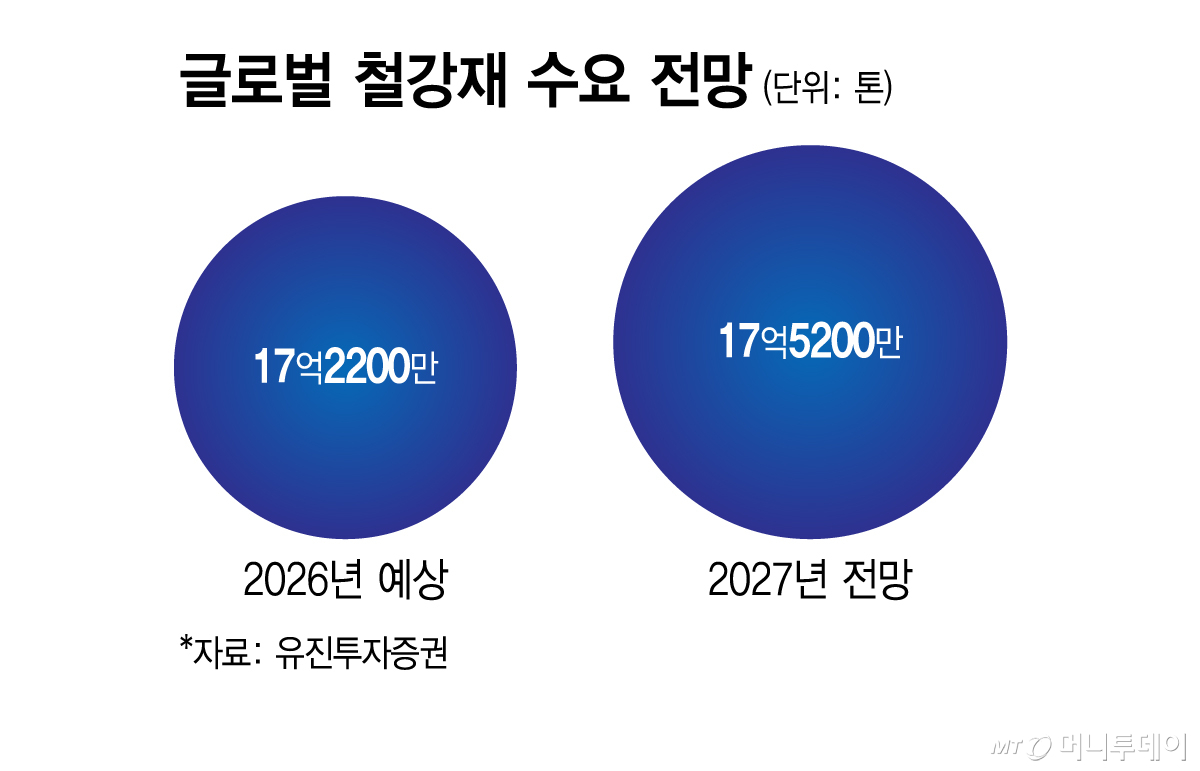
According to industry sources on the 16th, the World Steel Association (WSA) projected that global steel demand in 2027 will reach only 1.752 billion tons, a 1.7% increase from this year's forecast of 1.722 billion tons. This is a downward revision from the previously presented outlook of a 2.2% increase. In particular, China's steel demand is estimated to decrease from 780 million tons this year to 772 million tons next year. This is due to delays in the recovery of the local real estate market and infrastructure investment falling short of expectations.
China's domestic sluggishness poses a threat to the domestic steel industry as it could lead to expanded exports. This is because if Chinese steelmakers divert volumes they cannot absorb domestically to overseas markets, competition over global steel prices could intensify. Although the Chinese government has stated its stance on production cuts, the industry believes that oversupply can only be resolved through restructuring that reduces production capacity itself, going beyond simple adjustments to operating rates.
A positive aspect is that steel demand is increasing in the United States and Europe, among other regions, driven by expanded investment in AI data centers and power infrastructure. According to the WSA, U.S. steel demand is expected to increase by 1.5% and European Union (EU) demand by 3.1% compared to this year. This is because structural steel demand can arise not only from data center construction but also from the expansion of supporting power facilities and semiconductor factories.
In fact, this trend can be confirmed in recent U.S. steel import trends. Although the United States raised tariff barriers to protect its domestic steel industry, steel imports actually increased. According to Hana Securities, U.S. steel imports in August reached 2.21 million tons, recording the highest level since June 2024. This represents a 29.8% increase compared to the same month of the previous year. In terms of import value, it was $2.11 billion, a 14.4% increase from the same period last year.
The domestic steel industry is also launching market offensives led by shaped steel brands targeting AI-driven demand. Since data centers house various equipment such as servers and storage devices, structural steel that supports the load of buildings is important. In particular, H-beams used for columns and beams require selecting appropriate products according to the building's structure and load conditions. Representative examples include RH (rolled H-beam) produced by rolling and BH (built-up H-beam) manufactured by welding plates.
Dongkuk Steel took the lead in responding to the related market by launching its customized shaped steel brand, "D-Megabeam," last year. This month, Hyundai Steel also unveiled "H ONE," an integrated brand encompassing both RH and BH. The strategy is to integrate product lines to respond to diverse customer needs and propose suitable products for each project. An industry official said, "The goal is to comprehensively review the structure, load, specifications, steel grade, volume, and delivery schedules of large-scale construction projects to propose appropriate combinations of RH and BH products, and to provide solutions considering structural performance and economic efficiency."

 in INDUSTRY
