

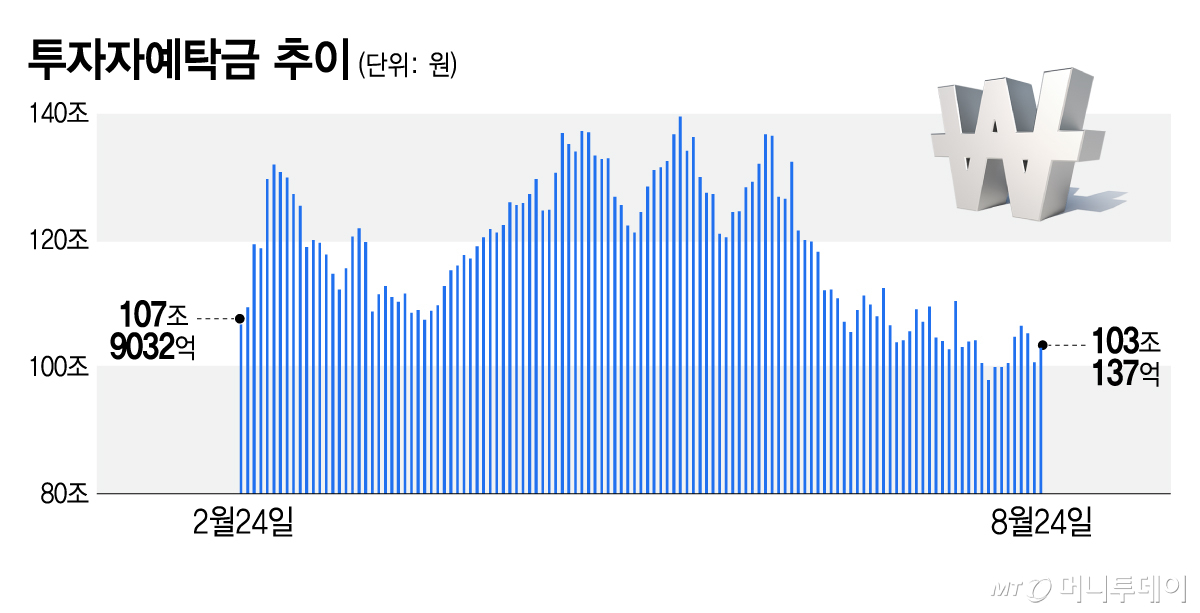
Market standby funds, which once neared 140 trillion won, have sharply declined to the 100th trillion won range. Trading volume, which had surged close to 200 trillion won, has now shrunk to one-third of its peak. Over the past two months, as the stock market corrected after continuously rising and surpassing the 9,000-point level, liquidity in the stock market has dropped sharply, dampening market vitality.
Investors exhausted by roller-coaster market conditions appear to be leaving the stock market for banks. The balance of time deposits at five major banks has exceeded 1,000 trillion won for the first time in history.
According to data from the Korea Financial Investment Association and others on the 25th, as of the 24th, investor deposits stood at 103.136 trillion won. Notably, on the 11th, they recorded 97.9289 trillion won, falling below the 100th trillion won mark for the first time in six and a half months since January 26. Investor deposits refer to funds deposited by investors with securities firms for trading financial investment products such as stocks. In other words, it represents cash remaining in investors' securities accounts and is generally regarded as standby funds for stock investments.
Typically, when stock trading is active, deposits increase. From the beginning of this year until June, when the KOSPI index rose daily and broke through the 9,000-point level, investor deposits steadily grew, reaching a record high of 139.6947 trillion won on June 4. Afterward, during the continued upward trend, they decreased slightly, but have now sharply declined amid the July downturn.
Margin trading balances, which had risen to around 38 trillion won by the end of June, also fell to approximately 27 trillion won at the beginning of this month. This marks the first time in six months that margin balances have dropped below 30 trillion won. The decline appears to be influenced by proactive management measures taken by the securities industry amid concerns over market overheating and regulatory tightening by financial authorities on issues such as excessive trading in single-stock leverage ETFs (exchange-traded funds).
In particular, the sharp contraction in investor sentiment was largely driven by concerns over AI (artificial intelligence) investments and the possibility of a semiconductor peak-out, which caused the domestic stock market to decline last month. At the end of July, the KOSPI index fell 38.6% from its all-time high to 5,593.56 points. Although it rebounded in August amid improving earnings, it has yet to successfully recover to the 7,000-point level.
Trading volume, which serves as an indicator of market liquidity, has also dropped significantly, shrinking to one-third of its peak. On the 24th, domestic stock market trading volume (including NextTrade) for KOSPI and KOSDAQ reached 63.124 trillion won. While it had risen to 195.7 trillion won on June 1, it has been declining since falling below 100 trillion won on July 6.
Although the KOSPI index has rebounded this month, signaling a recovery in stock market funds, macroeconomic uncertainties such as geopolitical risks and interest rate volatility are expected to persist. Rather than a full-scale rebound, the market is likely to fluctuate based on specific events. Lee Jae-won, a researcher at Yuanta Securities, stated, "The market is expected to continue with a structure where interest rates constrain the upside while corporate shareholder returns support the downside." He added, "While rising long-term interest rates and oil prices are familiar headwinds, further increases could strain supply-demand dynamics and valuations."

 in STOCK
