

As society enters a super-aged era, the importance of retirement income has grown, prompting suggestions that defined contribution pension management must shift from savings to investment. Although the total assets of defined contribution pensions have surpassed 500 trillion won, their returns are far too low to ensure adequate retirement security due to heavy concentration in principal-and-interest-guaranteed products. Consequently, it is argued that a fund-type system should be introduced to leverage professional asset allocation capabilities and raise the income replacement rate. There was also opposition to having the National Pension Service participate in the fund-type system.
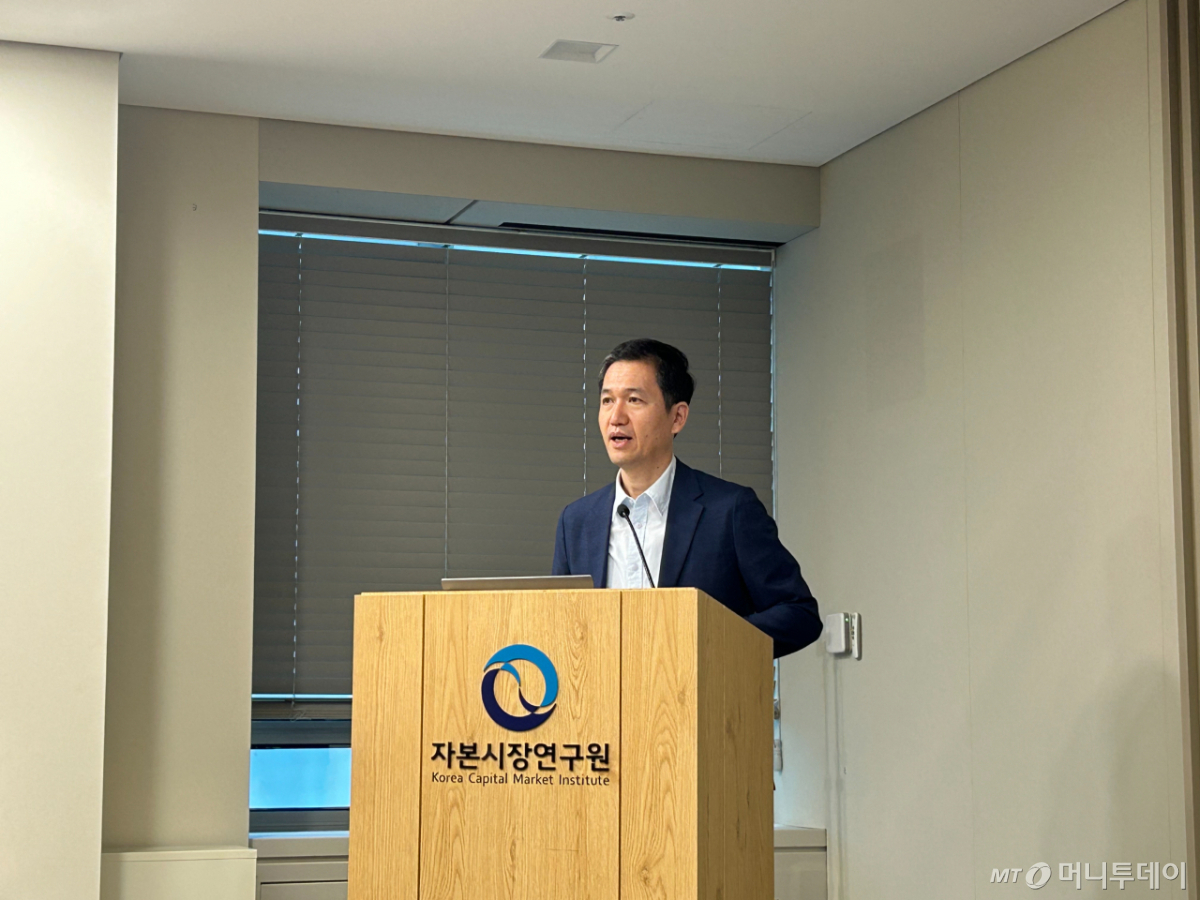
On the 4th, at the KCMI Issue Briefing held at the Capital Market Institute of Korea in Seoul Yeouido, Senior Research Fellow Nam Jae-woo presented a report titled "Reforming the Defined Contribution Pension System for Multi-layered Retirement Income in a Super-Aged Society," making these remarks.
Researcher Nam stated, "If we block early withdrawals ('mid-term leakage') and raise returns to 7–8% as done in the United States and Australia, the income replacement rate could reach up to 30% through defined contribution pensions alone. With just two mandatory systems—the National Pension and defined contribution pensions—we can achieve an adequate income replacement rate of 60–70%, allowing retirees to live comfortably on pension income."
To raise the income replacement rate as described, Researcher Nam argued that professional management must be entrusted to experts, maximizing indirect investment and outsourced operations, thereby necessitating the introduction of a fund-type system. The Task Force (TF) for Strengthening Defined Contribution Pension Functions also had labor, business, and government jointly declare in a joint statement the adoption of a fund-type system and mandatory participation in defined contribution pensions. However, while they agreed on the fund-type system and mandatory participation, they allowed mid-term leakage—a key requirement for raising the income replacement rate—to remain unaddressed. The results of the joint statement are expected to be reflected in amendments to the "Employee Retirement Benefits Security Act," which aims to revise the law within this year.
The core of the joint statement proposes establishing a DC-type fund system to pool funds and achieve economies of scale, with three specific sub-types: △non-profit alliance type, △financial institutional investor open type, and △public type.
Researcher Nam explained, "The essence of a fund-type system is not merely accumulating reserves to expand the scale of operations but reforming governance structures to enable professional management, conflict-of-interest management, and long-term performance evaluation through independent decision-making bodies that reflect workers' interests and fiduciary responsibilities." He added, "Each of the three sub-types does not exist in a mutually competitive relationship; rather, they serve different institutional purposes and are complementary to one another."
Researcher Nam opposed the participation of the National Pension Service in the public-type fund system. The National Pension Service argues that its high investment returns and low operating costs leveraging existing infrastructure are key advantages. However, Researcher Nam countered, "It would only make sense if the current portfolio of the National Pension Fund could simply add defined contribution pensions and operate them identically. But since the two funds have different operational objectives and risk tolerances, they cannot be managed under the same portfolio." He further stated that there would be no differentiation from the existing public-type fund 'Blue Seed' operated by the Korea Welfare Service, and that public intervention in the private market would be negative.
Even after introducing a fund-type system, the report emphasized that existing contract-type defined contribution pensions will remain for a significant period and should be pursued alongside operational efficiency improvements. In particular, for DC-type systems, enhancing the effectiveness of pre-designated operation systems—i.e., default options—is crucial. Although the scale of default options has grown to 53.3 trillion won, 85.4% is concentrated in stable-type products, resulting in an overall return rate of only 3.69%.
Researcher Nam noted, "The purpose of the default option system is to prevent the neglect of low-return products due to participants' indifference." However, he pointed out that under the current 'Opt-In' structure, where participants must choose one among three or four products offered by financial institutional investors, there are significant limitations. He continued, "If employers take responsibility and present only one product, it will be automatically selected. Ultimately, the performance of default options will rest on the employer's responsibility, leading to competition among employers based on how well they design their products."

 in STOCK
