

As stock market volatility has increased, funds are pouring into Target Date Fund (TDF) Exchange-Traded Funds (ETFs). This is because TDF ETFs invest in both stocks and bonds simultaneously, helping to reduce volatility. In particular, investors seeking to steadily manage their defined contribution pensions are turning to these products.
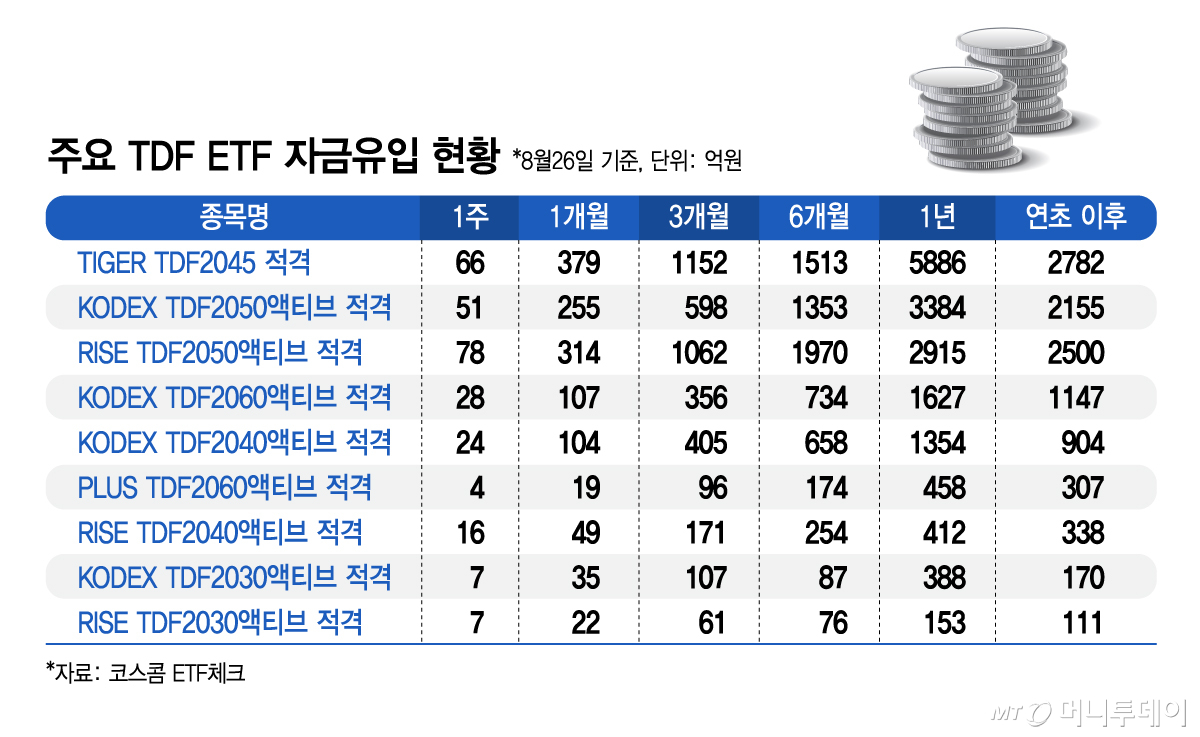
According to KOSCOM's ETF Check report on the 27th, total funds invested in the 15th currently listed TDF ETFs over the past year amounted to 1.6659 trillion won as of the previous day. Since the beginning of the year, 1.0455 trillion won has also flowed in. Over all periods ranging from one week to one year, net inflows into TDF ETFs have been positive.
Looking at individual products, the 'TIGER TDF2045 Eligible' ETF saw the largest fund inflow over the past year, with 588.6 billion won invested. Other products also received more than 100 billion won in funds, including: △'KODEX TDF2050 Active Eligible' (338.4 billion won), △'RISE TDF2050 Active Eligible' (291.5 billion won), △'KODEX TDF2060 Active Eligible' (162.7 billion won), and △'KODEX TDF2040 Active Eligible' (135.4 billion won).
Experts in the financial investment industry analyzed that this trend emerged as more investors began utilizing ETFs within pension investment accounts. A TDF ETF is a product combining a Target Date Fund (TDF), which adjusts asset allocation according to an investor's life cycle based on their expected retirement year, with an ETF.
Like traditional TDFs, TDF ETFs set higher stock allocations when retirement is approaching to pursue returns, and automatically increase bond allocations as retirement nears to prioritize stability. Additionally, being ETFs, they can be traded in real time, and unlike existing TDFs, investment details are easily accessible. Furthermore, up to 100% of pension accounts can be allocated to these products.
In particular, with increasing stock market volatility both domestically and internationally, more investors have turned to TDF ETFs. As of this day, the KOSPI index fell by 16.34% over the past three months. During the same period, the average return rate (based on reinvested distributions) for the 15th TDF ETFs was -5.72%.
Due to their specialization in pension investments, TDF ETFs also demonstrate solid medium-to-long-term returns. The ETF with the highest return over the past year is RISE TDF2050 Active Eligible, recording a gain of 23.29%.
Yuk Dong-hwi, Head of ETF Product Marketing at KB Asset Management, explained, "The effect was significant because the portfolio was designed to evenly capture growth opportunities in global stock markets through Ji Yeok-byeol (CEO) indices rather than concentrating on specific countries or certain themes."
RISE TDF2050 Active includes ETFs such as 'RISE U.S. S&P 500', 'RISE U.S. NASDAQ100', and 'RISE Comprehensive Bond (A- or higher) Active'.
Following that, the rankings are: △'KIWOOM TDF2050 Active Eligible' (return rate 20.26%), △'RISE TDF2040 Active Eligible' (19.29%), △'KIWOOM TDF2040 Active Eligible' (19.17%), and △'PLUS TDF2060 Active Eligible' (16.99%).
As TDF ETFs gained popularity, a new type of TDF ETF that invests 100% in domestic assets has recently emerged for the first time. Samsung Asset Management launched the 'KODEX Korea TDF2065 Active Eligible' ETF on the 25th. This product invests in core assets such as KOSPI and KOSPI 200, along with satellite assets including key sectors driving the Korean stock market like semiconductors, AI (artificial intelligence) power, and secondary batteries. Additionally, it strategically adjusts the allocation between stocks and bonds according to market conditions and manages bond duration (yield-to-maturity) in line with economic cycles.

 in STOCK
