

As the won has strengthened sharply, investors in U.S. exchange-traded funds (ETFs) are experiencing mixed results. Even among products tracking the same index, a performance gap has emerged based on whether "(H)"—indicating a hedged product—is included in the product name. Over roughly two months, with the exchange rate plummeting by 180 won, the return difference between these products exceeded 8 percentage points. However, experts advise that unhedged products are more suitable for long-term investments due to factors such as cost burdens.
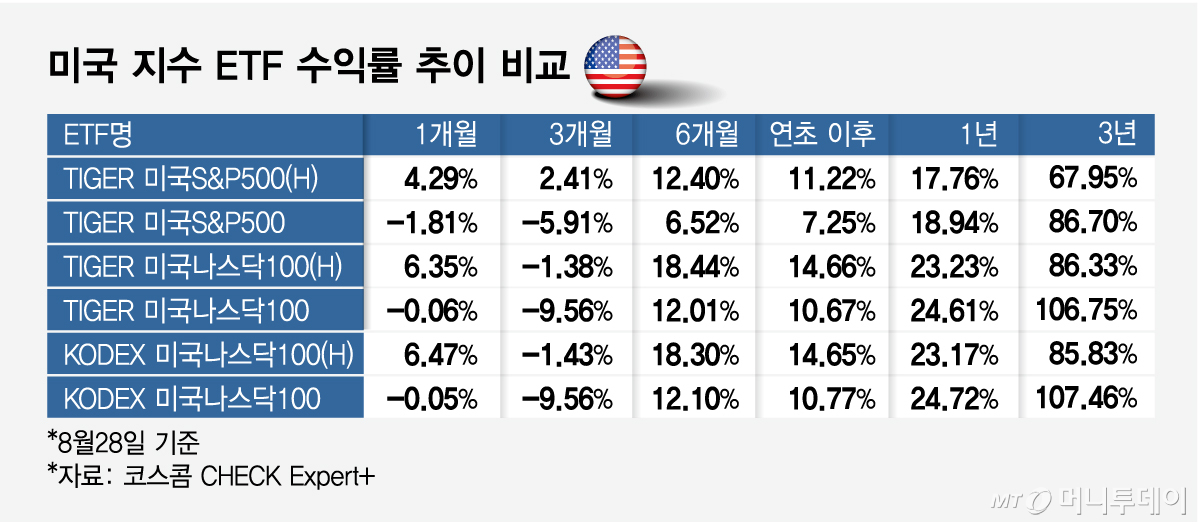
According to KOSCOM CHECK Expert+ on the 31st, as of the 28th, "TIGER U.S. S&P 500 (H)" recorded a return of 1.54% over the past three months. In contrast, the unhedged version, "TIGER U.S. S&P 500," managed only -6.91%. A similar pattern appeared in ETFs based on the NASDAQ-100 index. "TIGER U.S. NASDAQ-100 (H)" posted a return of -1.38%, outperforming the unhedged "TIGER U.S. NASDAQ-100" (-9.56%) by better defending against the index decline.
The reason for such divergent returns lies in differing approaches to reflecting exchange rate fluctuations. Since U.S. index ETFs invest in overseas assets, asset management companies decide whether to incorporate exchange rate movements into returns when designing products. If "(H)" appears at the end of the product name, it indicates a hedged product that fixes the exchange rate at a specific point in time to limit exposure to exchange rate volatility. Conversely, if "(H)" is absent, it denotes an unhedged product that directly reflects exchange rate fluctuations in returns.
The background for higher short-term returns of hedged products lies in the recent sharp appreciation of the won. On the 28th, trading on the Seoul foreign exchange market closed at 1,372.5 won per dollar, down 8.4 won from the previous trading day—the lowest level in approximately 13 months. Compared to the post-financial crisis high of 1,555.8 won recorded on the 2nd last year, this represents a drop of 183.3 won.
Park Seung-jin, a senior manager at Hana Securities, stated, "The won/dollar exchange rate fell vertically from the 1,550 won range within about two months, resulting in foreign exchange losses." He added, "Hedged products hedge against the won and dollar, eliminating exposure to foreign exchange gains or losses, which is why they have shown higher returns than unhedged products in the short term." He further noted, "While hedging incurs costs that slightly reduce returns, even accounting for this, foreign exchange losses remain significantly larger at present."
Experts forecast that the downward trend in the won/dollar exchange rate will continue through the end of this year, with some securities firms projecting a low of 1,300 won. Park Sang-hyun, a researcher at iM Securities, cited several factors for further declines: "Continued strengthening of domestic economic momentum based on robust semiconductor exports; increased dollar selling volume due to large-scale shareholder return policies by Samsung Electronics and SK Hynix; expansion of trade and current account balance surpluses; and reinforcement of domestic manufacturing sector momentum."
However, investors focused on long-term holdings are advised to utilize unhedged products. When the dollar interest rate exceeds the won interest rate—as is currently the case—hedged products incur hedging costs, which accumulate annually and erode ETF returns over longer holding periods. Due to these hedging costs, hedged products tend to have higher total expense ratios than unhedged ones. In fact, the total expense ratio of "TIGER U.S. S&P 500 (H)" is 0.0632 percentage points higher than that of its unhedged counterpart.
A representative from Mirae Asset Asset Management stated, "Investing in the U.S. S&P 500 serves not only to hold dollar-denominated assets but also provides a buffering effect where rising exchange rates partially offset stock price declines during sharp global market drops, making unhedged products suitable as the basic position for long-term investing." He added, "Hedged products are effective as trading tools to partially defend against exchange rate decline risks when the exchange rate is judged to be at a high level."

 in STOCK
